Quick Summary:
Oil and gas operations now run on connected software, from SCADA and historians to ERP, trading platforms and AI models. AI adoption, scaling digital twins, OT threats in the field and changing methane rules have increased the need for software validation. Volume reconciliation, AI model validation and peak-load performance give that testing measurable targets. AI also speeds up test design, while every AI agent that interacts with operational systems needs testing of its own.
Table of Contents:
- Introduction
- 4 Forces Pushing Oil and Gas Testing Budgets Up
- 5 Software Layers Oil and Gas Companies Must Test
- 3 Testing Priorities With Measurable Targets
- 3 Ways AI Solutions in Oil and Gas Industry Operations Change Testing
- Final Say
- FAQs
The oil and gas industry has always measured itself in barrels, molecules and margins.
Today it also measures itself in software releases.
The International Energy Agency (IEA) expects global energy investment to reach $3.4 trillion in 2026, with natural gas spending at about $330 billion, a ten-year high.
A growing share of this investment supports connected systems across oil and gas operations, from the control room to the general ledger.
That raises operational risk, the cost of a process, system or person failing at the wrong moment.
A faulty update can delay a pipeline nomination, misstate a cargo or hide an alarm from an operator.
Software testing catches those faults before they reach the field.
As AI enters daily operations, oil and gas companies need proof that every model and release behaves as planned. This is increasing the need for structured software testing across the industry.
ImpactQA validates functional workflows across SAP, CTRM and connected enterprise systems.
4 Forces Pushing Oil and Gas Testing Budgets Up
Each force below adds new software, new data or new rules to verify.
1. AI Has Moved Into Operations
The Powering Possible 2026 report surveyed almost 400 senior energy and finance leaders.
Some 62% now rank AI among their top two corporate priorities, up from 42% a year earlier, and 89% increased AI spending over the past year.
Integrated agentic AI workflows rose from 15% to 33% of respondents. Supply stability became the most-cited AI benefit, at 39%.
These findings cover the broader energy sector, but they show how quickly AI is becoming part of operational planning. Models that schedule maintenance or support cargo decisions need validation before teams rely on their outputs.
2. Digital Twins Are Scaling
A Verdantix study of senior infrastructure executives found more than 70% plan to increase digital twin spending over the next two years.
Half already use AI to support inspections, and more than 40% run AI-based failure prediction. More than two-thirds named fragmented data and siloed platforms as their main technical challenge.
The study covers infrastructure organizations, not only oil and gas industry testing companies. Its findings still highlight why integration testing and data validation matter as digital twin programs expand.
3. OT Threats Are Reaching the Field
Operational technology (OT) is the hardware and software that monitors and controls physical equipment.
Dragos reported that the VOLTZITE threat group compromised cellular gateways across US midstream operations.
Malware protection and detection gaps appeared in 37% of its oil and gas findings, and vulnerability management issues in 31%. These figures refer to Dragos’s findings, not the percentage of companies affected.
Security testing must therefore extend to interfaces where IT systems meet field equipment. It complements, but does not replace, OT security monitoring and vulnerability management.
4. Emissions Reporting Keeps Changing
The EU Methane Regulation requires importers to demonstrate producer-level monitoring, reporting and verification (MRV) equivalent to EU standards.
In October 2026, the European Commission proposed changes to the implementation timeline. The Council later supported a postponement of specified importer obligations, while the European Parliament also considered amendments. The final legislative position remains subject to the EU process.
In the US, the Environmental Protection Agency (EPA) proposed another round of revisions to its methane rules in October 2026.
Changes to reporting requirements can affect calculation logic, data fields and report formats. Regression testing helps verify that systems continue to produce accurate filings as requirements change.
5 Software Layers Oil and Gas Companies Must Test
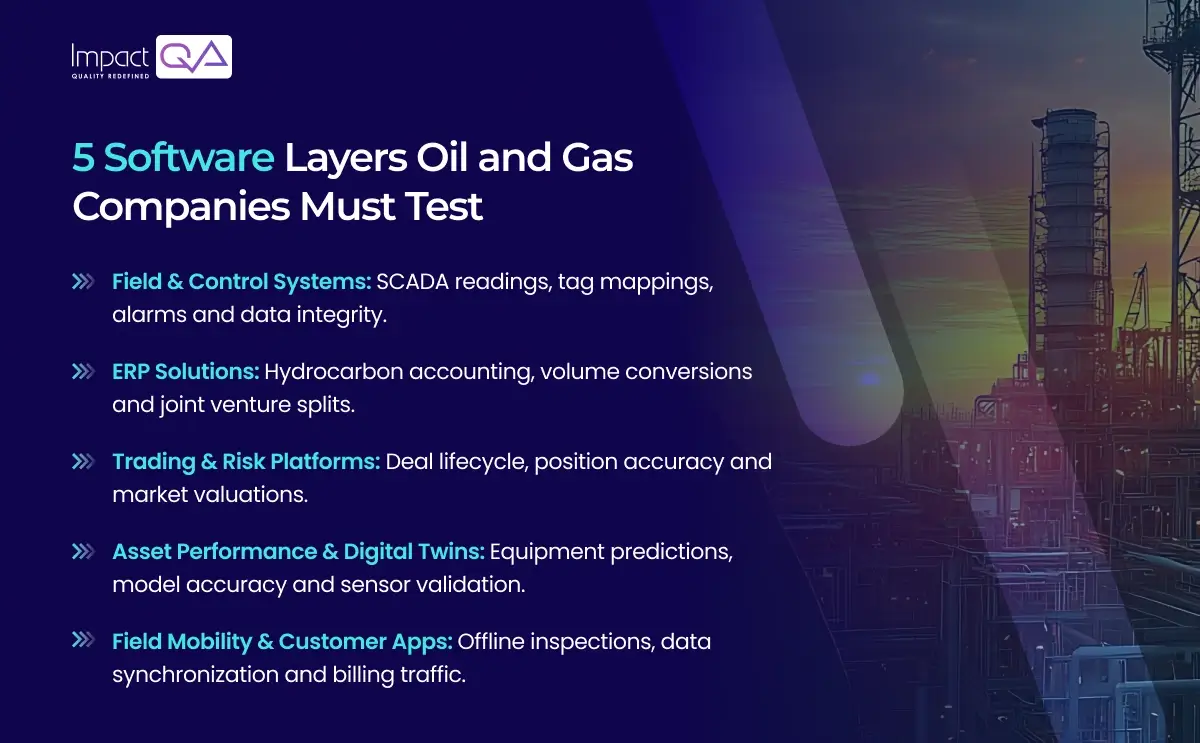
Most energy solutions for oil and gas industry operations sit across five connected layers.
A change in one layer travels to the next.
1. Field and Control Systems
Supervisory control and data acquisition (SCADA) systems collect readings from wells, compressors and pipelines.
A process historian stores those readings as time-stamped data for engineers and analysts.
Tests confirm tag mappings, unit conversions, alarm thresholds and data recovery after a network drop.
Potentially disruptive tests should run in simulated or isolated staging environments. Any testing involving production OT systems must follow the operator’s safety and change-control procedures.
2. ERP Solutions for Oil and Gas Industry Operations
ERP platforms such as SAP S/4HANA support the conversion of measured hydrocarbon volumes to standard conditions, so a barrel measured at 90°F can be reconciled against a 60°F reference.
Joint venture accounting splits costs among partners by their working interest.
Production revenue accounting then distributes income to royalty owners.
Tests cover configured volume-correction rules, partner splits and period-end close. Field and ERP volumes must use consistent units and reference conditions. This is why many operators choose independent SAP testing services for these programs.
3. Trading and Risk Platforms
Energy and commodity trading and risk management (E/CTRM) platforms, such as Openlink Endur, RightAngle and Allegro, record each deal through to settlement.
Gas price swings make accurate positions and mark-to-market valuations a daily need.
A single pricing change can ripple into risk reports and invoices. Testing must also verify that trade data moves correctly between CTRM, scheduling, accounting and reporting systems.
Automated regression compares valuations and downstream results before and after every upgrade.
4. Asset Performance and Digital Twins
Asset performance systems predict equipment failures from vibration, temperature and pressure data.
Digital twins mirror a physical asset so engineers can test changes virtually.
Both need validation against historical failure records before teams rely on their alerts. Regular comparison with current sensor data helps identify stale inputs and keeps each twin aligned with its physical asset.
5. Field Mobility and Customer Apps
Field technicians often work at remote sites with weak connectivity.
Their apps must save inspections and permit-to-work steps offline, then sync cleanly on reconnect.
Tests drop the connection mid-form to confirm every entry survives. They should also check duplicate submissions and conflicting updates when multiple users reconnect.
City gas distributors also run customer portals that face sharp peaks during billing cycles.
3 Testing Priorities With Measurable Targets
Clear numbers turn testing into a business control.
1. Volume Reconciliation Across Layers
Target: Agreed tolerance per contract
Field meters, the historian and the ERP should agree on every volume after conversion to the same units and reference conditions.
Volume Variance % = (|ERP Volume − Field Volume| ÷ Field Volume) × 100
If the field records 100,000 barrels and the ERP shows 99,850, the variance is 0.15%.
Automated checks flag any figure above the agreed tolerance for review.
2. AI Model Validation
Target: Balanced precision and recall
Predictive maintenance models are judged by two numbers.
Precision % = (Correct Failure Alerts ÷ Total Alerts) × 100
Recall % = (Failures Predicted ÷ Actual Failures) × 100
A model that raises 50 alerts, of which 40 prove correct, against 48 actual failures scores 80% precision and about 83% recall.
High recall catches more failures, while high precision saves wasted crew trips. Teams should also check whether alerts arrive early enough for maintenance action and validate models against data not used during training.
3. Performance at Peak Events
Target: Response times within agreed limits at peak load
Month-end close, gas nomination deadlines and extreme weather all push systems to their limits.
Load tests replay those peaks before they happen.
Each test should reflect the real user mix, with schedulers, traders and finance staff working at once. Teams should track response time, transaction throughput, error rates and recovery after traffic spikes.
Planning for the key challenges in oil and gas performance testing starts with these peak profiles.
3 Ways AI Solutions in Oil and Gas Industry Operations Change Testing
AI now works on both sides of the test.
1. AI That Speeds Up Testing
Use: Faster coverage
AI drafts test cases from process documents, such as a permit-to-work procedure.
It also analyzes past releases to flag defect-prone areas before a new cycle starts.
Engineers review each draft, since domain rules decide what counts as correct.
2. AI That Needs Testing
Use: Safe autonomy
An agent that reschedules maintenance or adjusts a cargo plan acts on operational systems.
Tests confirm its permissions, its escalation to a human for safety-critical steps and its audit trail. They should also verify fail-safe behavior when data is incomplete, along with rollback and recovery after an incorrect action.
3. Synthetic Data for Rare Events
Use: Edge-case coverage
Pressure spikes and equipment failures are rare in historical data.
Synthetic sensor data recreates those events, so models and alarms can be tested safely. Teams must check that synthetic scenarios reflect physical constraints and known equipment behavior rather than treating generated data as a replacement for real operational evidence.
ImpactQA tests AI-driven workflows, predictive models and decision controls before deployment.
Final Say
Energy investment and AI adoption are creating more connected systems across oil and gas operations. Every new model, digital twin and reporting change adds another area that companies need to validate.
ImpactQA’s Energy and Utilities testing covers SAP S/4HANA, Oracle, Salesforce, connected IoT field devices and E/CTRM platforms, with CI/CD-integrated checks and AI analysis of release data. NeX-AI supports SAP and CTRM test case generation, helping reduce manual test-writing effort.
The barrels still matter.
So does every release behind them.
Frequently Asked Questions (FAQs)
Share this post


Related Posts
Our Case Studies