
Quick Summary:
The right ERP testing company understands your platform, maps tests to business processes and demonstrates the value of automation. It should also manage test data, validate performance, test security controls and transfer test assets to your team. Use these ten questions and a weighted scorecard to compare providers before signing.
Table of Contents:
- Introduction
- 4 Reasons the ERP Testing Decision Weighs More in 2027
- 10 Questions to Ask an ERP Testing Company Before You Sign
- How to Score Each ERP Testing Service Provider
- Final Say
- FAQs
An ERP system supports essential business operations, from procurement and inventory to payroll and financial reporting. A defect in one process can affect several others. That makes testing a business priority, not just an IT responsibility.
Choosing an ERP testing company is a long-term decision. The right partner should know your ERP version, understand your workflows, demonstrate automation benefits and protect your data and test assets.
In 2027, the pressure is increasing. SAP’s mainstream maintenance for relevant Business Suite 7 applications runs through December 31, 2027. Oracle Fusion follows quarterly update cycles, while Dynamics 365 continues to evolve through its product release schedules. These changes make ongoing regression testing essential.
ImpactQA validates ERP data, integrations and business processes throughout implementation and migration.
4 Reasons the ERP Testing Decision Weighs More in 2027
1. Migration Deadlines Are Close
Gartner estimated that around 39% of approximately 35,000 SAP ECC 6.0 organizations had purchased or subscribed to S/4HANA licenses by the end of 2024 to begin their transition. A DSAG survey found that 37% of surveyed ECC users planning investment in the platform aimed to switch by the end of 2027.
Organizations preparing for migration need a partner experienced in both legacy systems and target platforms.
2. Releases Require Ongoing Validation
Oracle Fusion customers receive quarterly updates, typically with a two-week interval between the test and production environments. Oracle also provides monthly Critical Security Patch Updates for E-Business Suite 12.2.
Microsoft’s September 2026 roadmap change moved away from its twice-yearly public release-wave model. It did not change established product release schedules.
A testing partner must understand each platform’s actual update cycle and prepare regression tests accordingly.
3. Migration Delivery Needs Better Risk Control
ISG’s 2026 research found that only 15% of surveyed SAP migrations were completed on time and within budget. This highlights the importance of early defect detection, realistic test data and clearly defined testing scope.
A defect found during integration testing is easier to address than one discovered after go-live, when it may disrupt financial close or order processing.
4. AI Is Entering the ERP Core
Gartner forecasts that AI-enabled solutions will account for 62% of cloud ERP spending by 2027, compared with 14% in 2024.
AI features such as invoice-matching assistants require testing for accuracy, consistency, data privacy and access permissions alongside conventional functional checks.
10 Questions to Ask an ERP Testing Company Before You Sign
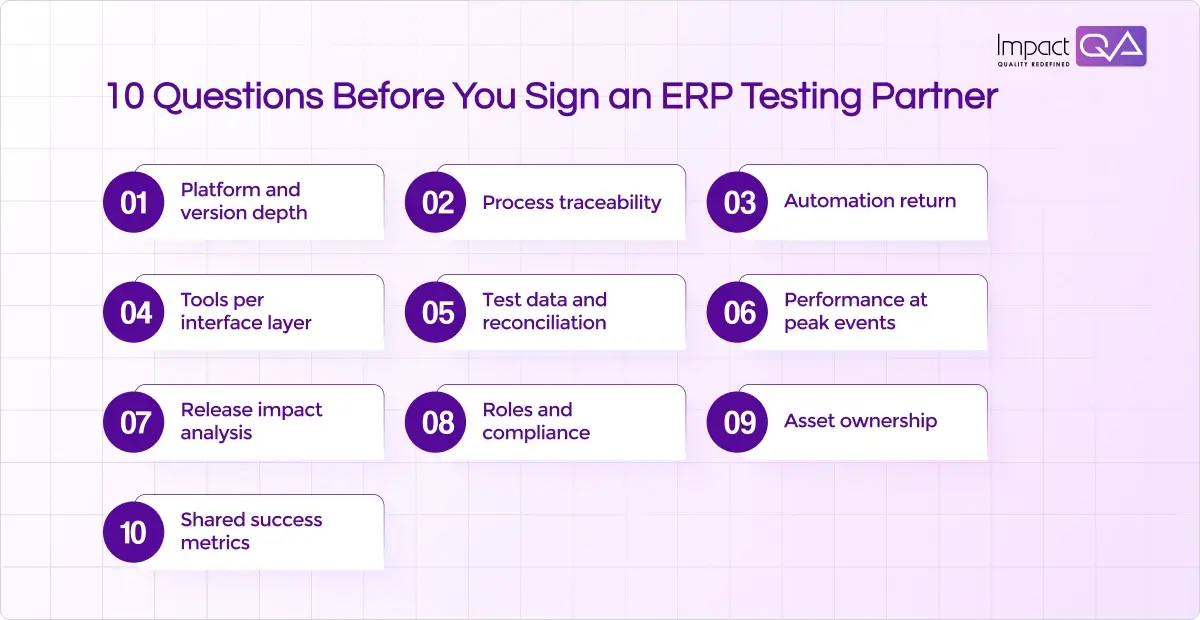
Question 1: Which ERP Platforms and Versions Have You Tested?
A strong answer includes: Named projects on your platform and version.
SAP S/4HANA, Oracle Fusion, Oracle E-Business Suite and Microsoft Dynamics 365 have different testing requirements. Ask for references matching your environment and industry, such as an EBS 12.2 patching cycle or an S/4HANA conversion from ECC.
Platform expertise should also extend to your industry’s workflows.
Question 2: How Will You Map Our Business Processes?
A strong answer includes: A process-to-test traceability matrix.
ERP application testing must follow complete business flows, including order-to-cash and procure-to-pay. Ask the provider to map each process to its test cases, integrations, custom code and extensions.
This matrix shows which business activities a release affects and which tests protect them.
Question 3: What Share of Regression Will You Automate?
A strong answer includes: A phased plan with measurable benefits.
ERP test automation is most valuable across repeated release cycles. Ask the provider to estimate development effort, maintenance needs and time saved.
A simplified effort-based payback ratio is:
Payback Ratio = [(Hours Saved per Cycle × Annual Cycles) − Maintenance Hours] ÷ Build Hours
For example, assume automation saves 400 hours per cycle across four cycles. Annual maintenance takes 300 hours, and development takes 650 hours.
The result is (400 × 4 − 300) ÷ 650 = 2.0. This means estimated net hours saved are twice the initial build effort. It is an effort-based measure, not financial ROI.
Ask which processes the provider would automate first and how it will maintain the scripts.
Question 4: Which ERP Testing Tools Will You Use?
A strong answer includes: Tools matched to each interface and integration layer.
SAP Fiori, Oracle Fusion pages and EBS Forms require different testing approaches. Oracle ERP testing tools may include Oracle Application Testing Suite for supported EBS scenarios. Browser automation can validate Fusion user journeys, while REST API tests check business services.
Ask who owns the licenses, scripts and maintenance if you change providers. The toolset should fit your product version and technical environment.
Question 5: How Will You Manage Test Data?
A strong answer includes: Masking, refresh schedules and reconciliation.
ERP tests need realistic customer, supplier, material and accounting records. Ask how the provider masks personal information in production data copies to meet privacy requirements such as GDPR.
For migrations, confirm how it compares record counts, field values and financial balances between source and target systems.
Question 6: How Do You Approach ERP Performance Testing?
A strong answer includes: Peak business events and a realistic user mix.
ERP performance testing should reflect month-end close, payroll and material requirements planning. It should also account for batch windows and integrations.
Little’s Law can help estimate concurrent users:
Concurrent Users = Throughput × (Response Time + Think Time)
For example, at 20 transactions per second, with a two-second response time and 28 seconds of think time, the estimate is 20 × (2 + 28) = 600 concurrent users.
This is a planning estimate. Actual load targets should reflect transaction patterns and peak business volumes.
Question 7: How Will You Keep Pace With Vendor Releases?
A strong answer includes: Release impact analysis and risk-based test selection.
The provider should review release notes, identify affected features and select tests based on business risk.
A tiered approach helps manage execution time: start with smoke tests, follow with core regression and schedule full regression for broader coverage.
Question 8: How Do You Test Security, Roles and Compliance?
A strong answer includes: Role-based testing and audit-ready evidence.
ERP roles determine who can create suppliers, approve payments or post journals. Ask how the provider tests access permissions and segregation of duties (SoD).
For example, one user should not be able to create and approve the same supplier payment when company policy prohibits it. Also confirm how testing covers sensitive data access, audit trails and SOX requirements.
Question 9: Who Owns the Test Assets?
A strong answer includes: Scripts, data definitions and documentation in your repository.
Confirm that your organization retains access to all scripts, test data definitions, reports and supporting documentation. These assets should be stored in your repository from the beginning.
Ask for a transition plan that allows another team to maintain the suite without rebuilding it.
Question 10: How Will You Measure Success?
A strong answer includes: Agreed metrics and transparent reporting.
Define success before signing. Useful measures include defect leakage, automation coverage and regression cycle time.
Defect Leakage (%) = (Production Defects ÷ Total Defects Found) × 100
For example, if 8 defects reach production out of 100 total defects found across testing and production, the leakage rate is 8%.
Agree on the measurement period and establish a baseline during the first 30 days. Some providers may also link part of their fee to agreed performance measures.
How to Score Each ERP Testing Service Provider
Rate each answer from 1 to 5, where 1 indicates limited capability and 5 indicates strong, evidenced experience. Average the two question ratings within each area before applying its weight.
Weighted Score = Sum of (Area Weight × Average Area Rating)
S. No. |
Evaluation Area |
Weight |
| 1. | Platform depth and process mapping | 30% |
| 2. | Automation and tools | 20% |
| 3. | Data and performance | 20% |
| 4. | Release, security and compliance | 20% |
| 5. | Ownership and metrics | 10% |
For example, a provider scoring 4 in every area receives 4.0 out of 5. Multiply each area’s average rating by its decimal weight and add the results.
Shortlist the top two ERP testing companies and ask each to run a proof of concept on one critical process. Compare coverage, defect detection, automation stability and reporting before making a decision.
ImpactQA helps validate critical workflows and maintain regression coverage across Oracle environments.
Final Say
ERP platforms are evolving through cloud adoption, frequent updates and embedded AI. Your testing partner must help manage these changes without compromising essential business processes.
ImpactQA’s ERP testing services cover SAP, Oracle, Microsoft Dynamics 365, Workday, NetSuite and Infor LN. Its capabilities include more than 2,500 ERP test scripts and Oracle accelerators covering over 500 business scenarios. Its published experience includes SAP work for Hydro and Oracle ERP testing for Terex.
Evaluate the evidence, compare providers and run a proof of concept before signing.
Download the full case study and see how it works in action.
Frequently Asked Questions (FAQs)
Share this post


Related Posts
Our Case Studies
