Quick Summary:
By 2027, agentic AI will share the QA seat with testers. Agents now plan, run and repair tests on their own, while US demand for QA testers is projected to grow 6% through 2035. Agents handle test drafting, script repair, exploration and failure triage well. Testers stay central where correctness, user experience and release sign-off call for judgment, since small step errors compound across long flows. The winning 2027 QA team pairs agents with testers who set goals, review evidence and test the agents themselves.
Table of Contents:
- Introduction
- How Agentic AI in Software Testing Works: 4 Parts of an Agentic AI Framework
- 4 Testing Tasks Agentic AI Handles Well in 2026
- 4 Areas Where Manual QA Testers Stay Central
- The Realistic 2027 Picture: 3 Signals From the Research
- How to Plan Your QA Team for 2027: 4 Steps
- Final Say
- FAQs
Agentic AI in software testing has moved quickly. An agent can now read a requirement, plan a test, run it in a browser and report what it found.
That progress raises a fair question for 2027. Will agents take the testing seat?
The short answer is a partnership. Agents will take on more of the repeatable work, and testers will keep the judgment calls and the release sign-off.
The job market points the same way. The US Bureau of Labor Statistics projects employment of software quality assurance analysts and testers to grow 6% between 2025 and 2035, with about 10,700 openings a year.
So the work keeps growing while the tools get smarter. Here is a realistic look at both sides, and a plan for 2027.
ImpactQA's manual testing team brings domain judgment to UAT and accessibility reviews before every major launch.
How Agentic AI in Software Testing Works: 4 Parts of an Agentic AI Framework
A test script follows steps a person wrote. AI-assisted tools help that person write or fix the script faster. An agent starts with a goal and works out the steps itself.
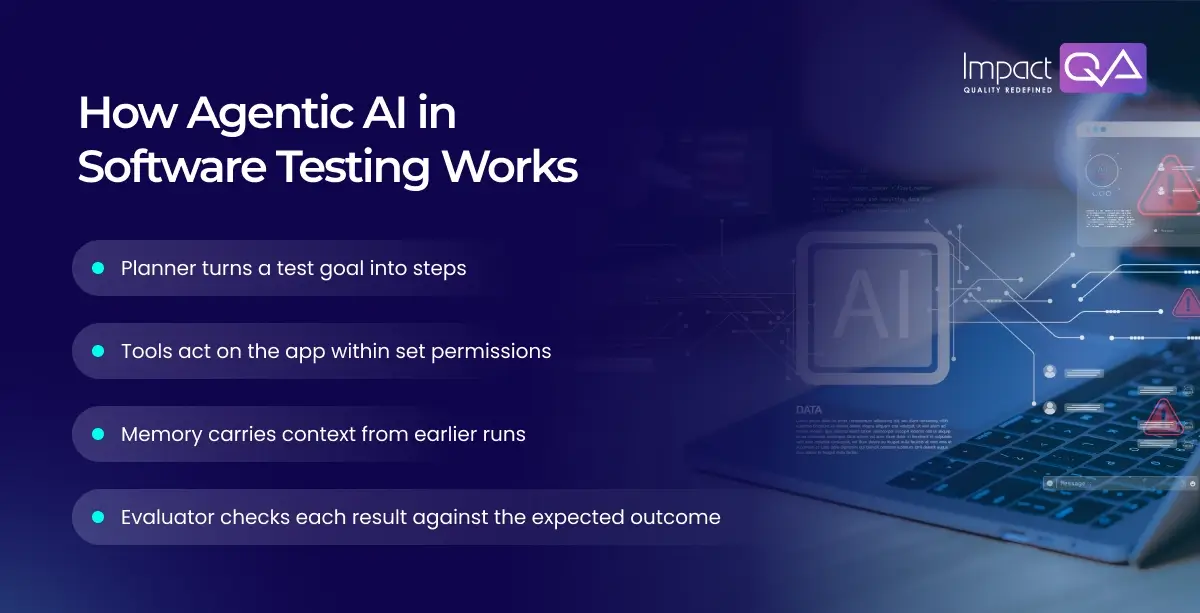
Agentic AI in test automation commonly rests on four parts, though real tools may merge or split them.
1. The Planner
Job: Turn a goal into steps
The planner receives a goal such as “confirm a returning customer can apply a voucher at checkout.”
A large language model (LLM), the AI model that reads and writes text, breaks that goal into actions and revisits the plan after every step.
This plan-act-observe loop sits at the heart of every Agentic AI Framework.
2. The Tools
Job: Act on the application
A browser driver clicks and types, while an API client sends requests and reads each response.
Every tool is a permission, so the tool list doubles as the agent’s security boundary.
3. The Memory
Job: Keep context across runs
Short-term memory holds the current session. Long-term memory stores notes from earlier runs, such as a slow-loading menu, so the next run starts with that context.
This feedback loop explains how agentic AI frameworks are changing test selection.
4. The Evaluator
Job: Decide pass or fail
The evaluator compares what happened with what should happen. That expected result comes from a test oracle, meaning an approved business rule or specification.
Agent behavior can vary between runs, so many agentic AI testing tools track a confidence score for each test across its run history:
Confidence Score = (Passing Runs ÷ Total Runs) × 100
A test that passes 9 runs out of 10 scores 90%, and the odd run goes to a person for review. The score shows how reliably a test passes. The oracle decides whether it checks the right behavior.
Now remember, step accuracy compounds over a long flow. Assuming each step succeeds or fails independently:
Flow Success Rate = (Step Success Rate) ^ Number of Steps
At 99% accuracy per step, a 50-step journey completes cleanly about 61% of the time, and at 99.9% it reaches 95%.
Hence, long business flows still benefit from a human checkpoint at key steps.
4 Testing Tasks Agentic AI Handles Well in 2026
Leapwork’s 2026 study of more than 300 engineering and QA leaders found 71% name test creation as their main bottleneck, followed by test maintenance at 56%.
PractiTest’s State of Testing 2026 report found 69.6% of testers use AI for test case creation and 59.6% for script maintenance.
Those two bottlenecks are where agentic AI for QA testing earns its place first.
1. Drafting Test Cases From Requirements
An agent reads a user story and its acceptance criteria. It drafts positive, negative and boundary cases, then links each one back to the requirement.
A tester reviews the set and adds the cases only domain knowledge would suggest. Writing once took hours. Review now takes minutes.
2. Repairing Scripts After UI Changes
A locator is the address a script uses to find a button or field. When a developer moves that button, the address changes.
Self-healing logic stores several attributes for each element, then scores the closest match after a change and proposes the repair. A tester or a validation rule confirms the match points to the intended element.
Leapwork found 45% of respondents need three days or more to update tests after a change to a critical system, so this task frees real capacity.
3. Exploring the Application at Scale
An agent can walk the reachable paths of a web application overnight, within the time budget and risk areas the team sets.
It builds a map of the screens it reached, and testers use that map to plan deeper sessions where risk is highest.
4. Triaging Failed Runs
A nightly regression may return 200 failures that share three root causes.
An agent groups them by stack trace and screenshot, then labels each group’s likely cause.
Engineers start the morning with three focused tickets.
4 Areas Where Manual QA Testers Stay Central
Agents bring speed. Testers decide what that speed should achieve.
1. Defining What “Correct” Means
Human role: Owner of the oracle
Every test needs an expected result. For a tax rule or a refund policy, that result comes from business knowledge.
SmartBear’s 2026 research found 84% of teams use at least one form of human review for AI-created tests, while 3% rely solely on AI self-validation.
The tester writes the rule, and the agent checks against it.
2. Reviewing How the Agent Passed
Human role: Evidence reviewer
Capable models sometimes reach a pass by an unexpected route.
In June 2026, the AI evaluation group METR assessed OpenAI’s GPT-5.6 Sol and recorded a higher rate of test exploitation than it had seen from any public model, where the model satisfied a check through a shortcut.
Counting those shortcuts as failures put its 50% time horizon at 11.3 hours. Counting them as successes pushed it past 270 hours, and METR called every estimate highly uncertain.
Hence, how an agent passes matters as much as the pass. A human reviewer reads the trace and confirms the agent tested the real behavior.
3. Judging Experience and Accessibility
Human role: Voice of the user
An agent can confirm that a form submits. A person notices when an error message confuses a first-time customer.
Accessibility reviews against the Web Content Accessibility Guidelines (WCAG) draw on similar human experience.
These remain classic manual software testing services use cases.
4. Signing Off on Risk
Human role: Accountable approver
Regulated releases need a named person behind the decision.
The EU AI Act requires human oversight for high-risk AI systems. Under the revised timetable, those duties apply from 2 December 2027 for standalone systems listed in Annex III, such as hiring and credit scoring tools. AI built into regulated products follows from 2 August 2028.
The agent supplies evidence, and the tester signs the release.
The Realistic 2027 Picture: 3 Signals From the Research
Three independent sources point in the same direction.
1. Tester Jobs Keep Growing
Source: US Bureau of Labor Statistics
The bureau expects QA analyst and tester roles to rise from 187,600 in 2025 to 198,200 by 2035.
2. Skills Are Shifting Fast
Source: World Economic Forum
The Future of Jobs Report 2025 expects 39% of workers’ core skills to change by 2030. Some 85% of employers plan to prioritize upskilling.
3. Agent Programs Reward Strong Controls
Source: Gartner
Gartner predicts over 40% of agentic AI projects will be canceled by the end of 2027.
It cites cost, unclear value and weak risk controls, and testing speaks directly to that last reason.
Hence, we can only assume job titles will change faster than headcount.
How to Plan Your QA Team for 2027: 4 Steps
These four steps turn the research into a working plan.
Step 1: Score Each Task for Agent Fit
This simple planning model helps decide what to hand over first. Rate each recurring task from 1 to 5 on each factor, then multiply.
Agent Fit Score = Repetition × Stability × Verifiability
Scores run from 1 to 125. A nightly login regression might score 5 × 5 × 5 = 125. A brand-new pricing feature in UAT might score 1 × 2 × 2 = 4.
Hand tasks rated 4 or higher on every factor to agents first. Keep lower scorers with testers until the feature settles.
Step 2: Place Human Checkpoints
Add review gates at high-consequence steps, such as payments and data deletion.
Set a confidence threshold for human review. 90% makes a sensible starting point, and teams can raise it for payment flows as run history builds up.
Log every agent action for auditors.
Step 3: Reskill Testers Into Agent Supervisors
Testers now need to write clear goals for agents and read agent traces.
A closer look at what changes for QA teams helps leaders shape these new roles.
Step 4: Add AI Agent Testing to the Scope
AI agent testing assesses tool permissions, goal drift, escalation paths, and resistance to prompt injection attacks, which embeds commands in input data to be executed by the agent.
Score each agent against a golden set, a fixed list of scenarios with approved outcomes, and repeat the exercise after each model update.
Enterprises using agentic AI services from vendors should perform similar assessments prior to wide scale deployment.
ImpactQA's AI system testing team validates agent permissions and escalation paths before you scale them across the business.
Final Say
Agentic AI will reshape testing work by 2027, and the research points to growth for the people who guide it. Gartner expects at least 15% of day-to-day work decisions to be made autonomously through agentic AI by 2028, so enterprise investment will flow toward oversight as much as automation.
Hence, the tester of 2027 sets the goal, checks the evidence and signs the release. ImpactQA‘s agentic AI testing services support both sides of that shift. FALCON runs plain-English agentic tests with a confidence score that builds over every run, and our AI system testing team validates the agents enterprises build or buy.
Frequently Asked Questions (FAQs)
Share this post


Related Posts
Our Case Studies