Quick Summary:
RightAngle implementations targeting 2027 need a release-specific test strategy covering trade capture, scheduling, inventory, pricing, risk and financial settlement. This 10-point checklist helps implementation teams validate migrated data, interface behavior, configuration and operational readiness against their target RightAngle release.
Table of Contents:
- Introduction
- What Is Shaping RightAngle Programs in 2027
- The RightAngle Go-Live Checklist
- Final Say
- FAQs
Somewhere along the Houston Ship Channel, at six on a Monday morning in 2027, a scheduler will open RightAngle in production for the first time, check that Sunday’s pipeline tickets landed against the right deals, and decide within a minute or two if the new system has earned a place in her routine. That moment is where every implementation plan gets graded.
Gartner has predicted that even less than 30% of recently implemented ERP initiatives will fully meet their original business goals by 2027. Since CTRM software solutions rest on the same blend of data migration and organizational change, the math stays the same.
Hence, the teams that reach that Monday calmly tend to be the ones that treated testing as a design input from the first workshop. The checklist below is written for them.
ImpactQA maps your regression packs against the S25 baseline and flags the workflows that need fresh coverage before build.
What Is Shaping RightAngle Programs in 2027
Three shifts set the 2027 calendar apart from earlier rollouts.
The platform baseline has moved. ION released RightAngle S25 in March 2025 with OpenID Connect single sign-on, enhanced accounting archives and a split of P&L into basis and non-basis price drivers. Earlier test packs predate all of it.
The physical market is tighter. The EIA’s 2026 Refinery Capacity Report counts 130 operable U.S. refineries, two fewer than a year earlier. When supply is thin, a scheduling error costs more per barrel.
Policy horizons are longer. The One Big Beautiful Bill Act extended the Section 45Z clean fuel production credit through December 31, 2029, and limited it to North American feedstocks for fuel produced after 2025. Feedstock attributes now need to travel with every movement.
The RightAngle Go-Live Checklist
Each checkpoint pairs a build decision with the readiness test that closes it.
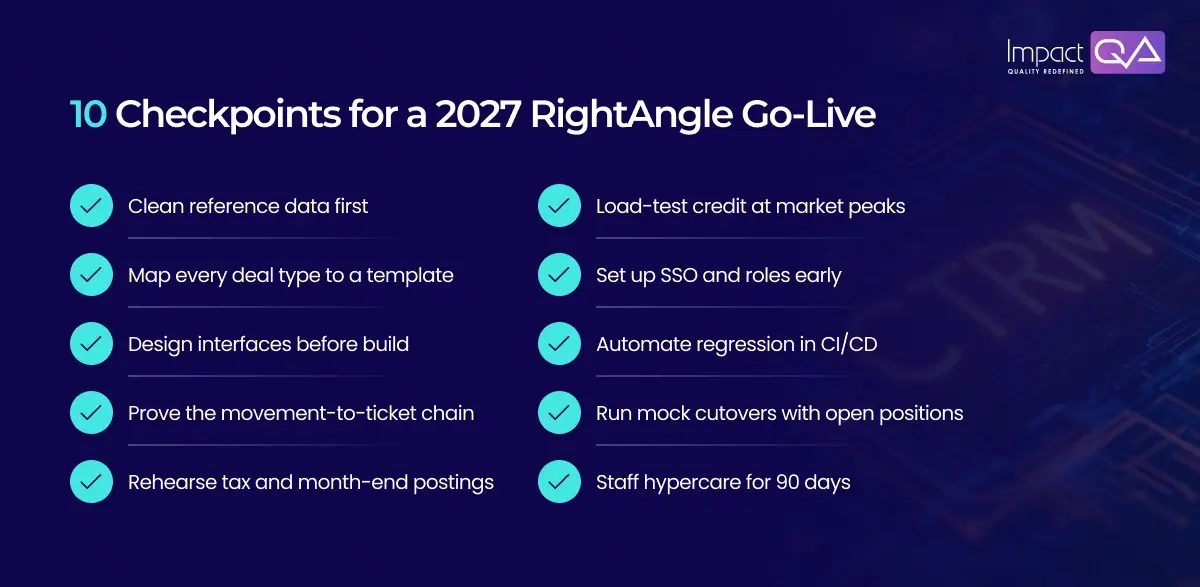
Checklist #1: Clean Reference Data Before Configuration Begins
RightAngle validates every deal against its reference tables, so one mis-mapped product code travels straight into inventory valuation and the tax engine. Merge duplicate counterparties and align units of measure first. Then map each pricing index to its publication calendar and script the product loads.
Ready when: a full deal-capture dry run returns zero orphaned references.
Checklist #2: Model Every Deal Type Against a Template
Physical term deals and exchange agreements settle in different ways. Map each live contract structure to a RightAngle deal template, including formula pricing with its averaging window. Then book awkward cases on purpose, such as a deal priced across a holiday.
Ready when: valuations match an independent calculation to the cent.
Checklist #3: Design the Interface Layer Before Detailed Build
Meter tickets and terminal bills of lading flow in, while journal entries flow out to the ERP. Give each interface a message contract with retry logic and a readable error queue. A managed integration hub, central to reliable CTRM implementation and integration frameworks, ages better than point-to-point links. Where Openlink Endur solutions hold the derivatives book, add a daily position reconciliation between platforms.
Ready when: every interface handles a replayed production day, malformed messages included.
Checklist #4: Prove the Movement-to-Ticket Chain
Scheduling is where RightAngle earns its keep. Trace a barrel from nomination to actualization, then confirm that automated ticket matching pairs it with the right obligation. Add friction such as a mismatched BOL. Scenario tests here do the most to improve CTRM system reliability, since ticket errors cascade into invoicing.
Ready when: book and physical inventory agree at every location after a simulated month.
Checklist #5: Rehearse Tax and Accounting Through Month-End
Each tax jurisdiction in scope needs its own test case, since RightAngle’s integrated tax engine calculates fuel taxes at the point of sale. Run accrual reversals and invoicing, then post to a copy of the general ledger. For renewable blends, tag feedstock origin at receipt so 45Z eligibility stays verifiable.
Ready when: a full simulated close ties out to the ERP.
Month-end close on your test calendar yet? Our CTRM testing services simulate a full RightAngle close and reconcile tax postings to your ERP ahead of go-live. Book a meeting.
Checklist #6: Load-Test Credit and Risk at Market Peaks
Credit Center creates and clears exposure across a transaction’s life, while the Risk Analytics Service runs VaR and stress scenarios. Script a price shock during month-end invoicing and measure exposure refresh times. Validate the S25 basis and non-basis P&L split against desk expectations.
Ready when: limit alerts fire within the agreed window at twice normal volume.
Checklist #7: Lock Identity and Entitlements Early
With S25, RightAngle connects to the corporate identity provider through OpenID Connect for single sign-on and multi-factor authentication. Configure it in test first. Next, build role matrices that separate deal entry from deal approval, the evidence SOX auditors ask for.
Ready when: every user persona has a documented role test.
Checklist #8: Build Regression Automation That Outlives Go-Live
Vendor patches keep arriving after launch, so the regression suite is a lasting asset. Rank workflows by criticality and transaction volume, automate the top tier with parameterized scripts, and run it nightly in CI/CD.
Ready when: the core pack runs unattended with a pass rate above 95%.
Checklist #9: Run Mock Cutovers With Open Positions
Two mock cutovers is a sensible minimum, because open trades and unbilled tickets are the hardest objects to move. Reconcile migrated totals against the legacy system after each rehearsal. Hold a parallel run through one month-end close, and agree on rollback triggers in writing before the final weekend.
Ready when: migrated open positions match legacy totals by volume and value.
Checklist #10: Staff Hypercare for the First 90 Days
Go-live opens a learning period. Monitor interface queues daily and pair a RightAngle analyst with a business user from each desk for triage. Feed every production defect back into the regression suite so the fix stays fixed. The 6-stage guide to E/CTRM software implementation and testing treats this period as a stage of its own.
Ready when: defect inflow declines week over week.
ImpactQA automates RightAngle regression with parameterized test suites that run nightly through your CI/CD pipeline.
Final Say
Investment in commodity trading and risk management CTRM software is shifting toward the quality of the rollout itself.
ImpactQA supports RightAngle CTRM software solutions with a five-step procedure: initiation through process review and automation readiness, planning by business criticality, building parameterized test cases in workshops with business users, designing scripts for parallel execution, and execution of regression packs with a target pass rate above 95%.
RightAngle-specific integration tools for orders, tickets, inventory and pricing, together with SOX-focused validation, keep trading and finance aligned as each release lands. Through 2027, release-aware validation will become a standing capability for every serious trading operation.
Frequently Asked Questions (FAQs)
Share this post


Related Posts
Our Case Studies