Quick Summary:
SAP S/4HANA transformation programs involve complex business processes, large regression suites, data migration, compressed testing windows, and significant business risk. Greenfield, Brownfield, and Bluefield journeys require different testing strategies, but all demand strong governance, optimized coverage, automation, business assurance, and continuous validation. AI-powered testing and intelligent impact analysis can help organizations identify what needs to be tested, reduce unnecessary regression effort, and strengthen release confidence without compromising business continuity.
Table of Contents:
- Introduction
- Why SAP S/4HANA Transformations Make Testing a Business-Critical Function
- Four Pillars of a Strong SAP Testing Strategy
- From Test Volume to Risk-Based SAP Testing
- How AI-Powered Testing Is Changing SAP Test Automation
- Building Continuous Quality Engineering Across the SAP Lifecycle
- Final Say
- FAQs
On December 31, 2027, SAP ends mainstream maintenance for SAP ERP 6.0, and every enterprise still on ECC is planning backward from that date. Gartner predicts that by 2027, fewer than 30% of recently implemented ERP initiatives will fully meet their original business case goals. The test phase sits between those two facts, and it decides whether a $100 million program holds its schedule.
ImpactQA examined that phase with our partner Panaya in the webinar “The $100M SAP Transformation Initiative: How Leading Enterprises Are De-Risking S/4HANA Initiatives with AI-Powered Testing,” held on August 6, 2026. Sachin Sangle, SAP Practice Head at ImpactQA, put it plainly: testing is where transformation risk is either contained or realized.
This article covers the strategy behind that statement and points to the moments in the session worth watching in full.
Watch the webinar:
Why SAP S/4HANA Transformations Make Testing a Business-Critical Function
Every SAP implementation creates a different testing challenge. The transformation path determines the baseline available, the amount of regression required, the scale of business-process validation, and the level of data and integration risk.
Greenfield, Brownfield, and Bluefield Require Different Testing Strategies
Transformation |
Core Testing Challenge |
Primary focus |
| Greenfield | New processes and limited historical baseline | Business-process validation, UAT, functional coverage |
| Brownfield | Large existing landscape, custom code, interfaces, and test assets | Regression, data migration, existing-process validation |
| Bluefield | Retained and re-engineered processes operating together | Regression, new-process validation, data validation |
1. Greenfield
Greenfield implementations begin with a new system and standardized processes. Because there is no direct baseline, teams are defining the testing scope from the ground up.
This creates a risk of testing everything with equal intensity, expanding the testing timeline without necessarily improving business coverage.
2. Brownfield
Brownfield transformations retain existing processes and important customizations while moving the landscape to S/4HANA.
The challenge is volume. Organizations may already have thousands of tests covering custom code, interfaces, and business processes. Those assets need to be reviewed and revalidated, while data migration needs to be proven.
3. Bluefield
Bluefield combines selective elements of both approaches. Teams must validate retained processes through rigorous regression while simultaneously validating newly re-engineered processes and migrated data.
The testing model therefore needs to support both philosophies without losing alignment between them.
ImpactQA helps enterprises strengthen SAP testing through risk-based validation and automation practices.
Why Testing Cannot Remain a Project-End Activity?
Across all three approaches, the pressure is similar: compressed timelines, limited testing windows, and constant pressure to minimize business disruption.
Traditional testing can create incomplete business-process coverage, manual bottlenecks, slower execution, error-prone cycles, and late defect discovery.
There are three reasons the testing function becomes especially important in SAP transformations.
1. First, SAP business processes are interconnected. A change to one area can create a ripple effect across modules and workflows such as Order-to-Cash, Procure-to-Pay, and Warehouse Management.
2. Second, business users are already managing their day-to-day responsibilities. Without structured UAT support, the additional testing burden can become a bottleneck.
3. Third, testing needs to become a continuous business assurance function, rather than an activity that begins only toward the end of a transformation. Business-user alignment around UAT cycles and release readiness is essential.
This broader view aligns with the direction of modern SAP testing services and enterprise quality programs, underscoring why enterprises increasingly engage the best SAP testing services provider to help embed quality throughout the SAP lifecycle, rather than treating testing as a one-time go-live activity.
Four Pillars of a Strong SAP Testing Strategy
A scalable SAP testing model needs more than test execution. ImpactQA structures SAP engagements around four interconnected capabilities that run from strategy through hypercare.
Pillar 1: Test Management and Governance
The first pillar establishes the overall testing strategy around the transformation model, prioritization, requirements traceability, business-process coverage, and defect governance.
Different stakeholders require different views into the program. Governance therefore includes dashboards and reporting that make quality status visible at the right level of detail.
Pillar 2: Test Optimization
The second pillar focuses on the existing test estate.
Thousands of legacy tests do not automatically mean strong coverage. The suite needs to be rationalized, redundant scenarios identified, and regression testing selected according to technical and business impact.
Business-process coverage mapping helps teams determine what is actually relevant to a particular change.
Pillar 3: Automation and Performance
The third pillar brings automation and performance engineering into the delivery model.
Automation can be integrated into DevOps pipelines to accelerate regression cycles and improve release readiness. Critical business processes and heavy read-write transactions also require performance validation before production.
This creates a more complete SAP testing model rather than treating automation as an isolated activity.
ImpactQA has also covered this transition in its SAP Test Automation Services guide, which examines automation from an efficiency, scalability, and business-continuity perspective.
Pillar 4: Business Assurance
The fourth pillar focuses on validating the business process itself.
This includes UAT support, business-user alignment, production-readiness assessment, compliance validation, and hypercare after go-live.
The goal is not simply to confirm that the application works. It is to provide business stakeholders with confidence that the system being handed over has been thoroughly validated.
From Test Volume to Risk-Based SAP Testing
Large SAP programs often accumulate thousands of test cases. But testing volume and business coverage are not the same thing.
The objective is not to execute every test in every cycle. It is to determine which tests are relevant to the change and which business risks require validation.
1. Why 99% Automation Does Not Always Mean 99% Coverage
The webinar highlighted an important example: some organizations believed they had 99% automated test coverage. After deeper analysis, the effective coverage was closer to 50% in one case and even 35% in another.
The problem was not necessarily insufficient test volume.
The problem was whether the tests actually covered the right risks.
This distinction is critical for enterprise SAP test automation services. Automation metrics need to be interpreted alongside business-process coverage, technical impact, and relevance to the current change. ImpactQA also explores this shift toward intelligent regression in why enterprises are investing in intelligent SAP regression testing services.
2. Intelligent Change Impact Analysis
Change impact analysis becomes particularly valuable when an SAP transport, customization, or business change affects only part of a large enterprise landscape.
An intelligent platform can correlate technical changes with impacted entry points, relevant tests, coverage gaps, and tests that are no longer necessary for the current cycle.
This changes the testing question from:
“How many tests should we execute?”
to:
“What actually needs to be tested because of this change?”
That shift can reduce unnecessary UAT and regression effort while keeping attention on the areas most relevant to business risk.
3. Preserving Test Assets During SAP S/4HANA Migration
Brownfield programs often bring another challenge: years of testing investment already exist across spreadsheets, test-management platforms, defects, requirements, automation assets, mappings, and execution history.
Migrating to a new testing environment should not mean rebuilding that knowledge from scratch.
The approach discussed in the webinar uses legacy-asset assessment and migration accelerators to move test cases, defects, requirements, mappings, and execution history with minimal manual effort while preserving historical context.
For organizations planning SAP S/4HANA migration, this creates a more practical path from existing testing investments to modern SAP quality engineering.
ImpactQA helps SAP teams prioritize high-risk changes with AI-powered testing and intelligent impact analysis.
How AI-Powered Testing Is Changing SAP Test Automation
AI becomes more valuable when it is applied to a well-governed testing model.
In the webinar, AI-supported capabilities extend across test authoring, automation, impact analysis, coverage identification, test evidence, and automation resilience.
1. From Validated UAT to Automated Regression
UAT plays a critical role in S/4HANA programs because business processes need to be validated before they become reusable regression assets.
Once a manual test has been validated and contains sufficient detail and evidence, it can be converted into an automated test rather than recreated from scratch.
This creates a practical progression:
Business Validation → UAT → Validated Test → Automated Regression
The result is not automation for its own sake. It is the conversion of validated business knowledge into repeatable regression coverage.
2. AI-Assisted Test Automation and Self-Healing
AI can also improve automation resilience.
The demonstrated approach identifies multiple possible locators for a UI control. If application changes invalidate existing locators, AI-based self-healing can identify the underlying object, locate a working alternative, and update the test.
Reusable automation components also reduce maintenance effort. A shared component can be updated once rather than requiring thousands of individual tests to be changed. This is where an AI-powered platform can move beyond test execution toward automation resilience and maintainability.
ImpactQA also covers the broader evolution of AI in SAP quality in how AI is changing SAP testing for enterprises.
3. Compliance-Ready Testing and Evidence
Enterprise SAP testing also needs to support governance and compliance where required.
The demonstrated capabilities included configurable reviews, electronic signatures, test-readiness controls, execution evidence, and restrictions around data and test-cycle exports for regulated processes.
For regulated organizations, this creates a testing model in which execution and auditability are treated as connected requirements.
Building Continuous Quality Engineering Across the SAP Lifecycle
The larger opportunity is to move beyond periodic validation toward continuous Quality Engineering. That means connecting strategy, requirements, business-process validation, test optimization, automation, performance, release readiness, and post-go-live assurance into one quality model.
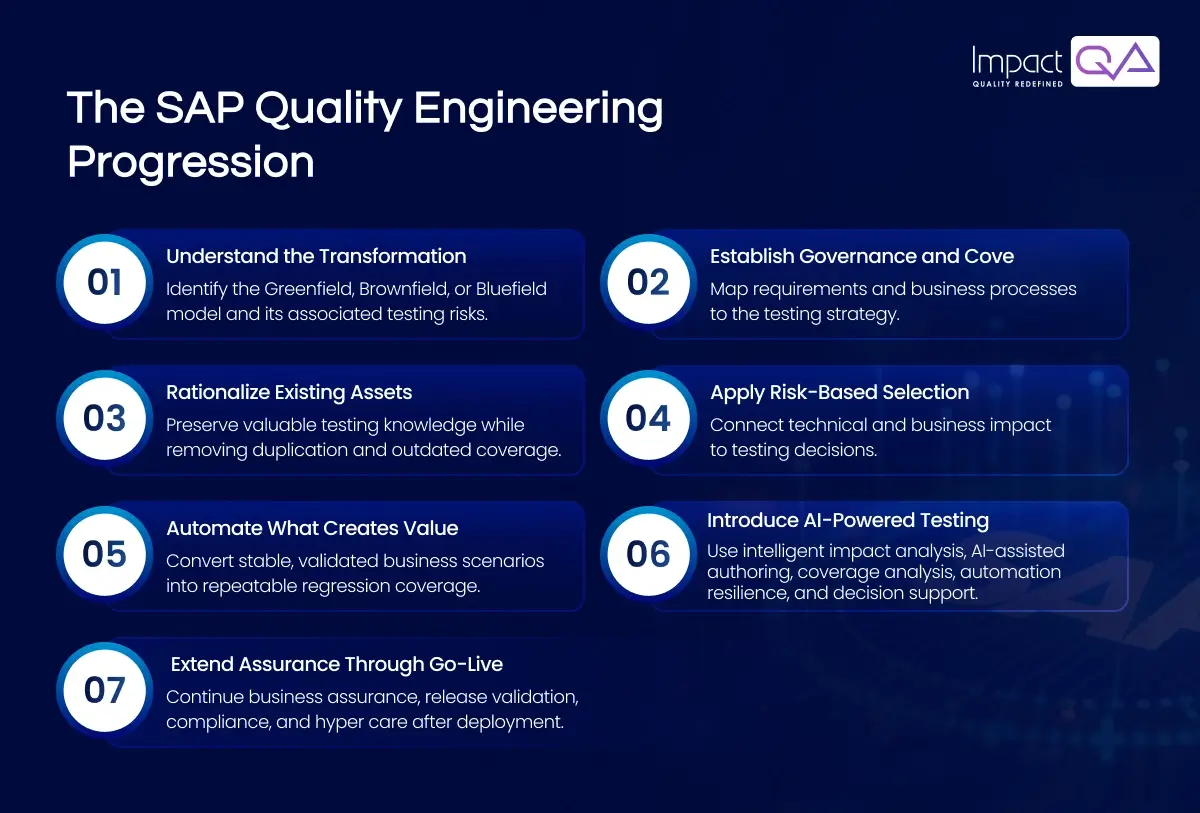
This creates an end-to-end quality engineering model in which testing remains connected to business outcomes throughout the SAP lifecycle.
Organizations looking to extend this approach into broader AI-led quality can also explore ImpactQA’s work on how Agentic AI is enabling continuous testing in S/4HANA.
Final Say
SAP programs are moving toward assurance that runs with every transport. Impact analysis scopes the cycle, automation executes it, and evidence is captured as the work happens. Enterprise budgets are following that direction, with funds once reserved for a pre-go-live test phase now supporting standing quality functions.
ImpactQA’s SAP testing services apply this model across S/4HANA programs, with functional-equivalence testing for system conversions and AI agents that generate manual and automated test cases directly from business requirements.
The technology will keep advancing. Programs that pair it with SAP domain expertise will set the pace for the next wave of transformations.
Frequently Asked Questions (FAQs)
Share this post


Related Posts
Our Case Studies