Quick Summary:
Traditional SAP automation established repeatable, controlled validation across business-critical processes. Agentic AI adds a layer that can interpret context, plan testing, generate scenarios, adapt to changes, and investigate failures. This article compares both approaches and explains where each fits within an enterprise SAP testing strategy.
Table of Contents:
- Introduction
- How SAP Test Automation Reached Its Agentic Chapter
- Agentic AI vs Traditional Test Automation in SAP: Key Differences
- Which Approach Does Your SAP Program Need?
- Final Say
- FAQs
Walk into any SAP war room on an S/4HANA cutover weekend, coffee cooling beside the transport logs and a functional lead refreshing the Fiori launchpad, and you will hear one question from anyone who has watched Joule agents arrive. AI in the ledger? Check. AI in the supply chain? Check. So when does the testing that guards those processes get agents of its own?
The answer is agentic AI in SAP testing, the next chapter after model-based automation, where software agents plan and adapt test execution around business-process goals. Gartner expects 40% of enterprise applications to carry task-specific AI agents by the end of 2026, up from less than 5% in 2025.
For teams running SAP S/4HANA testing, where does agentic AI actually change the way testing works, and where does traditional automation remain the right fit? This article compares both approaches mechanism by mechanism.
How SAP Test Automation Reached Its Agentic Chapter
Traditional SAP automated testing tools earned their place through reliability. SAP TAO and component-based automation in Solution Manager organized recorded transactions into reusable libraries. Model-based platforms such as Tricentis Tosca then scanned SAP GUI and Fiori screens into modules that business analysts could assemble. Impact analysis added precision by reading transport data to show which transactions a change touches. This stack still carries the regression load for most SAP programs, and ImpactQA has covered how it spans SAP ECC and S/4HANA frameworks.
The pace around that stack is what changed. SAP S/4HANA Cloud ships two major releases a year, and mainstream maintenance for SAP ECC ends in 2027, so many enterprises now run migration waves and continuous updates at the same time. SAP’s own roadmap has also turned agentic.
At Sapphire 2026, SAP introduced its Autonomous Suite with more than 50 domain-specific Joule Assistants, supported by more than 200 specialized agents. Applications that act on their own create a new kind of test target, and testing is evolving to match it.
Connect with ImpactQA to assess your automation estate, S/4HANA risks, and roadmap for intelligent testing.
Agentic AI vs Traditional Test Automation in SAP: Key Differences
Dimension |
Traditional SAP test automation |
Agentic AI in SAP testing |
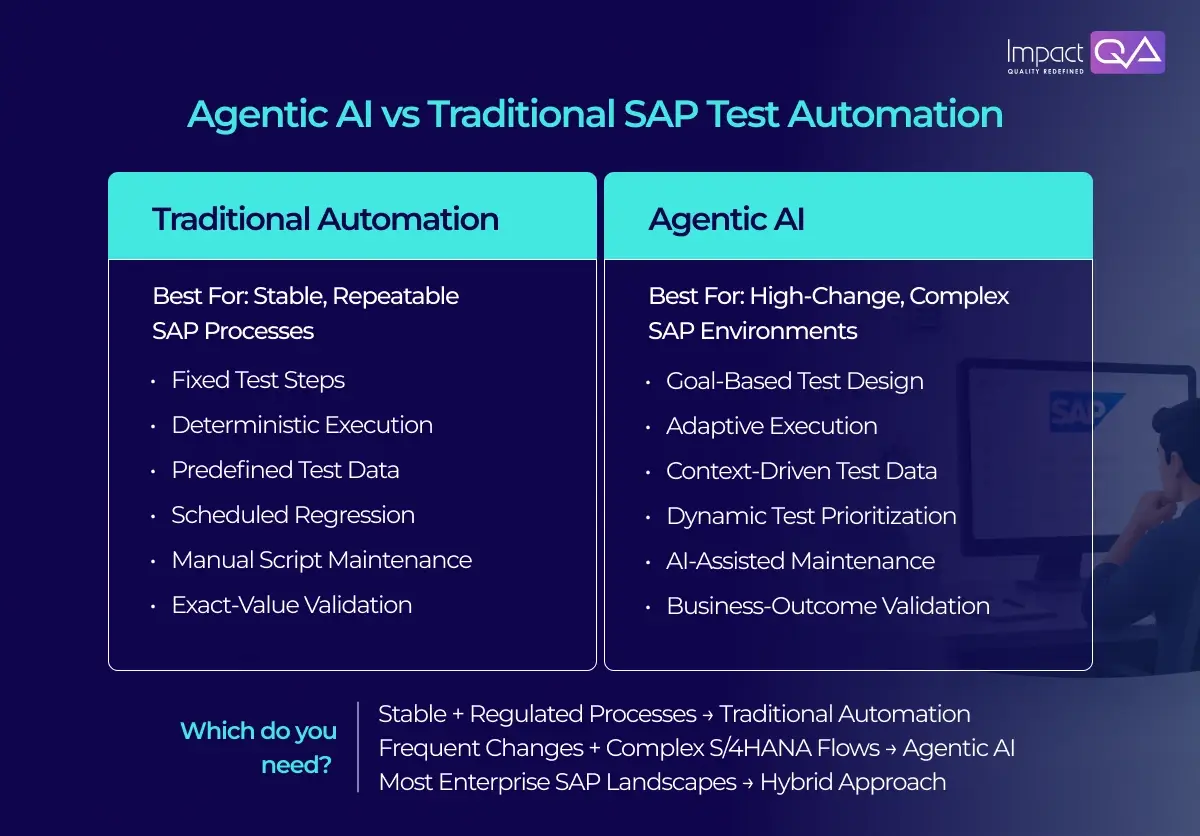
| Test design | Tester models each transaction step | Agent plans steps from a process goal |
| Execution | Fixed sequence, identical every run | Adapts to screen state and messages |
| Change handling | Impact analysis selects affected tests | Agent re-maps changed steps for approval |
| Process scope | Chained modules with scripted handoffs | Tracks documents across modules and systems |
| Test data | Prepared datasets per cycle | Finds or creates data on demand |
| AI features | Exact-value assertions | Outcome scoring against business rules |
Traditional automation executes a defined path with precision. Agentic AI pursues a defined outcome and chooses its path at runtime. The table summarizes where that distinction shows up in SAP work.
1. Test Design Starts From Business Intent
In SAP functional testing today, a tester models a transaction such as VA01 into modules with fixed steps and data. An agent receives a goal instead, for example “create a sales order for a credit-blocked customer and confirm the block.” It reads process documentation and decomposes the goal into steps, which a functional consultant reviews before the first run.
2. Execution Adapts at Runtime
Deterministic replay is a strength for audited processes. When an unexpected Fiori dialog appears, a scripted run records it for review, giving teams a clean, reproducible trail. An agent observes the same dialog, classifies it as informational or blocking, and continues when the message is benign, logging each decision it made.
3. Change Handling Moves Toward Self-Adjustment
Impact analysis reads transports and selects the tests a change affects. Agentic AI extends that step. After a release update renames Fiori controls or reorders fields, the agent re-maps its steps and queues the edits for approval. Configuration changes, such as a new pricing condition, route to the functional consultant because they alter expected results.
4. End-to-End Processes Span Modules and Systems
Order-to-cash crosses sales and finance modules, and often reaches external CRM or procurement platforms through APIs and IDocs. Scripted chains pass document numbers between modules through configured handoffs. An agent tracks state across the flow, reading each follow-on document and confirming the FI posting at the end. That continuity strengthens SAP integration testing services where handoffs carry the most risk.
5. Test Data Is Located or Built on Demand
Prepared datasets give every cycle a known baseline. Agents add flexibility by querying the QA client for a material with stock in a given plant, or creating prerequisite master data as the scenario requires. Data governance rules still apply, so agents operate inside approved clients and masking policies.
6. Agentic Features Need Agentic-Style Validation
Joule agents produce outputs that vary with context, such as a proposed invoice match or a supplier recommendation. Exact-value assertions suit deterministic transactions. Agent outputs are scored against business rules and tolerances, using curated evaluation sets and an audit trail of each decision. As SAP customers switch on agentic AI in SAP, this validation layer becomes a standing part of SAP QA testing services.
Which Approach Does Your SAP Program Need?
Most SAP landscapes benefit from both approaches, and the right mix depends on where change happens and where judgment is required. Four scenarios cover the common cases.
1. Traditional Automation Fits Stable, Regulated Regression
Month-end close and SOX-controlled FI postings reward deterministic replay, since each run produces identical evidence for auditors. SAP regression testing services built on model-based automation and impact analysis cover this ground well. ImpactQA has outlined the cost side of this model in how SAP test automation services improve ROI.
2. Agentic AI Fits High-Change S/4HANA Programs
Multi-wave rollouts and twice-yearly cloud updates generate constant test design work, especially in Fiori-heavy processes. Agents absorb much of that effort by planning new flows from process goals and re-mapping changed steps. The testing strategies for migrating from SAP ECC to S/4HANA show where these waves concentrate effort.
3. A Blended Model Fits Most Enterprise Landscapes
Agents generate and maintain tests, and approved tests are promoted into deterministic regression packs. Impact analysis then decides which packs run for each transport. SAP test strategy services define that boundary, including who approves agent changes and which processes stay fully scripted.
4. Agentic Validation Becomes Essential Once Joule Agents Go Live
Enterprises deploying Joule agents or custom agents built in Joule Studio need outcome-based evaluation for those agents, whichever approach runs the rest of their regression. This layer sits alongside existing SAP test automation services and grows as more agents reach production. ImpactQA explores the regression side of this shift in why enterprises are investing in intelligent SAP regression testing services.
Validate agent decisions against your business rules and audit needs with ImpactQA.
Final Say
SAP is building toward applications that execute processes on their own, and Gartner expects agentic AI to drive roughly 30% of enterprise application software revenue by 2035 in its best-case scenario. SAP testing will follow that curve.
Model-based regression will keep anchoring audited processes, while agents take on test design and the validation of AI features inside SAP itself. Enterprises that define the boundary between the two now will carry the cleanest path into the autonomous enterprise.
ImpactQA helps SAP customers build that boundary with evidence. Our SAP testing services combine AI-led testing capabilities with domain expertise across S/4HANA implementation and migration programs.
Frequently Asked Questions (FAQs)
Share this post


Related Posts
Our Case Studies