SAP ECC vs S/4HANA: Managing Test Automation Frameworks Across Legacy and Modern ERP

Quick Summary:
The shift from SAP ECC to SAP S/4HANA requires a thorough understanding of their differences, especially in the context of managing test automation frameworks. This blog compares SAP ECC and SAP S/4HANA, focusing on managing automation across legacy and modern ERP systems. It also covers key differences, challenges, and solutions for businesses transitioning between these platforms.
Table of Contents
- Understanding SAP ECC and SAP S/4HANA
- Managing Test Automation Frameworks in Legacy SAP ECC
- Challenges in Transitioning from SAP ECC to SAP S/4HANA
- Test Automation in SAP S/4HANA
- Best Practices for Managing Test Automation Frameworks
- How ImpactQA Helps in SAP Test Automation
- Conclusion
Businesses across the globe are undergoing a significant transformation in their Enterprise Resource Planning (ERP) systems. According to a 2024 Gartner survey, over 70% of SAP S/4HANA’s existing customers will find their software support expires at the end of 2025, which emphasizes the need to migrate to a newer version or take on increased maintenance costs. This wave of digital change raises an important question as to how businesses will manage test automation across both legacy SAP ECC and modern S/4HANA systems.
As companies consider transitioning from SAP ECC to S/4HANA, the challenges of maintaining test automation frameworks across these two platforms become evident. The differences between the legacy SAP ECC system and the newer, cloud-based SAP S/4HANA bring forward complexities in testing and automation. Understanding these differences is crucial for ensuring smooth system upgrades and efficient business operations.
Understanding SAP ECC and SAP S/4HANA
Before diving into the specifics of test automation, it’s important to understand what SAP ECC and SAP S/4HANA are and how they differ.
Key Differences Between SAP ECC and SAP S/4HANA
SAP ECC (Enterprise Core Component) has been the backbone of many organizations’ ERP systems for over a decade. It is an on-premises solution primarily based on traditional relational databases and offers modules like Financial Accounting (FI), Sales and Distribution (SD), and Materials Management (MM). While SAP ECC is reliable, it is seen as outdated, especially when compared to SAP’s next-generation ERP system, S/4HANA.
SAP S/4HANA, released in 2015, is SAP’s next-generation ERP platform designed to run on the HANA in-memory database. Unlike SAP ECC, which can be deployed on various database platforms, S/4HANA is optimized to run exclusively on the HANA database, offering faster processing speeds, a simplified user interface (SAP Fiori), and more integrated cloud capabilities.
- Database: ECC uses traditional relational databases, while S/4HANA runs exclusively on SAP HANA.
- Architecture: S/4HANA is designed to be more modular and flexible than ECC, making it easier for businesses to scale and integrate new features.
- User Interface: S/4HANA provides an intuitive, modern user interface with SAP Fiori, unlike the more traditional SAP GUI in ECC.
Embrace cloud-integrated test automation for streamlined performance.
Why Are Businesses Moving to S/4HANA?
The transition from SAP ECC to S/4HANA is driven by several factors. Businesses are drawn to the improved performance, lower total cost of ownership, and better user experience that S/4HANA offers. The shift towards digital transformation is also fueling this change, as organizations look for ways to improve efficiency, agility, and innovation.
Managing Test Automation Frameworks in Legacy SAP ECC
Test automation is essential in ERP implementations, upgrades, and maintenance. In the context of SAP ECC, businesses have typically relied on well-established test automation tools like SAP TAO (Test Automation Optimization), eCATT (Extended Computer Aided Test Tool), or Worksoft Certify for their testing efforts.
Managing test automation in a legacy system like SAP ECC often involves:
- Batch Processing: Traditional batch processing methods were used in ECC for business processes and transactions, and test automation had to align with this system structure.
- Customization: Many SAP ECC systems have extensive customizations, which can complicate the automation of tests.
- Limited Scalability: SAP ECC was not built with today’s scale in mind, especially when considering the performance demands of cloud systems or larger data sets.
Despite these challenges, many businesses continue to rely on their legacy test automation frameworks while considering the best way to transition to newer platforms like SAP S/4HANA.
Challenges in Transitioning from SAP ECC to SAP S/4HANA
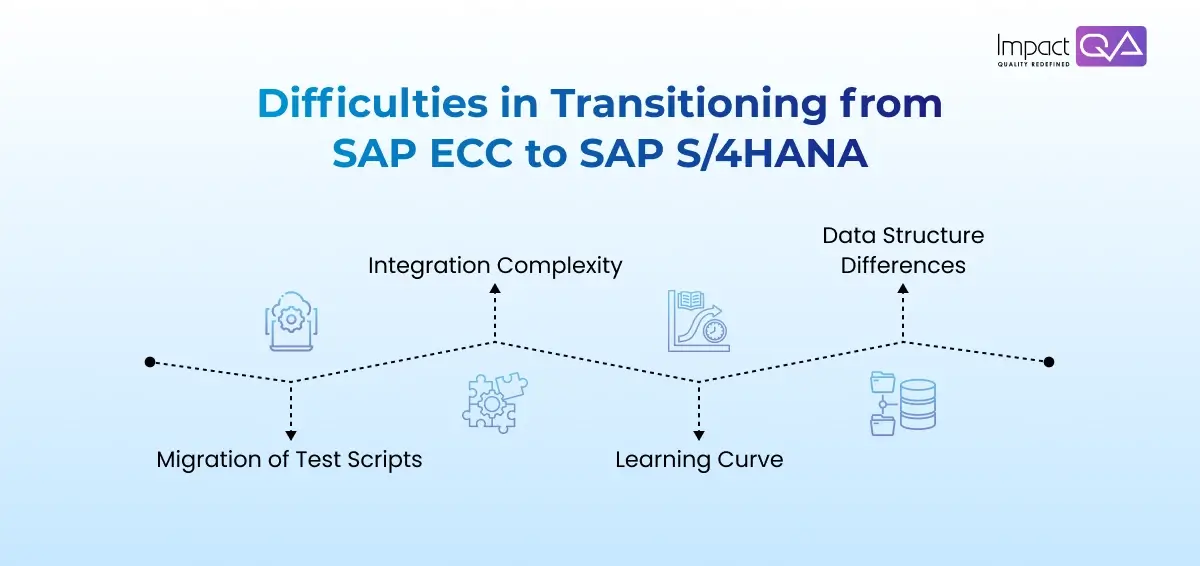
Transitioning from SAP ECC to S/4HANA involves more than just an upgrade; it’s a complete system overhaul. For businesses already relying on established test automation frameworks, this poses several challenges:
- Migration of Test Scripts: Test scripts developed for SAP ECC often need to be reworked or redesigned for S/4HANA. This is particularly challenging for businesses that have highly customized solutions.
- Integration Complexity: Integrating with third-party applications and services can be a challenge during the migration. Testing integrations across two different platforms requires a robust test automation framework.
- Learning Curve: S/4HANA’s new features, simplified architecture, and Fiori interface require testers to learn new methods and tools.
- Data Structure Differences: S/4HANA uses a simplified data model, but migrating data between ECC and S/4HANA can lead to significant complications during testing, especially in scenarios where legacy data structures are involved.
Organizations need to prepare for these challenges and strategize their testing efforts well ahead of the migration process to minimize downtime and operational disruption.
Test Automation in SAP S/4HANA
SAP S/4HANA brings several advancements in how test automation is conducted. Its streamlined architecture, integrated cloud capabilities, and focus on real-time processing influence the approach to test automation in the modern ERP system.
Key Features of SAP S/4HANA and Their Impact on Testing

- In-Memory Processing: SAP S/4HANA uses the HANA in-memory database, which significantly improves performance during testing by allowing faster transaction processing.
- SAP Fiori: The modern SAP Fiori interface allows businesses to design more intuitive and user-friendly applications, but it also means that test automation frameworks need to be adapted to accommodate the new design patterns.
- Cloud Integration: S/4HANA is built for the cloud, making it essential to test cloud-based applications and services as part of the testing framework. This requires organizations to have test automation solutions that support cloud environments.
- Simplified Data Model: The simplified data model in S/4HANA allows for easier testing, but businesses must still consider how to test legacy data migration during the transition phase.
Transitioning Test Automation Frameworks from SAP ECC to SAP S/4HANA
Moving from SAP ECC to SAP S/4HANA often involves updating or rewriting the entire test automation strategy. As the new platform offers faster processing and greater integration capabilities, businesses must ensure their test automation tools can fully leverage these changes.
Steps involved in transitioning:
- Tool Selection: Choose test automation tools that are compatible with both SAP ECC and S/4HANA, such as Worksoft Certify and Tricentis Tosca.
- Script Refactoring: Modify existing test scripts to account for new workflows, interfaces, and system structures in S/4HANA.
- Automation of New Features: Focus on automating new features, such as those enabled by SAP Fiori, to ensure comprehensive testing across the entire system.
Best Practices for Managing Test Automation Frameworks

As businesses move toward S/4HANA, it’s crucial to adopt best practices that can streamline test automation processes:
- Plan Early: Test automation should be an integral part of the migration strategy from day one.
- Modular Automation: Create modular, reusable test scripts that can be easily adapted to both ECC and S/4HANA environments.
- Cross-Platform Compatibility: Use test automation tools that are compatible with both platforms to avoid rebuilding test frameworks from scratch.
- Continuous Testing: Implement continuous testing practices to ensure that any new changes or updates are tested immediately without delays.
How ImpactQA Helps in SAP Test Automation
ImpactQA offers expert services for managing test automation across legacy and modern ERP systems. With years of experience in SAP testing, we cater to providing businesses with customized test automation frameworks that support both SAP ECC and S/4HANA systems.
ImpactQA’s services include:
- Test Automation Strategy Development: Helping businesses design a comprehensive test automation strategy that accounts for both legacy and modern systems.
- Tool Integration: Assisting with the integration of compatible test automation tools that work seamlessly across SAP ECC and S/4HANA.
- Test Script Migration: Offering expertise in migrating and refactoring existing test scripts for S/4HANA to ensure comprehensive test coverage.
- Cloud and Integration Testing: Providing advanced testing for cloud environments and third-party integrations to ensure that your system works smoothly across various touchpoints.
Leverage expert strategies to ensure seamless testing across SAP ECC and S/4HANA.
Final Say
As more organizations move from SAP ECC to SAP S/4HANA, the management of test automation frameworks becomes an increasingly important factor in ensuring smooth transitions and long-term success. The differences between these two systems are substantial, but with the right tools and strategies, businesses can minimize disruptions and make the most of their ERP investments.
For businesses navigating this transition, partnering with experienced experts like ImpactQA can make all the difference. The expertise in SAP testing and automation can help organizations smoothly bridge the gap between legacy and modern ERP systems so that testing efforts align with both current and future business needs.
Share this post


Related Posts
Our Case Studies