Quick Summary:
Enterprises are adding AI to the test automation foundations they built over the past decade. This article traces that evolution through recent analyst and industry research, explains the mechanisms driving the move to AI-driven test automation companies, and closes with five questions to ask a partner before you switch.
Table of Contents:
- Introduction
- How Test Automation Grew Into Its AI Chapter
- 6 Reasons Why Enterprises Are Switching to AI-Driven Test Automation Companies
- What to Ask Before You Switch
- Final Say
- FAQs
Enterprise test automation has grown through several generations of tooling, and each generation extended what the previous one built. Record-and-playback gave teams their first repeatable checks. Code-based frameworks brought those checks into version control and CI pipelines. The current generation adds machine learning to that foundation, and it explains why more enterprises are moving their programs to AI-driven test automation companies.
Analyst data shows the pace of that move. Gartner published its first Magic Quadrant for AI-Augmented Software Testing Tools in 2025 and projects that about 70% of enterprises will use these tools by 2028, up from roughly 20% in 2025.
This article traces the mechanisms behind that shift and the questions worth asking a partner before your team switches.
Get an automation estate assessment from ImpactQA’s certified quality engineering team.
How Test Automation Grew Into Its AI Chapter
Scripted automation earned its place in the enterprise. Keyword-driven and data-driven frameworks gave QA teams reusable libraries, and those libraries became the regression backbone for ERP rollouts and banking platforms alike. Many assets built in that era still run nightly and still catch defects before release.
The change came from the pace around those scripts. Release trains moved to weekly and daily cadences, and front ends began shipping on component libraries that regenerate element attributes with every build. Scripts bind to specific locators, so each UI refresh adds a maintenance ticket to the backlog.
Forrester reports that continuous automation testing platforms carried most organizations to roughly 25% automation of their testing. In 2025, the firm renamed its evaluation category to autonomous testing platforms, reflecting its view that AI and intelligent agents will extend that level. ImpactQA covered the earlier stretch of this arc in why enterprises are moving from scripted testing to intelligent test automation.
6 Reasons Why Enterprises Are Switching to AI-Driven Test Automation Companies
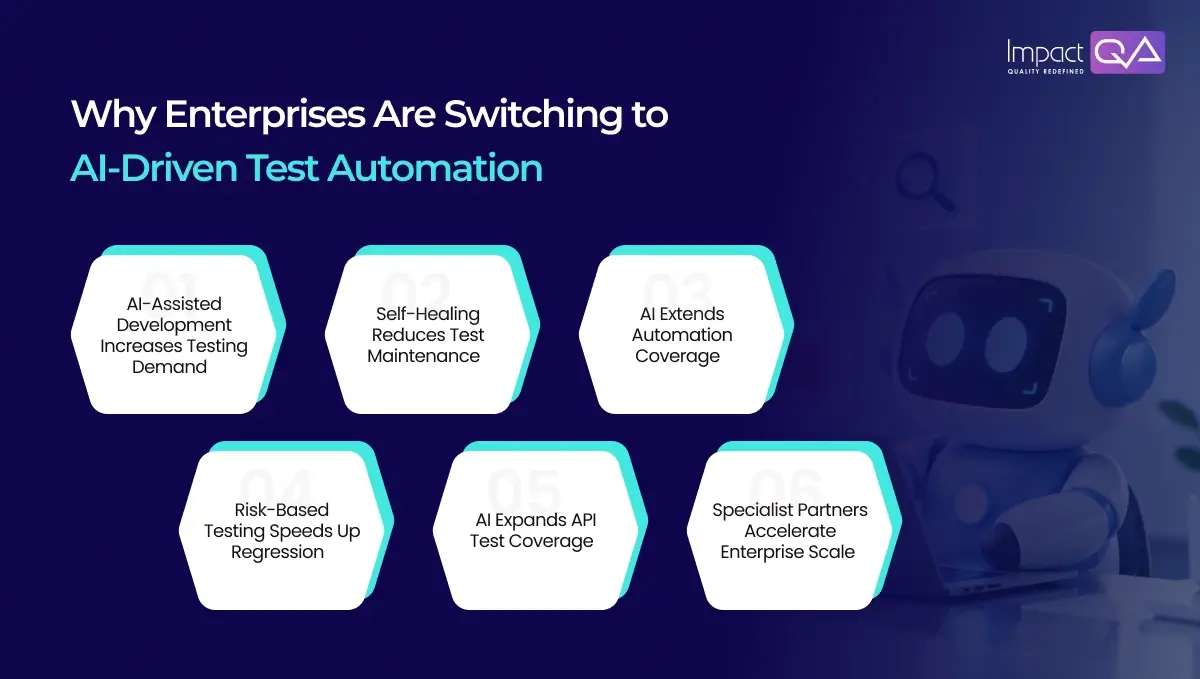
Six developments explain the move, and each one builds on automation investments enterprises already hold.
1. AI-Assisted Development Has Multiplied What Needs Validating
Google’s 2025 DORA report found that 90% of technology professionals now use AI at work, a 14% increase over 2024. DORA also recorded a positive relationship between AI adoption and software delivery throughput. More code per sprint means more change per regression cycle. The report’s authors describe AI as an amplifier, which places greater weight on the validation layer after each commit. AI test automation meets that volume in kind, generating and ranking checks at the speed code now arrives.
2. Self-Healing Converts Maintenance Hours Into Coverage Hours
When a developer renames a button ID, a scripted locator points at an element that has moved. A self-healing engine stores a fingerprint of each element, pairing its visible text with its position in the DOM tree. If the primary locator returns empty, the engine scores nearby candidates by similarity and swaps in the highest match above a set threshold, logging the change for review. This handles locator drift well. Requirements drift, where expected behaviour has changed, still routes to a tester because the assertion itself needs a human decision. Keeping those two categories separate is what makes healing auditable.
3. Automation Depth Is Extending Past the Scripted Baseline
Forrester’s 2026 follow-up with 37 enterprise customers found 51–60% automation on average, with some advanced teams exceeding 80%. Respondents estimated AI increased automation by 21–30% over traditional tools. Full autonomy was rated 2.2 out of 5.
Reusable components let enterprises extend existing automation instead of rebuilding every asset. That makes automation testing services covering migration, framework engineering, integration, and optimization relevant alongside the platform itself.
4. Risk-Based Test Selection Shortens Regression Windows
Full regression on every commit suited a monthly release calendar. With AI for automation testing, a model maps each code change to the tests historically tied to the touched files and ranks them by past failure rates. The pipeline runs the highest-risk slice first and moves the full suite to nightly windows.
Feedback that once took hours reaches developers in minutes, keeping defects inside the sprint where they cost least to fix. ImpactQA has documented how AI for automation testing is reducing test cycles by up to 80%.
5. API Automation Testing Gains Generated Coverage
A growing share of enterprise business logic sits behind APIs and microservices, and that layer changes faster than the UI above it. AI automation testing frameworks read an OpenAPI schema and generate functional and boundary-value cases for each endpoint, pairing them with synthetic payloads that respect field types.
Contract tests built the same way flag a schema change the moment a provider team merges it. For API automation testing, the specification itself becomes a living test source that updates with every version.
6. Specialist Partners Help Pilots Reach Enterprise Scale
McKinsey’s State of AI 2025 survey found that 88% of organizations use AI in at least one business function, up from 78% a year earlier. Software engineering sits among the functions most often reporting cost benefits from AI. About a third of organizations now report scaling AI enterprise-wide, and McKinsey links its highest performers to workflow redesign. That finding shapes the case for test automation companies over standalone tool licenses.
A partner delivering automated software testing services brings AI automation testing frameworks already wired to CI/CD, plus engineers who have migrated script estates before. Enterprises weighing this route often begin with why enterprises outsource test automation.
What to Ask Before You Switch
A switch works best when it carries existing assets forward. The five questions below show how a partner’s AI actually behaves, and each one maps to something you can verify during a pilot.
For a broader evaluation framework, see ImpactQA’s guide on how to select the best test automation services partner.
Checklist 1: How Does Your Self-Healing Engine Choose a Replacement Locator?
Ask for the scoring logic and the confidence threshold. A mature answer explains which element attributes feed the similarity score and shows the review log where healed locators wait for approval.
Checklist 2: Which Parts of Our Current Framework Carry Forward?
Your existing Selenium or Tosca suites hold years of encoded business rules. Ask how the partner imports those assets and how long old and new suites run in parallel during cut-over.
Confirm how the new suites plug into your CI/CD gates as well; ImpactQA outlines those integration layers in transforming software delivery pipelines with intelligent test automation services.
Checklist 3: How Does Generated Coverage Trace Back to Requirements?
AI can produce thousands of test cases in an afternoon. Ask to see the traceability matrix linking each generated case to a user story or risk item, so coverage reports reflect business intent alongside volume.
Checklist 4: How Is Test Data Governed?
Generated tests need realistic data to exercise real paths. Ask how the partner generates synthetic datasets and masks sensitive fields for GDPR and HIPAA, then how that data reaches each pipeline environment.
Checklist 5: Which Metrics Will Show Progress in the First 90 Days?
Agree on a short scorecard before the pilot begins. Defect escape rate and maintenance hours per release give a clear before-and-after view, while flaky-test rate shows how well healing holds over time.
Walk through your migration plan with ImpactQA's automation testing services team.
Final Say
Enterprise testing is moving toward platforms that create and maintain their own checks, with engineers directing risk and approving change. Gartner’s 2028 projection and Forrester’s renamed category point the same way, and investment is following McKinsey’s high performers into workflow redesign. The scripted frameworks enterprises built over the last decade remain the foundation this next layer stands on.
ImpactQA helps enterprises make that move on their own timeline. Our test automation services pair a proprietary scriptless framework, built to validate APIs and microservices across cloud applications, with test data management that generates synthetic datasets and masks sensitive records for GDPR and HIPAA compliance.
More than 150 certified automation engineers work across 250+ domain-specific automation frameworks, and client programs have reduced regression test cycles by up to 80%. Service virtualization replicates dependent systems for continuous execution, while partnerships with Tricentis and OpenText extend the tooling your teams already know. Falcon, our no-code agentic automation platform, gives teams a direct path to scale AI test automation across the enterprise.
Frequently Asked Questions (FAQs)
Share this post


Related Posts
Our Case Studies