Quick Summary:
Software teams struggle to maintain fast release cycles without sacrificing application quality and increasing maintenance burdens. Integrating AI into software testing resolves this bottleneck by automating script creation, fixing broken tests, and selecting relevant regression suites. This approach reduces overall testing timelines by 80%, allowing teams to deliver high-quality applications faster and with far greater efficiency.
Table of Contents:
- AI for Automation Testing: 7 Ways It’s Reducing Test Cycles by 80%
- 7 Ways AI is Reducing Test Cycles by 80%
- Strategic Implementation Frameworks for AI Quality Engineering
- Addressing Operational Challenges with Modern Automation Solutions
- Risk Mitigation and Limitations in Autonomous Quality Assurance
- Bottom Line
- Frequently Asked Questions (FAQs)
Software release speeds have outpaced traditional manual testing methods. According to Forrester’s Q1 2026 research on modern testing platforms, enterprise QA teams using smart workflows are successfully shortening regression timelines. These teams are now reaching over 80% automated test execution. Modern release engineering requires constant validation. Waiting until the end of a build cycle is no longer effective.
To keep up with rapid software updates, adopting AI for automation testing has changed from an experimental effort into a daily necessity. Companies using advanced AI automation testing frameworks lower delivery delays significantly. This removes traditional software bottlenecks. Additionally, it ensures full functional validation across complex modern systems.
At ImpactQA, we help enterprises leverage AI automation to improve speed, coverage, and software quality.
7 Ways AI is Reducing Test Cycles by 80%
High-performing software delivery pipelines use smart automation features to simplify validation steps. Below are seven practical ways this technology shortens quality assurance timelines.
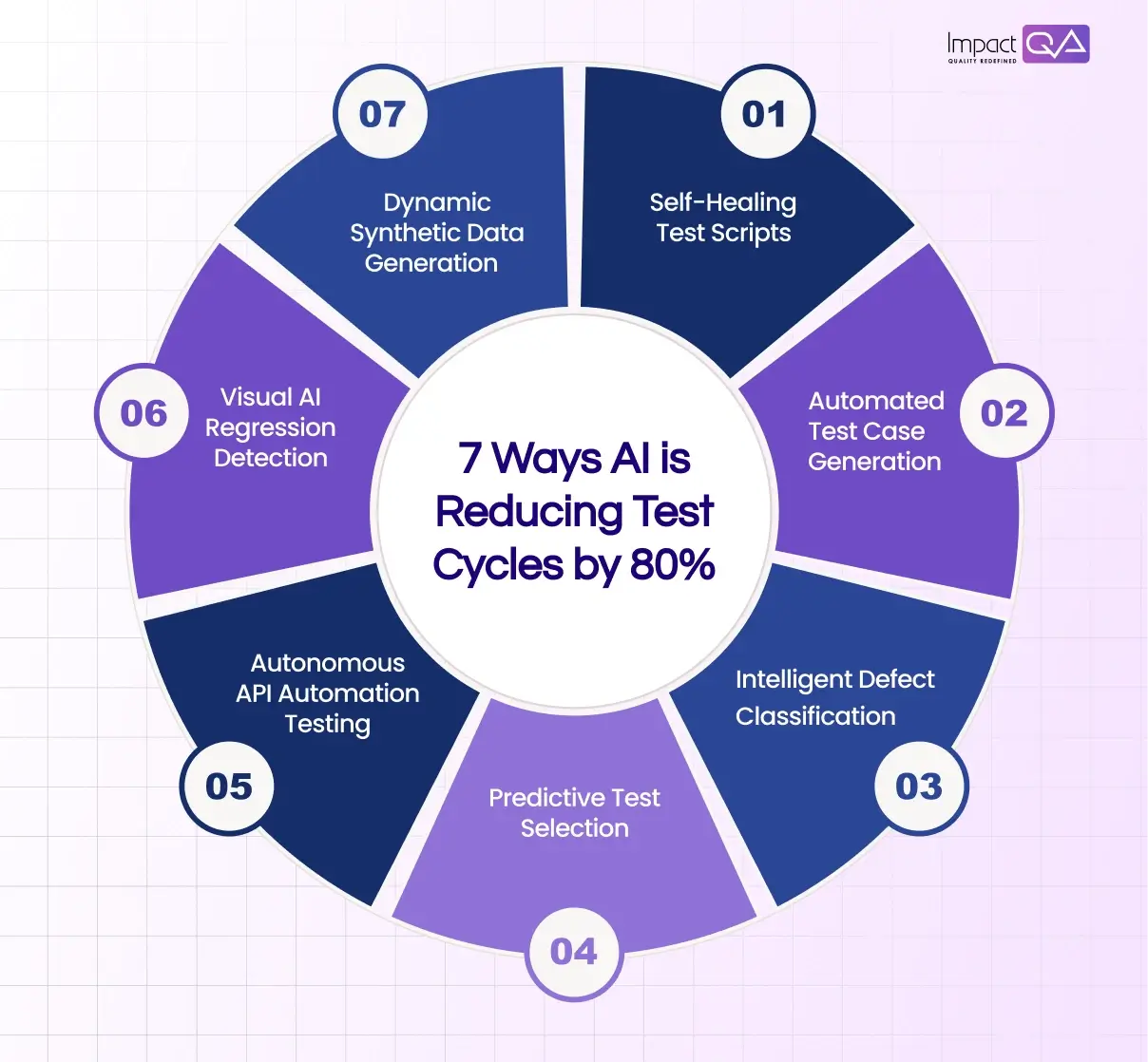
1. Self-Healing Test Scripts
Changing user interfaces often break existing test scripts during minor code updates. Smart algorithms inspect page elements continuously. They fix broken locators automatically during runs. Consequently, continuous integration builds do not fail unnecessarily due to unstable tests.
2. Automated Test Case Generation
Writing test cases manually takes time. It also frequently misses unexpected user paths. Automated models scan recent code changes and project requirements. They then generate focused test scripts instantly for quick execution inside delivery pipelines.
3. Intelligent Defect Classification
Sorting real application bugs from simple server setup errors wastes valuable engineering hours. Machine learning tools analyze run logs and group failures automatically. They send tickets directly to the right developer teams to speed up bug fixes.
4. Predictive Test Selection
Running an entire regression suite for small code changes slows down daily deployments. Smart tools review recent code updates and past bug patterns. They run only the specific test sub-suites affected by those recent changes.
5. Autonomous API Automation Testing
Backend connection points need constant checks as system components grow. Modern tools perform API automation testing by reviewing contract documents and mock data. They check complex multi-point connections without requiring manual script creation.
6. Visual AI Regression Detection
Comparing layout screens pixel-by-pixel causes many false alarms across different screen sizes. Computer vision tools spot real layout issues while ignoring intentional style updates. This reduces manual visual checks significantly.
7. Dynamic Synthetic Data Generation
Strict data privacy rules prevent teams from using real customer details during quality checks. Generative models create safe, realistic synthetic datasets instantly. This approach ensures full test coverage without exposing sensitive user information.
Strategic Implementation Frameworks for AI Quality Engineering
Successfully adding smart automation to release pipelines requires a clear strategy. Companies moving toward automated execution need structured plans rather than standalone tools. A good strategy starts by reviewing high-maintenance regression suites. Teams can then find unstable tests and set up self-healing features to stabilize the testing suite.
Additionally, software leaders should roll out updates in clear stages. They can start with simple apps before moving to core business systems. Modern automation testing framework implementations require clean data pathways. This allows automated tools to process real-time user actions, runtime metrics, and system logs. Consequently, tests update naturally as user behaviors change.
Furthermore, connecting continuous feedback loops between developer tools and test suites speeds up delivery timelines. Using specialized test automation services helps teams review code early. Smart models check new code additions before pull requests get approved. This proactive approach prevents fragile code from entering main product releases.
Finally, setting up a central dashboard lets quality managers track key performance metrics. They can easily monitor script stability, manual effort saved, and overall test coverage. Working with experienced teams for automation testing ensures staff skills grow alongside tool updates. Engineers then focus on managing testing rules, fine-tuning prompts, and auditing complex software outcomes.
Addressing Operational Challenges with Modern Automation Solutions
The bourgeoning adoption of smart testing tools forces companies to review their existing delivery systems. Older automation testing platforms often break under high code volumes. This leaves development projects susceptible to execution delays. While jumping on the technology bandwagon might look tempting, setting up modern AI systems requires careful architectural planning and precise tool setup.
Additionally, older servers often struggle to process real-time data required by modern execution engines. Companies moving from manual work to automated software testing services must update their systems. This allows them to run multiple tests at the same time in the cloud. Moreover, applications with complex backends need deeply integrated validation setups. Partnering with specialized automation testing services helps engineering leaders build clean pipeline setups that protect test quality while expanding total test coverage.
Furthermore, adding smart features to business software pipelines requires strong management rules. Without proper oversight, test suites risk accumulating extra, unneeded scripts created by automated tools. Utilizing professional test automation services helps QA teams review created test files. This keeps upkeep work low while keeping run speeds high.
Using AI in test automation also changes everyday team duties. QA engineers shift from writing repetitive scripts to training models, tracking edge cases, and reviewing overall coverage data. Software leaders who blend scalable automation testing habits with smart run engines systematically cut testing times by up to 80%. Consequently, companies build steady release speeds while keeping bug counts very low.
Risk Mitigation and Limitations in Autonomous Quality Assurance
While smart testing tools offer high execution speeds, software leaders must understand current system limits. Automated models work on patterns. Created scripts can sometimes miss real bugs or generate inaccurate user steps if instructions are too basic. Human review remains essential for critical business transactions.
Additionally, data privacy rules can complicate synthetic data creation. Models trained on uncleaned system logs risk revealing private business rules or personal customer data if proper cleaning steps are missed. Setting strict data security rules inside AI test automation environments protects regulatory compliance while keeping daily work flexible.
Moreover, model drift creates an ongoing cleanup task. Software updates roll out over time, so underlying models can generate outdated tests if they are not rechecked against new business rules regularly. Software teams using automated software testing services must run regular system checks. This verifies script accuracy and prevents gaps in regression coverage.
Finally, tracking cloud expenses becomes vital when running online generative tools. Unchecked requests for continuous script creation can raise system costs quickly. Setting execution limits and managing how often models run ensures companies get strong results without exceeding software budget limits.
At ImpactQA, we deliver AI-driven testing solutions that streamline workflows and shorten release cycles.
Bottom Line
As software release speeds continue to rise, using AI for automation testing is essential for staying on schedule. Modern AI automation testing frameworks help companies remove duplicate test runs. They also fix unstable scripts and clear out manual testing delays. This keeps application quality high without slowing down active deployment schedules.
At ImpactQA, we provide avant-garde test automation services tailored to complex business software environments. By combining deep domain expertise with modern testing methods and advanced automation testing solutions, we help organizations reduce testing times by 80% while achieving exceptional software reliability.
Frequently Asked Questions (FAQs)
Share this post


Related Posts
Our Case Studies