Quick Summary:
Enterprise test automation is entering a more intent-driven phase. As applications evolve faster and release cycles become more demanding, teams are looking for automation that can keep pace with change while giving QA greater visibility into execution quality.
Falcon brings that approach into everyday testing. Users describe what they want to test in plain English, an AI agent interprets the instruction and executes the scenario, while the platform captures the evidence from the run.
This article looks at the evolution from low-code to no-code automation, how Falcon low-code automation platform works, its core capabilities, the business value behind them, and the enterprise situations where the platform can make the greatest difference.
Table of Contents:
- Introduction
- What Is a No-Code Test Automation Platform?
- How Falcon Executes a No-Code Test? Key Features of Falcon Codeless QA Automation Software
- What Are the Benefits of No-Code Test Automation?
- Falcon Use Cases Across Enterprise Teams
- Final Say
- FAQs
Software teams are building more applications than ever, and a growing share of them is built visually. Gartner expects low-code tools to account for 75% of new application development by 2026, up from 40% in 2021. The firm also forecasts the low-code development technologies market to reach $58.2 billion by 2029, growing at 14.1% a year.
Testing is following the same path. Gartner projects that 70% of enterprises will have AI-augmented testing tools in their software engineering toolchains by 2028, up from 20% in early 2025.
A no-code test automation platform sits where these two trends meet. It lets the people who understand a product describe how it should behave in their own words, and it hands the execution to an AI agent. Falcon, ImpactQA’s agentic testing platform, is built on that idea. This article explains how it works and where it fits.
What Is a No-Code Test Automation Platform?
A No-code test automation platform allows users to create and execute automated tests through an intent-led interface. The tester describes the behavior to be validated, and the platform translates that intent into executable actions.
Consider an e-commerce scenario: “Log in, search for a product, add it to the cart, and verify the order summary.”
The business flow remains easy to understand because the test is described in the same language used to discuss the customer journey. Falcon’s AI agent then interprets the current screen and determines the interaction required to continue the flow.
This changes more than test authoring. It broadens participation in automation because the person who understands the workflow can contribute directly to its validation.
QA analysts know the acceptance criteria. Business analysts understand process rules. Product teams understand important customer journeys. A codeless approach gives that knowledge a more direct route into automated testing.
How No-Code Differs From Low-Code Automation?
Low-code tools cut coding through visual builders and reusable components, with scripting reserved for edge cases. ImpactQA launched Falcon in 2023 as a low-code automation platform built on drag-and-drop design and a pre-built component library. In that version, users still assembled components mapped to specific UI elements.
No-code removes the mapping layer entirely. Falcon’s current version asks for a plain-English description and nothing else: no recording, no selectors, no scripts. This overview of low-code and no-code automation tools covers the broader trade-offs between the two models.
For enterprises assessing a scriptless automation testing framework, this becomes particularly relevant when applications evolve frequently and automation has to keep pace.
How Falcon Executes a No-Code Test? Key Features of Falcon Codeless QA Automation Software
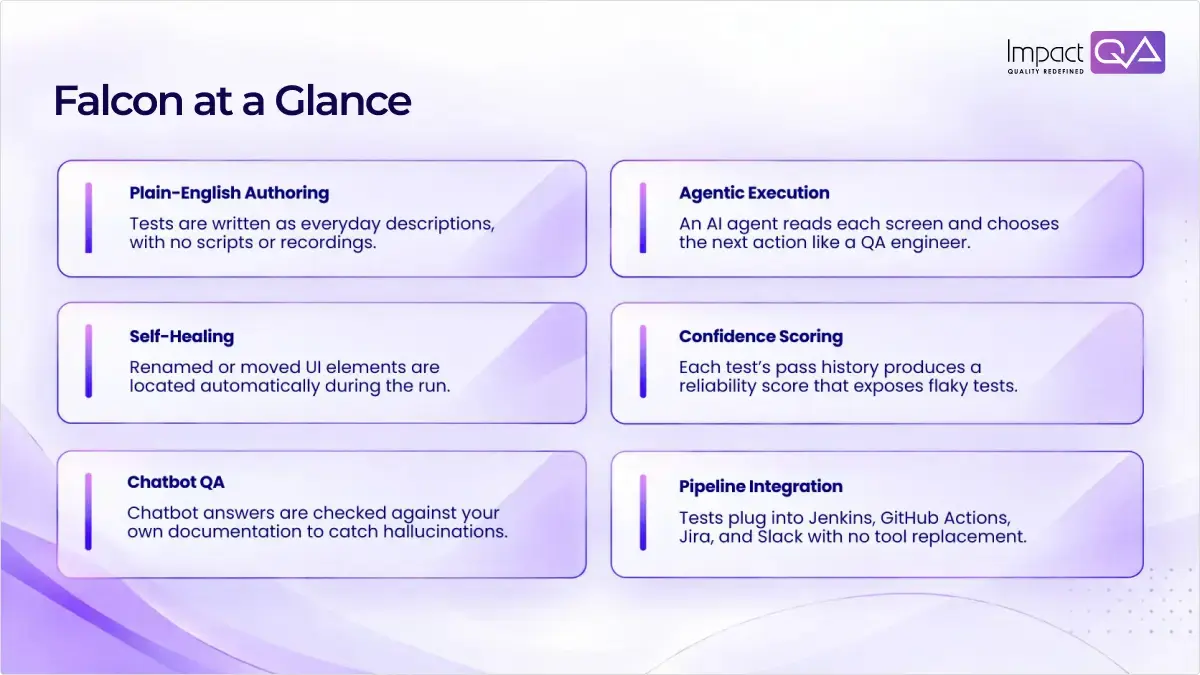
Falcon uses Claude AI as its execution agent. The agent reads the current screen, decides the next action, performs it, and reads the screen again. The loop continues until the flow completes or an assertion fails. Each step streams to a live console with screenshots and network logs. For the authoring side, see how Falcon simplifies test creation.
Each feature in Falcon’s codeless QA automation software targets a specific cost in the automation lifecycle.
Feature 1 – AI-Driven Agentic Execution
Falcon begins with the test objective expressed in plain English. Claude AI then reasons through the application screen by screen, selecting the next interaction as the scenario progresses.
This creates a closer link between the business scenario and its automated validation, particularly for workflows where the interface contains changing states or conditional prompts.
Feature 2 – Self-Healing Through Dynamic Error Handling
Enterprise interfaces change throughout their lifecycle. Labels get refined and controls move as products mature.
Falcon’s self-healing capability uses dynamic error handling to locate supported elements from their current context during execution. When a button is renamed or moved, the agent re-reads the screen and continues with the matching element. Maintenance time around routine interface changes shrinks, and more of it goes into meaningful test coverage.
Feature 3 – Confidence Scoring for Flaky Tests
Test history carries useful information. Falcon tracks how consistently a scenario passes across repeated executions and assigns a confidence score based on that history.
That additional signal helps a release team interpret an automated result in context. A test that has shown stable behavior over many runs carries a different level of confidence from one that has produced inconsistent outcomes.
Feature 4 – Doc-Grounded Chatbot QA
Enterprise chatbots add a quality question of their own: does each answer stay aligned with the organization’s approved information?
Falcon ingests help documentation and generates grounded test cases from it. Chatbot responses are then evaluated against that source material.
Organizations gain a repeatable way to validate conversational AI as the underlying model or knowledge base changes.
Feature 5 – Visual and API Testing
Falcon extends codeless automation beyond user-interface workflows.
Its visual testing capability checks the presentation of the application and identifies UI regressions, layout shifts and rendering issues. Its codeless API automation supports REST testing with request and response validation.
This helps teams connect visible application behavior with the services supporting it.
Feature 6 – Cross-Platform Coverage and Integrations
Falcon brings a common plain-English authoring experience across its supported automation environments. Current platform coverage includes web applications, real Android devices, REST APIs, AI chatbots and Oracle Forms, with Mainframe/CICS identified on the product roadmap.
Web testing runs through Playwright across Chromium, Firefox and WebKit, while mobile execution uses physical Android devices through ADB. Its enterprise integrations extend into Jenkins, GitHub Actions, Jira, Slack and BrowserStack, allowing Falcon to sit within established delivery workflows.
What Are the Benefits of No-Code Test Automation?
The business value of no-code automation becomes clearer when viewed across the automation lifecycle. The real gain comes from changing how teams create coverage, maintain it and interpret the results.
1. Broader Test Authorship
Test automation can draw directly from the people closest to the business process. QA analysts describe functional scenarios in familiar language, while product and business teams contribute their knowledge of critical workflows.
Automation engineers focus on test strategy and complex scenarios, while routine business-flow authoring opens up to more of the team.
2. A More Adaptable Automation Lifecycle
For teams shipping frequent releases, self-healing changes the rhythm of a sprint. Routine interface updates are handled during execution, so the regression suite stays ready for the next release and engineering hours shift toward broader coverage.
3. Stronger Release Intelligence
A single result tells part of the story. Confidence scoring adds the history behind it, so release teams focus their attention where it matters most and approach go-live decisions with clearer context.
4. Faster Scaling Across Environments
Falcon’s cloud-ready architecture supports parallel execution and automatic provisioning, allowing teams to expand execution capacity as coverage grows.
Because one platform spans multiple testing environments, organizations can treat automation as an enterprise-wide capability.
Falcon Use Cases Across Enterprise Teams
Falcon can enter the QA lifecycle at different points, depending on where an organization sees the greatest automation opportunity.
Use Case |
Where It Fits |
How Falcon Helps |
Enterprise Value |
| CI/CD Regression Testing | Frequent application releases | Runs critical scenarios through Jenkins or GitHub Actions and connects results with Jira and Slack | Creates a repeatable quality checkpoint within the delivery pipeline |
| E-Commerce & BFSI | High-change customer-facing applications | Uses intent-based execution and self-healing for evolving interfaces | Helps maintain regression coverage as journeys and interfaces change |
| Real-Device Mobile Testing | Android application validation | Executes scenarios on physical Android devices through ADB using the codeless authoring model | Extends automated coverage to real-device environments |
| AI Chatbot Validation | Enterprise conversational AI | Uses organization-approved documentation to generate grounded tests and validate responses | Creates a repeatable check for response accuracy and content alignment |
| REST API Automation | Service and backend validation | Automates REST requests with request and response validation | Brings API checks into broader automated workflows |
| Enterprise & Legacy Applications | Oracle Forms and established enterprise environments | Supports Oracle Forms and extends toward Mainframe/CICS through the Falcon roadmap | Brings codeless automation into technology estates that span modern and established platforms |
The breadth of these use cases matters because enterprise automation often grows from several starting points. One team may begin with regression coverage and extend into API validation. Another may start with chatbot QA or real-device testing and expand from there.
Falcon supports that progression through a consistent authoring model.
Final Say
Test automation has long focused on making quality checks repeatable. The next phase is about managing that repetition intelligently as applications and delivery pipelines keep changing, and Gartner’s projection of 70% enterprise adoption of AI-augmented testing by 2028 shows how quickly that phase is arriving.
Falcon approaches it through intent-based authoring and agentic execution. The business scenario stays at the centre, while the platform manages the execution complexity around it.
For QA leaders, that means faster coverage and richer context behind every result, delivered by ImpactQA through one codeless platform for web and mobile applications, with AI chatbot testing built in.
Frequently Asked Questions (FAQs)
Share this post


Related Posts
Our Case Studies