Quick Summary:
Manufacturing software testing demands expertise across connected production systems, from PLCs and SCADA to MES, ERP, IIoT devices, and industrial networks. This guide covers eight questions to ask when evaluating a manufacturing software testing services partner, including shop-floor testing, ERP-MES integration, security, compliance, performance, and operational support.
Table of Contents:
- Introduction
- Why Manufacturing Software Testing Needs Its Own Vetting Process
- 8 Questions to Ask Before You Sign Up for Manufacturing Software Testing Services
- Final Say
- Frequently Asked Questions
McKinsey reports that Industry 4.0 implementations can deliver 30–50% reductions in machine downtime across a range of sectors, gains that depend entirely on the digital systems connecting machines, data, operators, and enterprise processes performing as intended. That dependency is what makes manufacturing software testing a specialized QA discipline in its own right.
A manufacturing environment connects PLCs, HMIs, SCADA, MES, ERP, sensors, gateways, APIs, and industrial networks into one operational chain, and testing has to follow that same chain: validating data, workflows, device interactions, system states, and performance across every layer it touches.
The right testing partner understands those dependencies from the start, which is exactly what these eight questions are built to surface before you sign. Let’s explore them one by one.
ImpactQA combines shift-left, model-based testing, and automation across ERP and MES environments.
Why Manufacturing Software Testing Needs Its Own Vetting Process
Manufacturing software testing spans applications, operational technology, connected equipment, and enterprise platforms. A strong testing approach can therefore involve machine-control logic, ERP-MES data exchange, industrial protocols, cybersecurity, compliance evidence, IoT device behaviour, and performance under production conditions.
To note, manufacturing software operates across several technical layers at once; hence, testing the business application alone gives only part of the quality picture.
Consider a production order moving from ERP to MES, triggering shop-floor activity, generating machine data, and returning status information to the enterprise layer. Each handoff creates an opportunity for execution risks. That is why partner evaluation needs to focus on how the provider tests connected systems, where its specialists have worked, and what evidence they can produce.
8 Questions to Ask Before You Sign Up for Manufacturing Software Testing Services
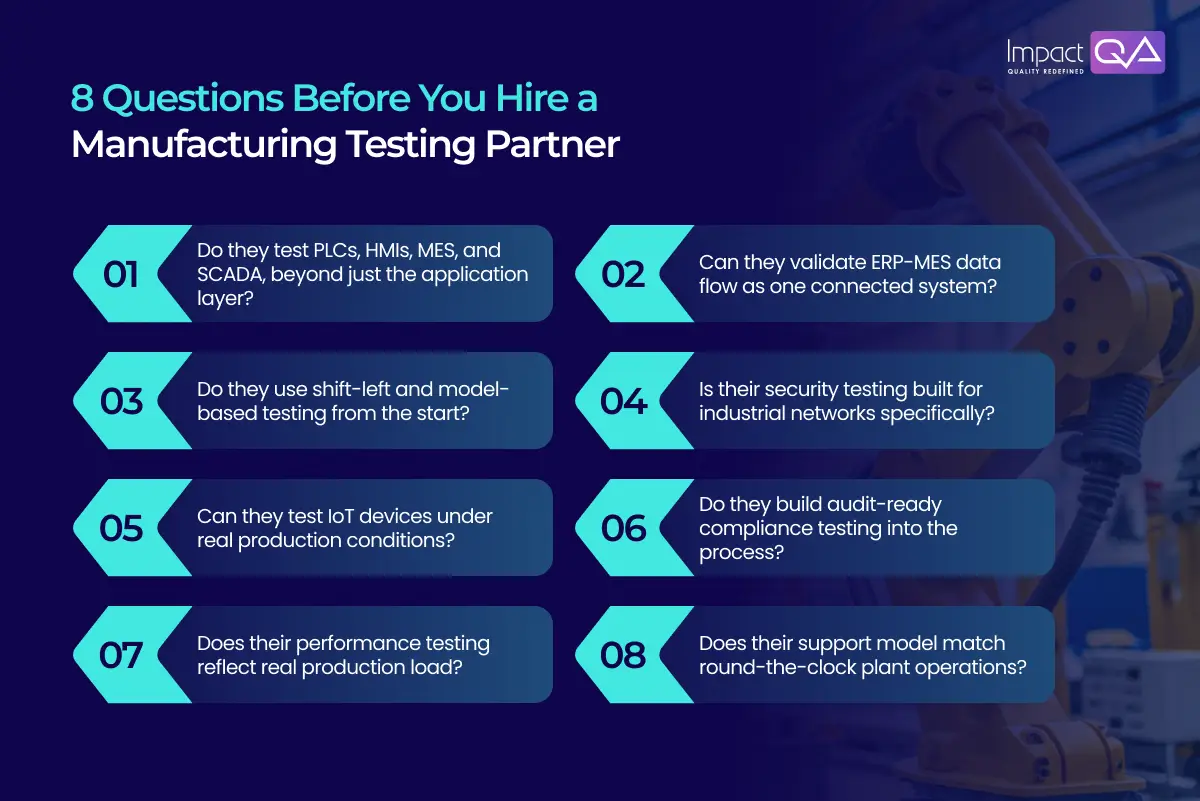
A manufacturing testing partner should understand the complete production technology chain. These eight questions help you assess technical coverage before the engagement begins.
1. Do They Test the Shop Floor, Beyond the Software Layer on Top?
Start with the systems closest to production.
Ask about experience testing PLCs, HMIs, MES, and SCADA, including control sequences, alarms, interlocks, operator inputs, manual overrides, state transitions, and fault recovery.
The useful evidence is a real project example. Ask what the team tested, how the environment was configured, and how it validated the interaction between machine events and application workflows.
A provider with genuine shop-floor depth should be able to explain the testing approach at both system and process level.
2. Can They Validate ERP-MES Data Flow as One Connected System?
ERP and MES testing needs to follow the transaction across system boundaries.
Production orders, material consumption, inventory movements, work-center status, quality results, and completion data can move between MES and enterprise platforms. The test strategy should therefore validate payload structure, field mappings, transformations, timing, error handling, retries, and end-to-end reconciliation.
A successful interface call proves the transport worked. The test still needs to confirm that the right business result was created. See our article on ERP testing for the manufacturing industry for a deeper look at ERP-MES validation.
3. Do They Build Shift-Left and Model-Based Testing Into Early Development?
Shift-left testing brings validation closer to requirements, architecture, configuration, and early development.
Model-based testing can derive scenarios from process flows, system states, transitions, and defined business behaviour. For a manufacturing workflow, that can expose complex paths before the solution reaches production.
Service virtualization adds another useful capability. Teams can simulate dependent ERP, MES, machine, or external services when the required environment is unavailable.
Ask how the provider converts process models into executable scenarios and carries those scenarios into regression coverage.
4. Is Their Security Testing Scoped to Industrial Networks?
Industrial cybersecurity requires testing across the connected environment.
A relevant scope can include network segmentation, access controls, device authentication, remote access, firmware security, OTA updates, and protection across connected sensors, gateways, edge systems, and industrial applications.
Ask how the provider separates IT and OT considerations and how it handles security testing around production-sensitive assets.
Look for experience that covers the network, device, application, and control layers rather than a security assessment focused on the application alone.
5. Can They Test IoT-Connected Devices Under Real Production Conditions?
IIoT (Industrial Internet of Things) testing should cover the behaviour of the full device-to-application chain.
Ask how the provider tests connectivity, message integrity, latency, data loss, gateway failures, reconnect scenarios, device availability, and downstream processing. A mature test environment should also support realistic machine-data simulation and controlled fault conditions.
The testing setup matters here. Ask which devices, interfaces, and operating conditions the team can reproduce. ImpactQA‘s IoT-enabled testing environments are designed to simulate, monitor, and validate connected manufacturing devices across multiple systems.
6. Do They Test for ISO and Industry-Specific Compliance?
Compliance testing should connect requirements directly to test evidence.
Ask how the provider maps controls to test cases, maintains traceability, captures execution results, and handles regression when requirements or system configurations change.
For manufacturers, the scope may include quality processes, access controls, data integrity, audit trails, electronic records, and sector-specific controls.
Request an example of the test documentation used to support an audit. That will show how the provider handles compliance in practice.
7. What Does Their Performance Testing Cover Under Real Production Load?
Manufacturing performance testing should reflect the conditions the plant actually experiences.
That can mean high transaction volumes, concurrent users, machine telemetry, batch processing, database load, integration traffic, and long-running operations. Measure response time, throughput, resource utilization, queue behaviour, and recovery after stress.
Ask how the provider creates realistic workloads and isolates bottlenecks across applications, databases, networks, and integration layers.
8. Can Their Support Model Match a Plant That Never Actually Stops?
Manufacturing support has to account for multiple shifts, maintenance windows, plant schedules, and regional operations. Ask how the provider handles after-hours validation, release support, incident response, environment availability, and critical test failures.
Also check how the model supports distributed plants and teams across regions and time zones.
ImpactQA covers shop-floor, ERP-MES, security, and performance testing for manufacturing under one engagement.
Final Say
A manufacturing testing partner should be able to explain how it will validate the technology chain that keeps production moving. Ask for these 8 areas and then have the team walk through one real manufacturing workflow. Trace a production transaction from the shop floor through MES and ERP. Ask what happens when a device disconnects, a message is delayed, a control state changes, or production volume spikes.
That conversation can reveal how deeply the provider understands the manufacturing environment.
ImpactQA’s own work testing ERP and MES platforms, including a Fortune 500 crane manufacturer’s Oracle EBS optimization, has been built around answering these questions directly. For a closer look at how that work runs in practice, our detailed article on continuous testing for a hybrid ERP environment covers a real manufacturing deployment.
Download the full case study and see how it works in action.
Frequently Asked Questions (FAQs)
Share this post


Related Posts
Our Case Studies