Quick Summary:
Performance testing in 2026 is evolving from a late-stage checkpoint into an architecture-shaping discipline, driven by AI-powered anomaly detection, continuous CI/CD-integrated validation, cloud-native and Kubernetes-aware testing, and edge and microservices resilience. As applications are expected to load instantly and adapt under unpredictable traffic, testing practices are becoming more predictive, telemetry-informed, and infrastructure-aware. This article examines nine emerging trends reshaping how engineering teams validate speed, scalability, and stability across modern, distributed software systems.
Table of Contents:
- Introduction
- 9 Performance Testing Trends Shaping Software Quality in 2026
- The Evolution of Tooling: 2026 Landscape
- Final Say
- Frequently Asked Questions
In 2026, users have developed a rather ambitious definition of “fast.” An application should load in a blink, keep pace with a rush of traffic, and adjust the moment conditions change.
That expectation is pushing software performance testing into new territory. It’s no longer a late-stage checkpoint, but rather, it’s shaping architecture-level decisions earlier in the build cycle.
According to Grand View Research, the global software testing market (of which performance testing is a core functional discipline) was valued at USD 49.36 billion in 2025 and is projected to reach USD 93.15 billion by 2033, at a CAGR of 8.5%. The same research identifies functional and quality-critical testing disciplines as the largest contributors to that growth, underscoring how central rigorous validation has become to software delivery at scale.
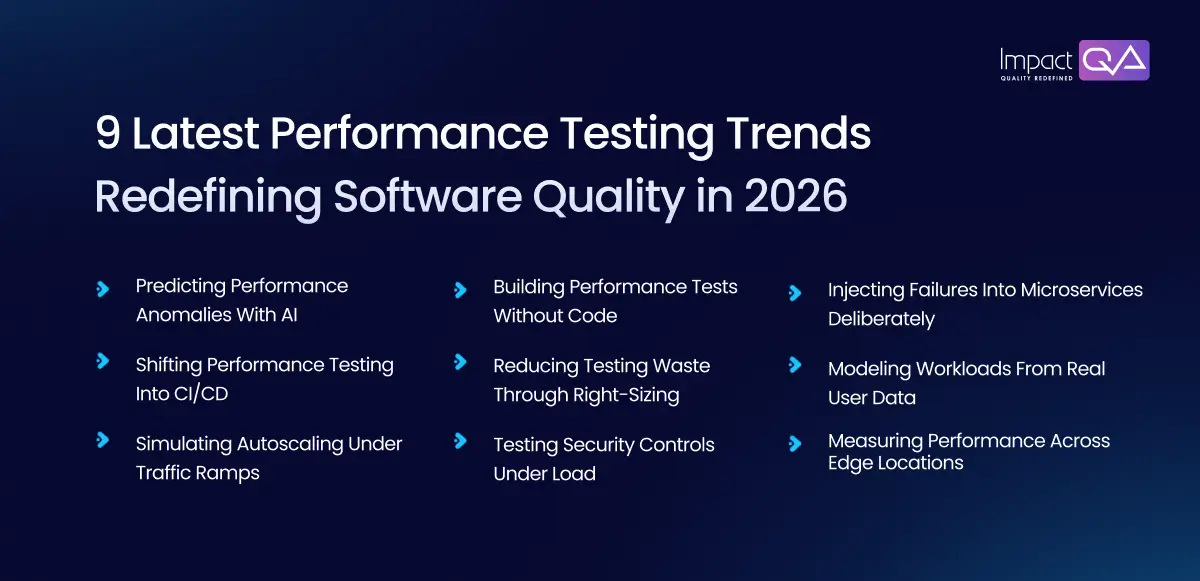
Several continuous performance testing trends are changing how this discipline used to work. Below are 9 emerging trends in performance testing worth understanding technically.
Let ImpactQA's AI-powered testing identify them before they impact users.
9 Performance Testing Trends Shaping Software Quality in 2026
Performance engineering is moving toward telemetry-informed, infrastructure-aware testing. These nine latest trends in performance testing capture the technical changes behind that shift.
1. AI Is Predicting Performance Anomalies
AI is giving performance testing a stronger predictive layer. Models can study historical telemetry to understand normal behaviour and spot unusual changes in response time or system load. When a test shows rising latency, AI-powered performance testing can correlate that signal with related infrastructure metrics and point engineers toward a likely bottleneck.
The value here is speed of diagnosis. Instead of manually moving through application logs after every failed run, engineers can use correlated test and telemetry data to narrow the investigation much faster.
2. Continuous Performance Testing Is Moving Into CI/CD (Shift-Left)
Performance testing is moving closer to the code that changes application behaviour. Teams can run lightweight performance checks within CI/CD and reserve heavier workloads for later pipeline stages.
A small test may expose an inefficient database query soon after a commit. A larger workload can then evaluate how that change behaves under sustained traffic. This tiered model creates earlier performance feedback without turning every pipeline run into a full-scale load test
3. Cloud-Native Testing Is Simulating Autoscaling Behaviour
In Kubernetes environments, performance depends partly on how infrastructure reacts to changing demand. Testing therefore needs to examine autoscaling behaviour alongside application response.
A traffic ramp can show how quickly the Horizontal Pod Autoscaler adds capacity. Engineers can then observe what happens to request queues while new pods become available. Scale-down behaviour matters as well. Rapid removal of capacity can interrupt active workloads or create instability when demand rises again.
4. Low-Code Tools Are Simplifying Performance Test Creation
Low-code performance testing is making workload creation more accessible. Recorded browser journeys or API interactions can be turned into reusable workflows with less scripting effort.
That can help teams model common user journeys faster while engineers spend more time analysing results and tuning system bottlenecks. Parameterization also allows the same workflow to represent different users and traffic conditions.
For larger engineering teams, the bigger shift is reduced dependence on manually maintained performance scripts.
5. Sustainable Performance Engineering Is Reducing Testing Waste
Performance testing can consume significant computing resources, especially when large environments run repeated workloads. Sustainable performance engineering brings resource efficiency into test planning.
Teams can measure the infrastructure consumed by test runs and right-size environments around the actual workload. Test selection can also remove unnecessary executions. Service virtualization provides another option by simulating expensive dependencies instead of recreating entire environments.
The objective is practical: gain useful performance data while using fewer resources to produce it.
6. Performance Testing Is Putting Security Controls Under Load
Security mechanisms also consume system resources. Authentication services may see a surge in requests during peak traffic. Rate limits and token validation can behave differently when the system is under pressure.
Performance testing can bring these conditions into the same scenario. Teams can examine whether security controls continue to respond within acceptable limits when traffic increases.
This creates a useful connection between performance and security engineering. The goal is to understand how protective controls behave when the application is carrying its heaviest workload.
7. Resilience Testing Is Introducing Failures Into Microservices
A distributed application can experience performance degradation even when its primary service remains healthy. A delayed dependency can increase response times across an entire transaction.
That is why performance teams are increasingly combining load with controlled fault injection. Engineers can introduce latency into a downstream service or make a dependency temporarily unavailable. The test then reveals how the application responds through mechanisms such as retries, circuit breakers or cached responses.
8. RUM Data Is Making Workload Models More Realistic
Real User Monitoring is giving performance teams a direct view of how applications behave in the field. Production telemetry can reveal which journeys receive the most traffic and where response times vary across real user conditions.
Those observations can feed back into performance scenarios. A test can reproduce an observed traffic surge or reflect the actual distribution of user journeys instead of relying on assumptions created months earlier.
This closes an important gap between synthetic load and real application behaviour. The test environment starts looking more like the environment the application actually operates in
9. Edge Testing Is Measuring Performance Across Distributed Locations
Applications delivered through CDNs and regional infrastructure can produce different response times depending on where requests originate. A centralized performance test may therefore provide only part of the picture.
Edge performance testing brings regional behaviour into the test scenario. Teams can examine how request routing and caching affect response times across different points of presence. They can also identify latency introduced closer to the user’s network path.
The Evolution of Tooling: 2026 Landscape
Feature |
Traditional Models |
Modern 2026 Frameworks |
| Load Generation | Static, scripted | Adaptive, dynamic |
| Script Maintenance | High | Low; self-adjusting |
| Reporting | Post-execution summaries | Real-time predictive dashboards |
| Issue Detection | Manual correlation | Automated root-cause analysis |
| Pipeline Integration | Minimal | Deep, gated CI/CD |
Adopting trending performance testing software tools in 2026 requires architectural foresight:
- Apache JMeter remains relevant for teams valuing open-source freedom
- k6 appeals to DevOps teams prioritizing a code-first approach
- LoadNinja offers real-browser testing without scripting for accurate UI-level insight.
The right stack depends entirely on your infrastructure demands.
Move toward intelligent performance validation with ImpactQA. Test modern applications against evolving workloads.
Final Say
Performance testing in 2026 is becoming a broader engineering discipline. AI-assisted analysis, continuous validation, production-informed workloads, cloud-native testing, resilience engineering, and edge observability are changing how teams understand system behaviour. The fundamentals still matter. What’s changed is where, when, and how those measurements get used.
The organizations getting the most value treat performance as an architectural input from day one, not a release-gate afterthought, often by partnering with specialized performance testing services providers like ImpactQA to close that gap faster.
Get an inside look at the strategy behind the success.
Frequently Asked Questions (FAQs)
Share this post


Related Posts
Our Case Studies