
Quick Summary:
Manual testing remains an essential part of enterprise software quality, particularly when applications involve complex workflows, changing requirements, usability considerations, and business-critical processes. Unlike predefined automated scripts, manual testing allows QA professionals to explore unexpected scenarios, assess real-world user behavior, validate business logic, and apply human judgment. Enterprises can combine manual and automated testing based on their specific requirements, using each where it delivers the greatest value. Choosing the right testing partner also matters, with expertise, domain knowledge, structured processes, and clear reporting being key considerations. With experienced QA professionals handling testing requirements, enterprises can identify issues earlier and deliver more reliable software.
Table of Contents:
- Introduction
- What Is Manual Software Testing and Why Does It Matter for Enterprises?
- 7 Reasons Enterprises Continue to Invest in Manual Software Testing
- Manual Testing vs. Automation Testing: Where Each Fits
- What Should Enterprises Look for in Manual Software Testing Services?
- Final Say
- FAQs
The year is 2026. AI and automation are changing how software is deployed, helping enterprises move faster than ever. And yet, investment in manual testing services continues.
That may sound counterintuitive until you look at what enterprise software actually asks QA teams to validate. Large-scale applications involve complexities that cannot always be reduced to a fixed sequence of automated steps.
Manual Testing puts a human tester directly into that equation. Because if only the outcome of a process is verified, the testing is far from the finale. Testers must also understand how the application behaves in real use and whether the experience makes sense.
For businesses, this remains the primary focus. Software quality ultimately comes down to whether an application works for its users and effectively supports the business processes that depend on it. And this article explores why enterprises continue to invest in manual software testing services and where human-led testing remains essential.
Let ImpactQA handle your manual testing requirements with experienced QA professionals.
What Is Manual Software Testing and Why Does It Matter for Enterprises?
Manual software testing is the process of evaluating an application through human-led test execution, observation, and analysis rather than relying exclusively on automated scripts. It is particularly valuable when testing requires contextual judgment, exploratory thinking, usability assessment, or validation of complex business scenarios.
A manual tester may validate a feature against documented requirements, explore different user paths, test unusual inputs, assess interface behavior, or investigate a defect beyond the original reproduction steps.
This makes manual software testing services relevant across several areas, including:
- Functional testing
- Exploratory testing
- Usability testing
- Regression testing
- Compatibility testing
- User acceptance testing
- Scenario-based testing
- Business-rule validation
The value becomes even more apparent in enterprise environments, where a single application may connect multiple departments, systems, databases, APIs, and user roles.
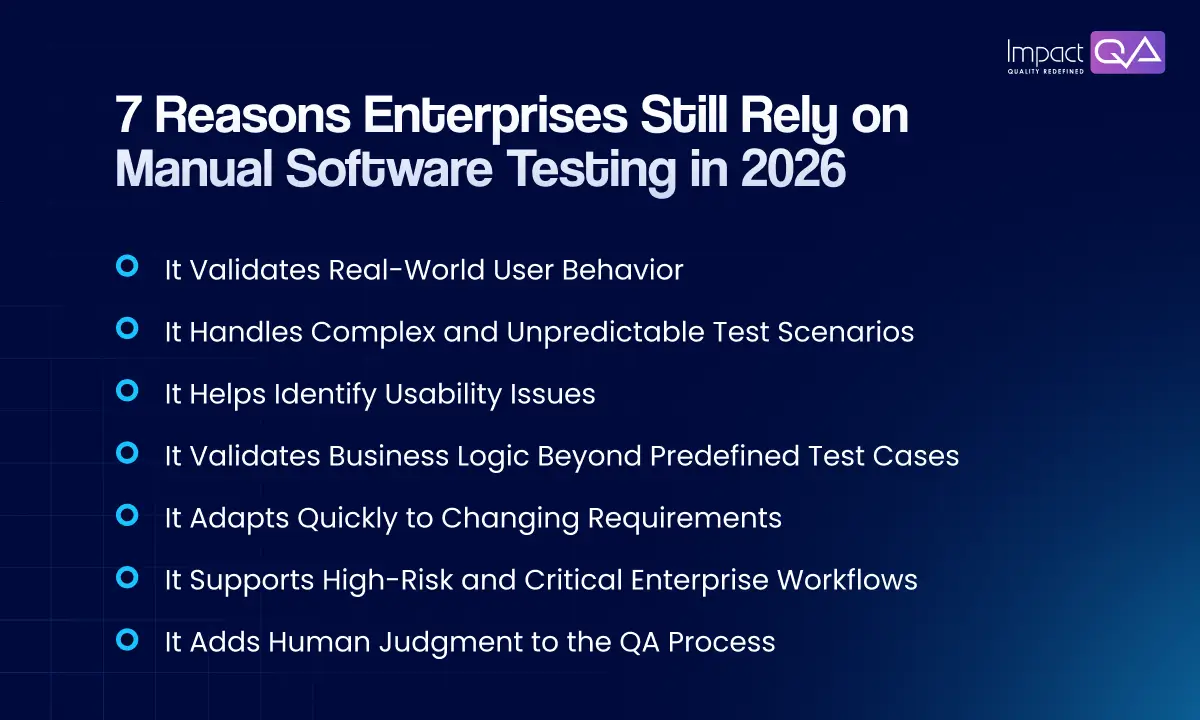
7 Reasons Enterprises Continue to Invest in Manual Software Testing
Here are some top reasons why companies deem manual software testing services a must in the process:
1. It Validates Real-World User Behavior
Automated tests generally follow predefined conditions, while manual testers can interact with software more like real users who rarely behave exactly as a test case predicts.
They may navigate between screens in an unusual order, enter unexpected information, skip an instruction, return to a previous step, or interpret a workflow differently from the product team.
This is particularly important for enterprise applications where different roles interact with the same system in different ways. An administrator, employee, customer, and manager may all approach a workflow differently.
2. It Handles Complex and Unpredictable Test Scenarios
Some software scenarios are too variable or context-dependent to be represented through fixed test scripts. Take, for instance, a workflow that involves approvals, permissions, third-party integrations, and multiple conditional paths. A tester may need to change one input, observe the result, and decide what to investigate next based on that outcome.
That is where experienced manual functional testing services add value.
Testers can explore:
- Unusual combinations of inputs
- Exception handling
- Conditional workflows
- Multi-step transactions
- Unexpected navigation paths
- Complex user-role interactions
The objective is to investigate how the application behaves when conditions do not unfold exactly as expected.
3. It Helps Identify Usability Issues
A system can be correct and still provide a poor user experience, and identifying many usability problems requires human interpretation.
A button may work fine but be difficult to find. A warning message may appear but fail to explain what the user should do next. These are quality issues that a tester can identify through direct interaction.
This is particularly relevant for enterprise software because employees often have to use complex applications repeatedly. Small usability problems can become significant sources of friction when they affect thousands of users or occur throughout a critical business workflow.
4. It Validates Business Logic Beyond Predefined Test Cases
Manual testers can evaluate whether software behavior makes sense from a business perspective.
A transaction might technically complete, but should it have been approved for that particular user? A particular role might be able to access a screen, but should it be able to modify the information displayed there? These questions require testers to understand the relationship between application behavior and business requirements.
That makes experienced manual QA testing services particularly useful for applications where functional correctness and business correctness are closely connected.
5. It Adapts Quickly to Changing Requirements
Manual testing can respond quickly when requirements, workflows, interfaces, or business rules change because testers can modify their approach without rebuilding an entire automated test suite.
This does not mean automation has no place. It means manual testing offers flexibility when the expected behavior itself is still evolving. For enterprises working through frequent product changes, that adaptability can be valuable during development and release cycles.
6. It Supports High-Risk and Critical Enterprise Workflows
Manual validation is especially valuable when software supports business-critical processes where defects can have operational, financial, or customer-facing consequences.
Think of workflows involving:
- Financial transactions
- Healthcare processes
- Customer onboarding
- Supply chain operations
- Employee management
- Approval systems
- Enterprise resource planning
- Role-based access
In these environments, simply confirming that a workflow completes is not always enough. Testers need to understand the context in which the workflow operates and investigate whether the result is appropriate. This is one reason enterprises often incorporate manual software testing services into release validation for high-impact functionality.
7. It Adds Human Judgment to the QA Process
The biggest strength of manual testing is not the ability to execute test cases manually; it is the ability of experienced testers to observe, interpret, question, and investigate software behavior.
A tester can recognize when something feels inconsistent even before a formal defect is raised.
They can ask:
- Does this workflow make sense?
- Is this result appropriate for the user’s role?
- What happens if the user takes a different route?
- Is this error message actually useful?
- Could this behavior create confusion elsewhere in the application?
That judgment is difficult to reduce to a simple pass/fail condition. For this reason, manual and automation testing address different aspects of software quality rather than competing for the same role.
Manual Testing vs. Automation Testing: Where Each Fits
Manual testing and automation testing serve different purposes within an enterprise QA strategy. Manual testing is particularly valuable for scenarios requiring human observation and judgment, while automation is better suited to repetitive, predictable, and frequently executed test cases.
Testing Need |
Manual Testing |
Automation Testing |
| Exploratory testing | Strong fit | Limited |
| Usability evaluation | Strong fit | Limited |
| Complex user scenarios | Strong fit | Depends on scenario |
| Repetitive regression | Possible | Strong fit |
| Frequent execution | Less efficient | Strong fit |
| Human judgment | Strong fit | Limited |
| Large-scale repeatable coverage | Limited | Strong fit |
The two approaches are therefore complementary rather than competing. Enterprises can use automation for repetitive and predictable validation while relying on manual testers for exploratory testing, usability assessment, complex workflows, and scenarios requiring contextual judgment.
ImpactQA provides both manual testing and test automation services, allowing enterprises to combine either approach based on their application and release objectives.
ImpactQA provides flexible testing support tailored to your requirements.
What Should Enterprises Look for in Manual Software Testing Services?
A capable manual testing provider should offer more than test execution; it should bring structured test planning, domain understanding, defect analysis, documentation, and the ability to adapt testing to business risks.
When evaluating manual testing services, enterprises should consider:
- Experience with complex enterprise applications
- Functional and exploratory testing capabilities
- Domain-specific QA knowledge
- Clear test planning and documentation
- Strong defect reporting and traceability
- Regression and release testing expertise
- Cross-browser and cross-platform testing where relevant
- Ability to collaborate with automation teams
- Risk-based testing practices
- Transparent reporting and QA metrics
The right provider should fit into the existing software development and QA lifecycle rather than operate as a disconnected testing function.
Final Say
To sum up, manual testing has remained relevant and prevalent because enterprise software keeps demanding judgments that predefined tests cannot always provide.
AI and automation can accelerate execution and expand coverage, but they don’t remove the need to understand how software performs for real users and the business processes it supports.
The strongest QA strategy, therefore, is about knowing where human judgment creates the most value and using it deliberately alongside the rest of the testing lifecycle.


