Quick Summary:
Mobile application security testing is critical because a functional app can still expose sensitive data. Before launch, testing helps uncover risks across data storage, authentication, APIs, network communication, devices, and backend systems. Performance testing also matters because heavy traffic can strain security controls, while automation keeps repeated security checks aligned with faster release cycles. Device and network fragmentation can reveal weaknesses hidden in controlled environments, and API vulnerabilities can expose backend systems even when the app itself appears secure. The article also examines how AI is making mobile security testing more adaptive through test generation, anomaly detection, risk prioritization, and regression optimization, while explaining what to look for when choosing a mobile application testing services partner.
Table of Contents:
- Introduction
- What Is Mobile Application Security Testing, and How Is It Different From General Mobile App Testing?
- 5 Critical Reasons Every App Launch Needs Dedicated Mobile Application Security Testing
- What Should Mobile Application Security Testing Cover?
- How AI Is Changing Mobile Application Security Testing
- What to Consider While Choosing a Mobile Application Testing Services Partner?
- Final Say
- FAQs
Your mobile app is built. The launch date is finally on the calendar with all the features in place and a polished interface. But an app that works as expected is not necessarily an app that is safe to release.
Mobile app testing takes on a different significance when an application moves from development into the hands of real users. What appears to be one application is actually a network of connected components: APIs handle requests, authentication services control access, backend systems process data, and third-party integrations extend what the app can do. And each connected layer expands the security surface that needs to be tested before release.
The stakes are hardly theoretical. IBM’s 2026 Cost of a Data Breach Report puts the global average cost of a data breach at $4.99 million, the highest figure recorded in the report’s history. The question is therefore bigger than the feature set. Can the application hold up when a less-than-predictable world puts those underlying systems to the test?
That is where the finer nuances of mobile application security testing begin to matter. Read ahead to understand why.
ImpactQA helps detect security risks before they reach your users.
What Is Mobile Application Security Testing, and How Is It Different From General Mobile App Testing?
Mobile application security testing identifies vulnerabilities across an app’s code, data, authentication mechanisms, APIs, and supporting infrastructure that could be exploited to gain unauthorized access or compromise sensitive information.
General mobile app testing examines whether an application functions correctly across devices, operating systems, networks, and user scenarios. Security testing takes the process further by examining how these functions could be exploited to bypass controls or access protected data.
No matter how well-architected an app is, it could still leak session tokens, store credentials in plain text, or expose an unsecured API endpoint. Finding these chinks in the armor requires security-specific techniques such as static and dynamic analysis, penetration testing, API assessment, and encrypted storage verification alongside the regular testing cycle.
The distinction matters at launch: functional coverage can tell you that an app works; security testing probes how it could fail under deliberate misuse.
5 Critical Reasons Mobile Application Security Testing Is A Must Before Every App Launch
The five areas below show why mobile application security testing needs to be part of the launch process rather than a final check added after development is complete.
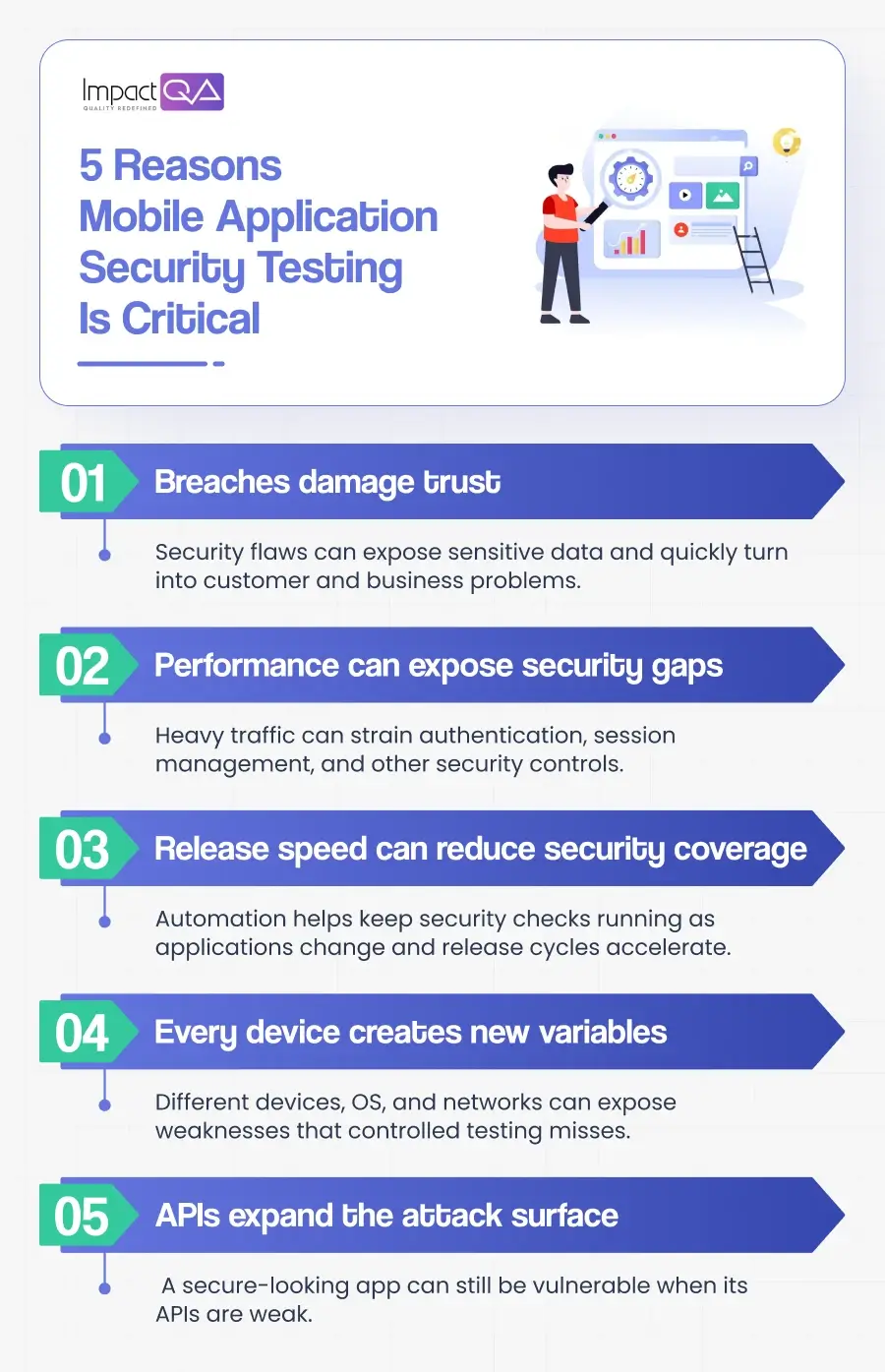
1. App Stores and Users Don’t Forgive Breaches
Your app may be new, but the data it handles is not something you can afford to expose. App stores can suspend or delist an app the moment a data-safety violation surfaces, and users who lose trust in an app rarely give it a second chance.
Sensitive info does not get a free pass simply because it resides in a mobile application. An insecure storage mechanism can expose information directly from the device; weak authentication can make account takeover easier; a poorly secured API can open a path into backend data. This is why security testing examines the application beyond its visible screens, covering areas such as storage, authentication, cryptography, APIs, and communication.
2. Security and Performance Failures Compound Each Other
Security measures rarely operate in isolation. When a mobile application experiences heavy traffic, its behavior can change. Authentication requests may slow, token refresh cycles can increase, rate limits may come under strain, and backend resources can become constrained. These conditions can reveal weaknesses that remain hidden during routine usage.
That is why security testing must go hand in hand with mobile app performance testing. It should include peak-load validation because controls such as authentication, session management, and rate limiting may weaken under heavy demand. Stress testing helps verify they remain effective.
3. Manual Testing Can’t Keep Pace With Launch Speed
By the time a mobile app reaches its tenth release, testing every journey manually can become a release bottleneck of its own.
That makes mobile app automation testing valuable for security, not just regression coverage. SAST and DAST checks can run through CI/CD while repeatable security scenarios execute alongside functional tests. Parallel device execution then reduces the time required to validate those changes across multiple environments.
ImpactQA’s mobile automation framework supports Appium-based testing with parallel execution across devices and platforms, helping bring repeated security validation into faster release cycles.
4. Device and Network Fragmentation Multiplies the Attack Surface
There is no single “mobile environment.” An authentication flow may hold on a current iPhone over a trusted connection but expose a weakness on an older OS version or an unsecured network. Certificate validation, encrypted communication, session handling, and API requests all must remain secure as the environment changes. That is where issues such as insecure transport or man-in-the-middle exposure can emerge.
For enterprises, testing across devices, OS versions, and network conditions helps ensure security controls remain effective in real-world environments.
5. Your Mobile App Is Only as Secure as Its APIs
A mobile interface can look perfectly secure while the APIs behind it quietly leave the door open. Weak authorization, predictable endpoints, excessive data returned in responses, or poorly validated tokens can expose business logic and sensitive information even when the front end behaves exactly as expected.
That makes API testing a core part of mobile application security testing. Requests should be tested for broken access controls, authentication and authorization failures, excessive data exposure, input validation issues, and token-handling weaknesses. A mobile app may have the strongest client-side controls in place; if the API trusts the client too much, those controls mean very little.
What Should Mobile Application Security Testing Cover?
A strong security assessment should examine the mobile application within a larger technical ecosystem. Here is what it should cover:
Sr. No. |
Testing Area |
What It Validates |
| 1. | Authentication & authorization | Account access, session controls, roles, and permissions |
| 2. | Data Security | Storage, encryption, sensitive information, and data integrity |
| 3. | API Security | Authentication, authorization, input handling, and data exchange |
| 4. | Network Security | Secure communication across network conditions |
| 5. | Application Security | Vulnerabilities, misconfigurations, and exploitable logic |
| 6. | Device & platform security | Behaviour across operating systems, devices, and configurations |
How AI Is Changing Mobile Application Security Testing
AI is making mobile security testing more adaptive by helping teams identify where risk is most likely to emerge as the application changes.
In AI mobile app testing, machine learning can help generate test scenarios, analyze defects, prioritize regression coverage, identify anomalies, and create test data. AI tools for mobile app testing can also use previous execution results and application changes to determine which areas deserve deeper validation.
The practical advantages are speed and prioritization. A team does not have to treat every test case as equally important after every code change. ImpactQA’s broader AI-led testing capabilities include intelligent test generation, regression optimization, defect analysis, and risk-based test prioritization.
For mobile security, this can make continuous testing more practical as applications evolve, helping teams identify emerging risk patterns earlier instead of waiting for the next major testing cycle.
What to Consider While Choosing a Mobile Application Testing Services Partner?
Not every mobile application testing services provider treats security as its own discipline. Many still fold it into general functional QA, which is exactly the gap this article opened with.
When evaluating a mobile application security testing services partner, the questions worth asking are concrete:
- How many real devices and OS versions do they test against?
- Is their automation framework tool-agnostic or locked to one vendor?
- Do they have in-house labs or rely entirely on third-party device farms?
ImpactQA‘s answer to each of those is built into how its Mobile Testing Center of Excellence operates: real-device coverage, an Appium-based automation framework, and dedicated in-house labs.
The right partner should treat mobile security as a dedicated engineering discipline, with the coverage and infrastructure to test beyond a single device or release environment.
ImpactQA helps integrate mobile security testing into faster release cycles.
Final Say
A mobile app can pass functional testing and still carry vulnerabilities into production. Mobile application security testing closes that gap by examining the code, data, APIs, authentication, devices, and network conditions that sit behind the user experience.
The earlier security is tested, the less expensive the problem is to discover. A launch should mark the point at which an app is ready for users, not the point at which its security testing finally begins.
Download the full case study and see how it works in action.
Frequently Asked Questions (FAQs)
Share this post


Related Posts
Our Case Studies