Quick Summary:
Growing system complexity, increasing integrations, and expanding testing volumes are making traditional CTRM testing difficult to sustain. This blog explores how autonomous QA, AI risk analytics, and intelligent automation are reshaping CTRM implementation and testing. It examines emerging testing strategies, predictive quality intelligence, and practical considerations that can help commodity trading organizations reduce risk and support large-scale digital transformation initiatives.
Table of Contents:
- Introduction
- Why Traditional CTRM Testing Models Are Reaching Their Limits
- Autonomous QA: The Next Phase of CTRM Quality Engineering
- AI Risk Analytics and Predictive Quality Intelligence
- Intelligent Automation Strategies Transforming CTRM Validation
- Preparing for the Future of CTRM Testing
- Conclusion
Commodity trading organizations operate within highly interconnected ecosystems where pricing models, logistics workflows, settlements, market data feeds, and regulatory obligations continuously interact. As CTRM Software becomes more sophisticated, testing teams must validate increasingly complex business scenarios across multiple commodities, trading instruments, and integrated platforms. Even a small defect in exposure calculations or settlement processes can create significant operational and financial consequences.
At the same time, the growing scale of commodity trading and risk management (CTRM) software is exposing limitations in traditional testing approaches. Static test scripts and manual validation activities struggle to keep pace with accelerated deployment cycles and expanding system dependencies. This shift is driving greater adoption of autonomous QA, AI risk analytics, and intelligent automation within CTRM implementation and testing programs.
At ImpactQA, we help organizations reduce risk and improve quality across leading CTRM platforms.
Why Traditional CTRM Testing Models Are Reaching Their Limits
Many commodity organizations continue to rely on extensive manual validation processes for trade capture, scheduling, settlements, inventory management, and reporting functions. While these approaches have supported business operations for years, they face increasing pressure from growing system complexity and shortened deployment timelines. The challenge is not simply the volume of testing. It is the increasing number of interconnected processes that must function accurately across the trading lifecycle.
Several factors are contributing to this challenge:
Expanding Integration Ecosystems
Modern CTRM Software rarely operates in isolation. It exchanges data with ERP systems, exchanges, market data providers, logistics platforms, treasury applications, and regulatory reporting systems. As integration points increase, validating end-to-end business processes becomes significantly more demanding. A single configuration issue can affect multiple downstream functions, making comprehensive testing essential.
Complex Commodity-Specific Workflows
Different commodities introduce distinct business rules. Power, natural gas, crude oil, refined products, metals, and agricultural commodities often require unique pricing structures, settlement calculations, transportation models, and inventory processes. Generic testing frameworks frequently fail to capture these specialized scenarios adequately.
Faster Release Expectations
Many CTRM Software Companies are adopting agile delivery practices and continuous deployment strategies. While these initiatives improve delivery speed, they also increase regression testing volumes and place additional pressure on quality engineering teams. Manual testing alone is no longer sufficient to support such demands consistently.
Consequently, organizations are looking beyond conventional automation toward more intelligent testing models capable of adapting to changing business conditions with minimal human intervention.
Autonomous QA: The Next Phase of CTRM Quality Engineering
Autonomous QA represents a significant progression from scripted automation. Instead of executing predefined test cases alone, intelligent systems continuously learn from application behavior, historical defects, production incidents, and user interactions. This creates a more adaptive testing environment that evolves alongside business applications.
Within commodity trading environments, autonomous testing introduces several important capabilities.
Self-Generating Test Scenarios
Machine learning models can analyze business workflows and transaction patterns to automatically identify high-risk testing areas. Rather than depending exclusively on manually created test cases, testing assets evolve alongside application changes. This allows teams to maintain broader coverage without continuously expanding manual effort.
Intelligent Test Maintenance
One of the most persistent challenges in automation programs is script maintenance. Autonomous frameworks can detect interface changes, data modifications, and workflow updates, then adjust testing logic accordingly. This reduces maintenance overhead while preserving testing effectiveness across changing application environments.
Risk-Based Test Prioritization
Not every system change carries equal business impact. Autonomous QA platforms evaluate transaction criticality, historical defect patterns, and operational dependencies to prioritize testing activities. This allows teams to focus on resources where failures would create the greatest financial exposure and operational disruption.
As CTRM software solutions continue to expand in complexity, autonomous testing will play a critical role in supporting modernization initiatives, cloud migration programs, and large-scale platform transformations.
AI Risk Analytics and Predictive Quality Intelligence
Testing traditionally focuses on identifying defects after development activities are completed. AI risk analytics introduces a different perspective by helping organizations anticipate quality concerns before they materialize. This approach allows testing efforts to become more proactive and business-focused.
This capability is particularly valuable for commodity trading operations where risk exposure can change rapidly due to market conditions and transaction volumes.
Predicting High-Risk Functional Areas
AI models can examine previous deployments, defect histories, production incidents, and transaction volumes to identify modules most likely to experience failures. Settlement engines, pricing functions, exposure calculations, contract management workflows, and market data integrations frequently emerge as high-priority candidates for deeper validation.
Detecting Unusual Trading Behaviors
Intelligent analytics can compare transaction activity against historical operating patterns to identify unexpected deviations. These deviations may indicate pricing inconsistencies, integration failures, configuration issues, or calculation defects that require immediate attention. Early detection helps quality teams investigate concerns before they affect downstream business processes.
Strengthening Deployment Readiness
Risk analytics enables quality teams to evaluate deployment readiness using measurable indicators rather than intuition alone. Historical quality trends, defect patterns, and business impact assessments provide stronger visibility into application stability. This creates a more structured approach to deployment decisions while reducing operational uncertainty.
For organizations operating sophisticated commodity trading and risk management (CTRM) software environments, predictive quality intelligence can significantly improve operational visibility and risk management practices.
Intelligent Automation Strategies Transforming CTRM Validation
Automation remains a foundational element of quality engineering, but its role is becoming increasingly intelligent and context-aware. Organizations are moving beyond simple script execution toward automation frameworks capable of supporting business-critical decision-making.
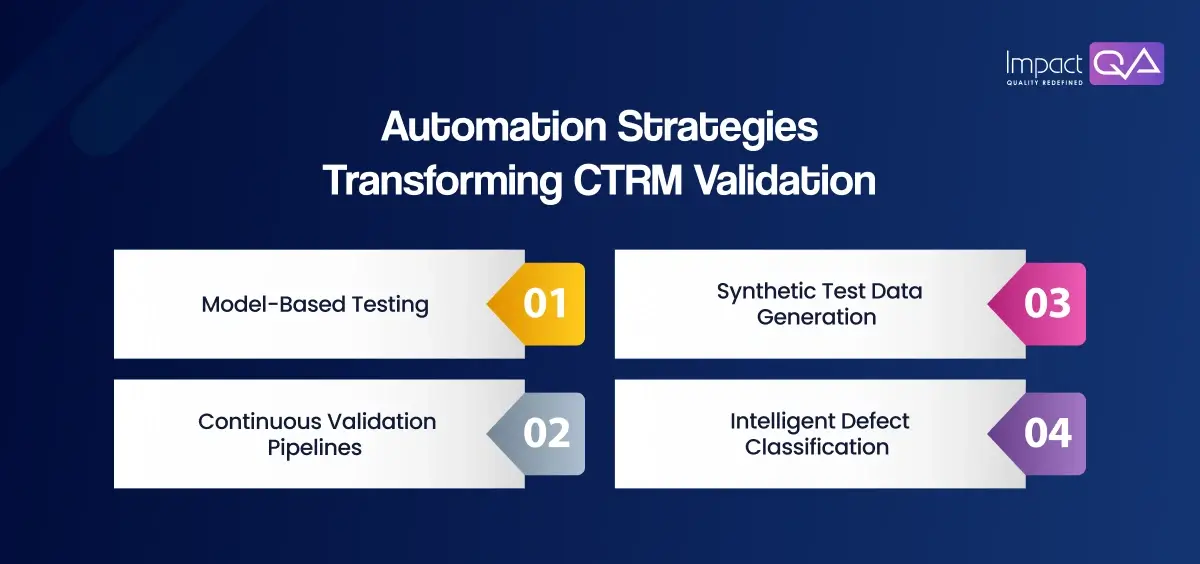
Several emerging strategies are reshaping testing practices across CTRM Software environments.
Model-Based Testing
Business process models can automatically generate extensive testing scenarios covering trade lifecycles, settlements, nominations, scheduling activities, inventory management, and accounting workflows. This improves test coverage while reducing dependency on manually written test cases.
Synthetic Test Data Generation
Commodity trading systems often require large volumes of realistic market, pricing, and transaction data. Intelligent automation platforms can generate representative datasets that closely mirror production conditions without exposing sensitive information. This allows teams to validate business scenarios more effectively.
Continuous Validation Pipelines
Automated validation embedded within CI/CD pipelines allows organizations to verify business functionality, integrations, calculations, and performance continuously. This approach helps identify defects earlier while reducing bottlenecks across development and testing activities.
Intelligent Defect Classification
AI-assisted defect analysis can categorize failures, identify probable root causes, and recommend remediation actions. Investigation cycles become shorter, which enables faster resolution of business-critical issues.
Preparing for the Future of CTRM Testing
The transition toward autonomous quality engineering requires more than technology investments. Organizations must establish testing strategies that align with business objectives, operational priorities, and risk management requirements. Success depends on combining advanced technologies with strong domain expertise.
Several considerations deserve attention:
Build Domain-Aware Testing Models
AI systems produce stronger results when trained on commodity-specific business rules, trading workflows, pricing methodologies, settlement calculations, and inventory processes rather than generic application data.
Integrate Risk Intelligence Across Testing Activities
Quality decisions should incorporate trading exposure, financial impact, compliance considerations, and operational dependencies rather than focusing solely on defect counts or execution metrics.
Combine Human Expertise with Machine Intelligence
While automation can accelerate validation efforts, experienced domain specialists remain essential for interpreting complex business outcomes, validating trading logic, and assessing regulatory implications.
Create Scalable Quality Architectures
Future testing frameworks should support cloud platforms, advanced analytics, API ecosystems, and emerging AI-enabled trading capabilities without extensive redesign efforts. Scalability will become increasingly important as trading organizations continue to expand digital initiatives.
At ImpactQA, we help commodity trading firms improve quality through autonomous QA and intelligent automation.
Conclusion
The future of CTRM implementation and testing is increasingly centered on intelligent quality engineering. Autonomous QA, AI-driven risk analytics, and intelligent automation enable organizations to identify quality concerns earlier, focus validation efforts on high-impact business processes, and manage growing system complexity with greater precision. As CTRM environments expand across cloud, analytics, and integrated trading ecosystems, quality strategies must become more adaptive and data-driven.
At ImpactQA, we support this transition through specialized implementation, upgrade, and support services for RightAngle, Openlink Endur, Allegro, and SAP Commodity Management platforms. We combine deep domain expertise with advanced testing approaches to help organizations strengthen CTRM Software operations, modernize CTRM software solutions, and improve quality outcomes across complex commodity trading environments.
Share this post


Related Posts
Our Case Studies