Quick Summary:
Deploying intelligent algorithms at scale requires rigorous compliance and unyielding consumer trust. This article examines how ethical AI frameworks mitigate algorithmic bias, secure sensitive data, and ensure regulatory alignment. By integrating advanced validation mechanisms, US enterprises convert compliance burdens into competitive advantages, securing system transparency and long-term operational integrity through robust quality engineering.
Table of Contents:
- Introduction
- Addressing Key Compliance Challenges and Algorithmic Risks
- Strategic Components of Ethical Corporate Governance
- Operationalizing Compliance via Advanced Technical Validation
- Strategic Benefits of Principled Enterprise Automation
- Conclusion
The rapid integration of autonomous algorithms into enterprise workflows introduces unprecedented compliance challenges and systemic risks. With domestic oversight intensifying and federal standards shifting, organizations must move beyond basic deployment and adopt comprehensive ethical AI frameworks. These governance blueprints are necessary to verify that autonomous systems operate without bias, protect data privacy, and maintain absolute algorithmic transparency.
Consequently, modern businesses must prioritize structured governance to protect their brand equity and ensure continuous operational continuity. Merging ethical principles with rigorous technical validation allows organizations to systematically eliminate algorithmic drift and compliance gaps. This proactive approach transforms risk management into a core business asset, ensuring that all deployed models remain auditable, dependable, and fully aligned with legal requirements.
ImpactQA applies advanced AI testing services to eliminate algorithmic bias and accelerate compliant releases.
Addressing Key Compliance Challenges and Algorithmic Risks
Deploying autonomous systems across enterprise environments exposes organizations to a complex web of legal mandates and deep-seated technical vulnerabilities. A primary challenge stems from data bias, where historical data skews machine learning models, causing discriminatory outcomes in automated lending, hiring, or predictive analytics. When a model mirrors systemic inequities, it exposes the business to massive regulatory penalties and permanent reputational damage. Additionally, the lack of visibility into deep neural networks creates a black-box problem, making it incredibly difficult for risk teams to explain specific automated outcomes to regulatory auditors.
Data privacy compliance represents another critical operational barrier, particularly under strict consumer protection frameworks like CCPA. Advanced models often process vast amounts of personally identifiable information (PII), increasing the risk of data leakage or unauthorized data ingestion during training phases. Furthermore, enterprises frequently struggle with model drift, where an algorithm’s real-world accuracy degrades over time due to changing market conditions and shifts in production data. Without continuous, structured monitoring, these undetected deviations can quietly breach compliance boundaries, leaving the organization exposed to significant legal liabilities.
To navigate these complex risks safely, organizations must adopt a specialized ethical AI framework. This structured approach helps compliance teams systematically evaluate model behavior against strict legal and ethical benchmarks. Implementing these guidelines ensures that algorithmic transparency is maintained across all departments, preventing unverified code from reaching production environments. Building this structured foundation allows enterprises to mitigate operational risks early, transforming compliance from a reactive burden into a predictable, repeatable process.
Strategic Components of Ethical Corporate Governance
A robust ethical governance architecture relies on several interconnected components working together to maintain continuous compliance and system trust. First, explainability must be integrated directly into the core design of the system. Utilizing specialized performance analysis protocols allows data teams to break down complex neural networks into clear, auditable decision points. This level of clarity ensures that internal auditors and external regulators can easily verify exactly why a model reached a specific conclusion.
Second, strict data security and privacy controls must be applied at every step of the data engineering pipeline. Organizations should employ advanced anonymization techniques, differential privacy, and secure synthetic data generation to protect sensitive user information during model training. Restricting data ingestion to cleared, compliant datasets prevents unauthorized PII leakage and protects the enterprise from costly regulatory infractions. Additionally, clear data lineage logs must be maintained to track the origin, transformation, and utilization of all corporate data assets.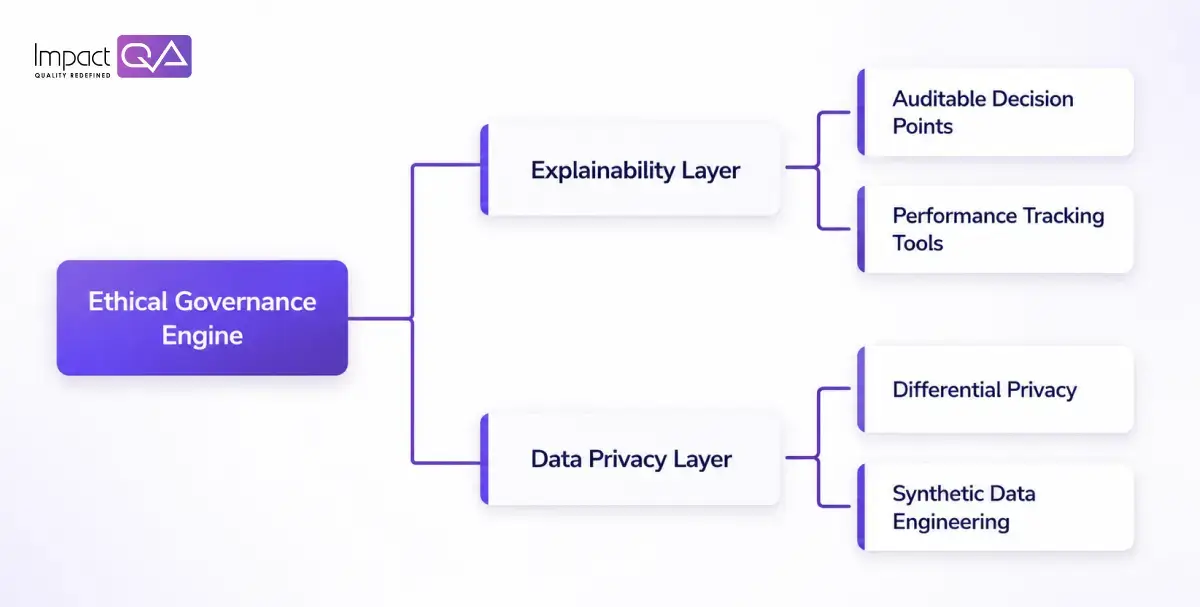
Finally, continuous bias detection and mitigation systems must be deployed directly into production pipelines. These automated systems constantly evaluate model inputs and outputs against pre-defined fairness metrics, such as disparate impact ratios and equalized odds. If an algorithmic deviation or bias spike is detected, the governance engine triggers immediate alerts or automatically routes traffic back to a safe fallback model. This continuous loop of automated oversight keeps corporate algorithms completely aligned with both internal ethical standards and external legal mandates.
Operationalizing Compliance via Advanced Technical Validation
Translating abstract ethical principles into practical enterprise workflows requires a heavy emphasis on specialized technical validation and rigorous testing. This is where comprehensive AI testing becomes indispensable, providing the objective data needed to verify that models are safe, fair, and reliable. Applying structured testing protocols across the entire software lifecycle allows engineering teams to catch edge cases, security flaws, and biased outputs before they reach production. This systematic validation bridges the gap between high-level compliance policies and daily engineering execution.
Modern enterprise architectures increasingly rely on specialized AI testing services to evaluate complex, multi-layered intelligent applications. These advanced validation protocols thoroughly inspect model behavior under stressful, adversarial conditions to ensure the system cannot be manipulated into generating harmful or non-compliant outputs. For organizations deploying large language models, structured LLM testing is vital for identifying hallucinations, preventing prompt injections, and verifying that generated responses remain within approved corporate and legal guardrails. Similarly, dedicated chatbot testing ensures that customer-facing conversational interfaces consistently deliver accurate information without exposing sensitive data.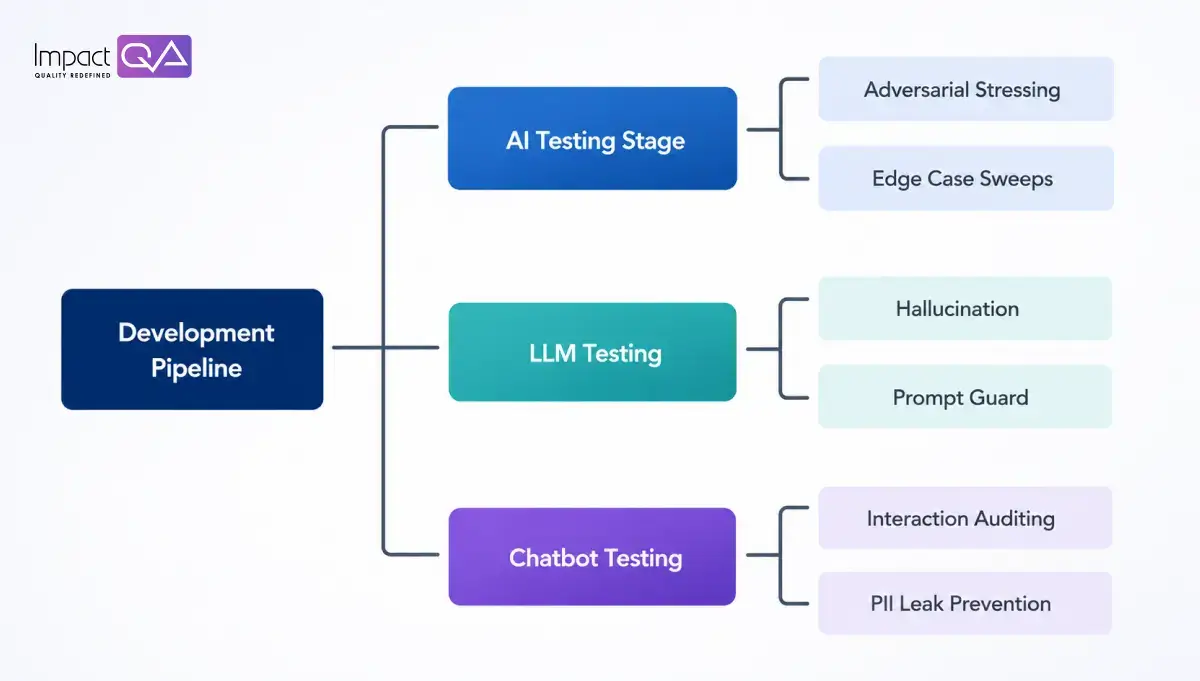
Furthermore, as businesses transition toward autonomous operations, deploying an AI testing solution becomes essential for validating dynamic workflows. These automated validation platforms run thousands of synthetic scenarios to check system boundaries, ensuring that automated tasks remain compliant even when processing unstructured data. Integrating these structured testing pipelines directly into CI/CD environments allows enterprise development teams to deploy intelligent software with total confidence, knowing every model has been thoroughly vetted against strict compliance and performance benchmarks.
Strategic Benefits of Principled Enterprise Automation
Adopting a comprehensive ethical framework yields substantial long-term benefits that extend far beyond simply avoiding regulatory penalties. A primary advantage is the significant reduction in systemic risk across all automated operations. By standardizing validation protocols, organizations protect themselves from unexpected system failures and biased algorithmic decisions that could lead to discrimination lawsuits. This disciplined approach establishes a predictable, auditable deployment pipeline that minimizes costly post-production fixes and avoids embarrassing public controversies.
Key Long-Term Corporate Benefits:
Continuous Regulatory Alignment: Automating compliance tracking ensures models dynamically adapt to new geographic and structural rules without requiring a complete system overhaul.
Algorithmic Asset Verification: Vetting software through rigorous AI and software testing pathways builds clean, auditable code bases that increase corporate evaluation metrics.
Stakeholder Value Generation: Demonstrating verifiable mathematical fairness satisfies stringent environmental, social, and corporate governance compliance demands, drawing institutional investment.
Additionally, a structured approach to compliance dramatically improves overall operational agility. When an enterprise builds its systems around a clear ethical architecture, adapting to new state regulations or updated privacy laws becomes a straightforward configuration task rather than a chaotic re-engineering crisis. This long-term scalability allows forward-thinking organizations to outpace less-prepared competitors, expanding their footprint across markets with minimal friction.
ImpactQA implements robust ethical AI frameworks to protect data privacy and streamline continuous compliance.
Conclusion
Achieving true algorithmic integrity requires moving past static check-box audits and implementing continuous monitoring across live enterprise platforms. Because machine learning models are non-deterministic, maintaining data transparency and verifying parity requires dynamic baseline tracking rather than rigid testing. Forward-looking organizations must deploy automated statistical frameworks directly into production pipelines to catch minor operational drift or creeping data bias before escalating into compliance failures. Integrating this proactive oversight allows companies to convert regulatory liabilities into valuable corporate assets, establishing customer trust, and maintaining a completely verifiable system footprint.
Operationalizing these sophisticated governance controls requires a highly disciplined engineering approach backed by specialized industry expertise. ImpactQA addresses these critical security needs by providing advanced, specialized AI system testing & assurance services that are custom-tailored, to protect complex enterprise workflows. Our global validation teams deliver targeted risk-reduction strategies that eliminate model discrepancies, ensure absolute data privacy, and keep corporate automated operations fully aligned with shifting regulatory frameworks.
Share this post


Related Posts
Our Case Studies