AI-Powered Mobile Test Automation: Ensuring Real-World App Performance in 2026

Quick Summary:
Mobile application failures are increasingly driven by unstable automation, fragmented device ecosystems, inconsistent network validation, and delayed defect detection rather than isolated functional defects. This blog explores how intelligent mobile automation frameworks in 2026 are improving release reliability through adaptive execution, predictive validation, autonomous maintenance, and real-world performance analysis across modern enterprise mobile environments.
Table of Contents:
- Introduction
- Why Conventional Mobile Testing Models Are Failing
- Core Technologies Reshaping Intelligent Mobile Automation
- Major Challenges Enterprises Face During AI Adoption
- Best Practices for Scalable AI-Driven Mobile Validation
- Business Advantages of Intelligent Mobile Test Automation
- Final Say
What happens when mobile applications begin evolving faster than testing cycles can respond? In 2026, enterprises are releasing mobile applications across increasingly complex digital ecosystems where dynamic mobile environment variables continuously influence application behavior and performance. Traditional automation frameworks are struggling to keep pace with this level of change, particularly when applications must deliver stable functionality, seamless responsiveness, and consistent user experiences across highly dynamic environments.
This shift is accelerating the adoption of AI in software testing as enterprises move toward more intelligent and adaptive validation models. AI testing services now support intelligent test execution, predictive validation, chatbot testing, and adaptive automation across dynamic mobile ecosystems. At the same time, AI automation agents and agentic AI services are enabling more responsive and scalable quality engineering strategies that continuously adapt alongside evolving application behavior.
ImpactQA combines predictive testing and intelligent automation to improve the efficiency of mobile testing.
Why Conventional Mobile Testing Models Are Failing
Modern mobile ecosystems generate significantly higher execution complexity than conventional automation frameworks were originally designed to manage. Frequent UI modifications, dynamic backend integrations, fragmented device environments, and unstable network conditions continuously affect application behavior and validation accuracy.
Script Instability During Frequent Updates
Traditional automation frameworks depend heavily on static object identifiers and predefined execution flows. Even small interface modifications can break multiple scripts simultaneously, increasing maintenance effort and slowing regression execution across continuous delivery environments.
Limited Real-World Device Validation
Most conventional frameworks validate applications only across selected device combinations and controlled environments. This creates major gaps in production readiness because real-world users operate applications under varying device capabilities, operating systems, and connectivity conditions.
Delayed Identification of High-Risk Defects
Static automation systems execute predefined scenarios without analyzing execution trends or behavioral risk patterns. As a result, critical defects often remain undetected until advanced delivery stages or post-production environments, which increases operational and reputational risks.
Reduced Automation Scalability
As mobile ecosystems expand, conventional automation frameworks struggle to manage execution consistency across distributed cloud environments, large regression suites, and continuously changing application architectures, leading to unstable release cycles and execution bottlenecks.
Core Technologies Reshaping Intelligent Mobile Automation
Intelligent automation frameworks are reshaping mobile testing by enabling validation systems that respond dynamically to evolving application environments and execution conditions. Instead of relying on static automation scripts, enterprises are adopting AI-driven testing models that support adaptive validation, continuous execution intelligence, and scalable testing across rapidly evolving mobile release cycles.
Self-Healing Automation Frameworks
Self-healing automation systems automatically identify modified interface elements and adjust execution paths dynamically. This reduces script maintenance effort significantly while improving execution continuity across rapidly changing mobile application environments.
Predictive Defect Analytics
Modern AI testing solution frameworks analyze historical defects, execution behavior, and production incidents to identify high-risk modules before deployment. This enables testing teams to prioritize validation efforts based on operational impact and release risk.
Intelligent Visual Validation
Advanced automation platforms now validate rendering consistency, layout behavior, accessibility alignment, and responsive interface performance across diverse mobile devices without depending entirely on static object recognition methods.
Autonomous Execution Optimization
AI agents for automation continuously monitor execution performance, identify unstable workflows, optimize test prioritization, and improve validation efficiency across distributed testing infrastructures with minimal manual intervention.
Conversational Interface Validation
Enterprises implementing virtual assistants and conversational platforms are increasingly adopting chatbot testing practices to validate multilingual interactions, response consistency, intent recognition accuracy, and conversational reliability across mobile applications.
Major Challenges Enterprises Face During AI Adoption
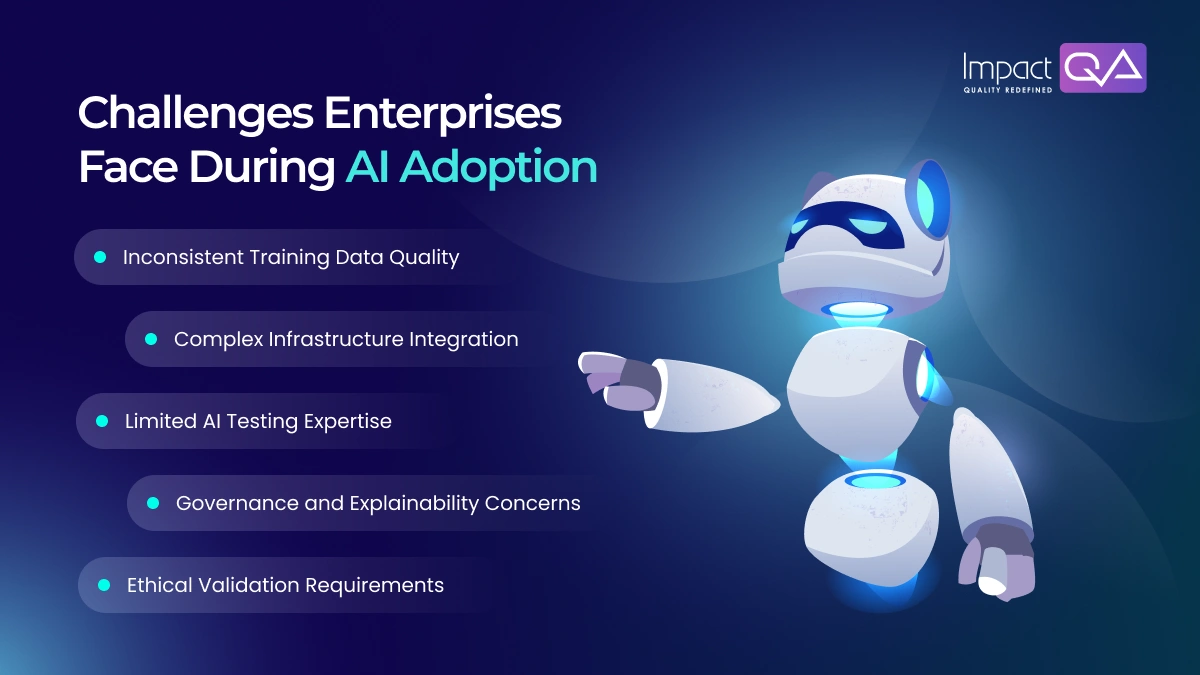
Although intelligent automation frameworks deliver measurable operational improvements, enterprises often face implementation challenges involving infrastructure alignment, governance, execution transparency, and data management during large-scale adoption initiatives.
Inconsistent Training Data Quality
Predictive testing models rely heavily on structured execution histories, defect repositories, and behavioral datasets. Incomplete or inconsistent data reduces analytical accuracy and weakens the effectiveness of intelligent validation systems.
Complex Infrastructure Integration
Modern mobile ecosystems involve APIs, cloud-native services, distributed architectures, and continuous delivery pipelines. Integrating intelligent testing frameworks across these interconnected systems requires significant planning and execution governance.
Limited AI Testing Expertise
Traditional testing teams may lack expertise in predictive analytics, intelligent execution analysis, and machine learning-driven validation approaches. This creates operational delays during implementation and long-term automation optimization initiatives.
Governance and Explainability Concerns
Enterprises within regulated industries require greater transparency across intelligent testing workflows. Organizations increasingly need clear visibility into execution decisions, defect prioritization logic, and AI-driven testing recommendations to support governance and compliance requirements.
Ethical Validation Requirements
Organizations implementing AI-driven applications are increasingly adopting ethical AI framework practices to validate fairness, transparency, accountability, and bias control within intelligent systems affecting critical customer-facing operations.
Best Practices for Scalable AI-Driven Mobile Validation
Successful implementation of intelligent automation requires structured execution models, continuous optimization strategies, and governance-focused validation frameworks aligned with long-term enterprise delivery objectives.
Prioritize Risk-Based Validation
Organizations should prioritize testing workflows based on business-critical transactions, historical defect patterns, production traffic behavior, and operational impact instead of executing all regression scenarios uniformly during every release cycle.
Simulate Real-World Usage Conditions
Testing environments should replicate unstable connectivity, regional device diversity, fluctuating latency, battery consumption behavior, and unpredictable user interaction patterns to improve real-world application validation accuracy.
Strengthen Cross-Functional Collaboration
Developers, testers, DevOps engineers, and business stakeholders should maintain aligned execution visibility across release pipelines to reduce communication gaps, accelerate issue resolution, and improve delivery coordination efficiency.
Continuously Optimize Automation Assets
Enterprises should regularly remove obsolete scripts, monitor execution stability trends, and improve validation coverage through intelligent analytics capable of identifying weak automation areas and recurring execution failures.
Establish Controlled Autonomous Execution
Organizations adopting AI automation agents should implement governance mechanisms that maintain execution transparency, approval controls, and operational accountability during high-risk production releases and compliance-sensitive deployments.
ImpactQA helps enterprises strengthen quality engineering through AI-driven automation.
Business Advantages of Intelligent Mobile Test Automation
The business impact of intelligent mobile automation extends beyond execution efficiency. Enterprises are increasingly adopting adaptive validation frameworks to strengthen scalability stability and long-term mobile application reliability.
Faster and More Stable Release Cycles
Self-adaptive automation frameworks reduce execution instability and regression maintenance overhead. This enables enterprises to accelerate release timelines while maintaining stronger validation consistency across continuous delivery pipelines.
Lower Production Defect Leakage
Predictive analytics and intelligent execution prioritization help identify high-risk defects earlier within testing cycles. This reduces production incidents, remediation complexity, and operational disruptions caused by late-stage validation failures.
Improved User Experience Consistency
Real-world performance validation strengthens application responsiveness, rendering stability, accessibility alignment, and interaction reliability across varying devices, operating systems, and network conditions used by mobile customers.
Reduced Long-Term Operational Costs
AI testing services reduce repetitive manual intervention, automation maintenance effort, and execution inefficiencies. This allows quality engineering teams to focus more on strategic validation and performance optimization initiatives.
Better Scalability Across Enterprise Ecosystems
Agentic AI services improve automation scalability across distributed environments by supporting autonomous execution management, intelligent reporting, and continuous optimization within large enterprise mobile application portfolios.
Final Say
The next phase of mobile quality engineering will be shaped by systems that can independently interpret application behavior, detect unstable execution patterns, and respond to product changes without constant human intervention. As mobile platforms become more integrated with AI-driven personalization, connected devices, real-time analytics, and autonomous workflows, testing will gradually shift from scheduled validation cycles to continuous intelligence-led monitoring. Enterprises that continue depending heavily on static automation models may struggle to manage the speed, scale, and behavioral complexity of future mobile ecosystems.
ImpactQA helps enterprises prepare for this transition through specialized AI testing services focused on intelligent and adaptive mobile quality engineering strategies. Our approach combines domain-focused testing expertise with advanced automation intelligence to support high-frequency release environments and large-scale mobile ecosystems. This enables enterprises to strengthen performance consistency and implement smarter validation strategies across modern digital applications.
Share this post


Related Posts
Our Case Studies