How Can SAP Security Testing Protect Your Data and Compliance Needs

Quick Summary:
SAP systems manage high-value enterprise data, making security validation non-negotiable. This blog highlights how SAP security testing strengthens your defense against data breaches, supports compliance requirements, and effectively manages access risks across critical systems. It also outlines structured approaches, real challenges, and practical strategies that strengthen system integrity. With the right SAP testing strategy and services, organizations can move from reactive fixes to controlled, audit-ready security assurance across complex SAP environments.
Table of Contents:
- Introduction
- Why SAP Security Testing Is Critical for Enterprise Risk Control
- Key Challenges in SAP Security Testing and Compliance
- Core Components of an Effective SAP Security Testing Strategy
- Best Practices and Measurable Benefits of SAP Security Testing
- Conclusion
Enterprise systems such as SAP operate at the core of financial reporting, procurement, supply chain, and HR operations. This centralization makes them a high-value target for security threats and compliance scrutiny. While organizations invest in functional validation through SAP testing, security gaps often remain undetected until audits or incidents expose them. This creates operational and regulatory risks that are difficult to reverse.
A structured approach to SAP application security testing shifts the focus from reactive fixes to proactive validation. It evaluates user roles, access controls, configurations, and vulnerabilities before they affect business operations. By integrating security testing into SAP’s regular validation cycles, organizations gain better control over sensitive data, ensure alignment with compliance requirements, and reduce exposure across interconnected systems.
ImpactQA combines SAP testing solutions with deep domain expertise.
Why SAP Security Testing Is Critical for Enterprise Risk Control
SAP environments support critical business processes, which means even a minor security misconfiguration can lead to data exposure or compliance violations. Unlike traditional systems, SAP requires specialized validation due to its complex role-based access structure and tightly integrated modules. This is where SAP security testing becomes essential, as it identifies risks that standard SAP testing may overlook.
Security testing in SAP focuses on validating user roles, segregation of duties (SoD), and authorization controls. These areas directly impact how users interact with financial data, procurement workflows, and reporting systems. Without proper validation, unauthorized access can go unnoticed, leading to fraud risks or audit failures.
Key aspects that make SAP security testing indispensable:
- Segregation of Duties (SoD) Validation: Ensures that no single user has conflicting access rights. For example, preventing users from creating and approving payments reduces fraud risk and strengthens audit readiness.
- Role and Authorization Testing: Evaluates whether users have the required access. Excess permissions often accumulate over time, which increases exposure to data misuse or accidental changes in critical systems.
- Configuration and Patch Validation: Identifies vulnerabilities caused by outdated configurations or missed patches. Regular SAP application security testing ensures that system updates do not introduce new risks.
- Compliance Alignment Checks: Maps system access and controls against regulatory frameworks. This reduces the effort required during audits and ensures continuous compliance rather than last-minute corrections.
An effective SAP security testing strategy integrates these validations into the broader SAP testing solutions lifecycle. Instead of treating security as a separate activity, it becomes part of release validation, reducing risk at every stage. This approach allows organizations to maintain system integrity while supporting faster deployments.
Key Challenges in SAP Security Testing and Compliance
Despite its importance, SAP security testing comes with several operational and technical challenges. These challenges often delay implementation or limit the effectiveness of testing efforts. Understanding these barriers is the first step toward building a reliable SAP security testing strategy.
One of the primary challenges is the complexity of SAP systems. With multiple modules and thousands of authorization objects, identifying risk combinations becomes difficult. Traditional SAP testing services may not always address these complexities, especially when security validation requires deep domain expertise.
Major challenges organizations face:
- Complex Role Structures: SAP environments often have layered roles with inherited permissions. This makes it difficult to identify conflicting access combinations without specialized tools and expertise.
- Frequent System Changes: SAP systems undergo continuous updates, including patches and enhancements. Each change can introduce new vulnerabilities, making consistent security testing in SAP a demanding process.
- Limited Visibility Across Modules: Security risks often span across modules such as finance, logistics, and HR. Without integrated SAP testing solutions, these cross-functional risks may remain undetected.
- Audit Pressure and Compliance Deadlines: Organizations often rush security validation before audits. This reactive approach increases the likelihood of missing critical issues and creates last-minute remediation efforts.
- Skill Gaps in Security Testing: SAP application security testing requires specialized knowledge of authorization concepts, compliance frameworks, and system configurations. Many teams lack this combined expertise.
These challenges highlight the need for structured SAP testing services that go beyond functional validation. By adopting a proactive SAP security testing strategy, organizations can address these issues systematically, ensuring continuous monitoring instead of periodic checks.
Core Components of an Effective SAP Security Testing Strategy
A well-defined SAP security testing strategy provides a structured approach to identifying and mitigating risks. It ensures that security validation is consistent, repeatable, and aligned with business objectives. Instead of isolated testing efforts, it integrates security into the broader SAP testing lifecycle.
The foundation of an effective strategy lies in combining automation, risk-based testing, and continuous monitoring. This approach improves coverage while reducing manual effort, making SAP testing solutions more efficient and reliable.
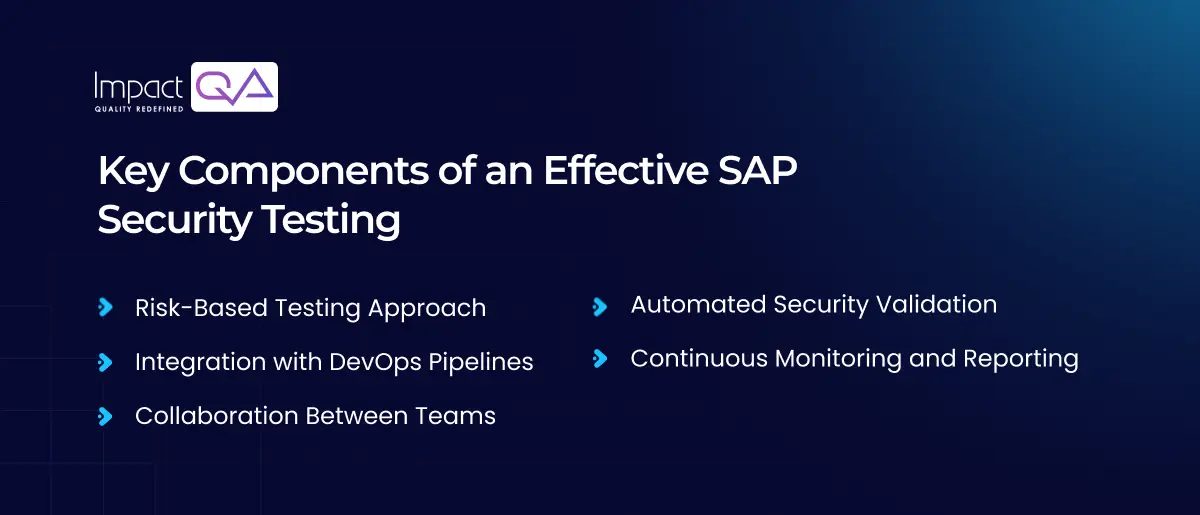
Essential components of a strong SAP security testing strategy:
- Risk-Based Testing Approach: Prioritizes testing based on business impact. Critical processes such as financial transactions and user access controls receive focused validation to ensure that high-risk areas are addressed first.
- Automated Security Validation: Uses tools to identify SoD conflicts, access violations, and configuration issues. Automation improves accuracy and reduces the time required for repetitive security checks.
- Integration with DevOps Pipelines: Embeds SAP application security testing into release cycles. This ensures that every update is validated before deployment and helps reduce the risk of introducing vulnerabilities.
- Continuous Monitoring and Reporting: Tracks security metrics and provides real-time insights into system risks. This helps organizations respond quickly to potential threats and maintain compliance readiness.
- Collaboration Between Teams: Aligns security, QA, and business teams to ensure that testing covers both technical and functional aspects. This integrated approach improves the effectiveness of SAP testing services.
Best Practices and Measurable Benefits of SAP Security Testing
Implementing SAP security testing effectively requires adherence to proven best practices. These practices ensure that testing efforts deliver measurable results and align with business goals. When combined with the right SAP testing solutions, they create a strong foundation for secure and compliant SAP operations.
A disciplined approach to security testing in SAP helps organizations achieve better control over access, reduce vulnerabilities, and maintain compliance across all modules.
Best Practices for Effective SAP Security Testing:
- Regular Role Reviews and Cleanup: Conduct periodic reviews of user roles to remove unnecessary access. This reduces the risk of privilege misuse and keeps authorization structures aligned with business needs.
- Shift-Left Security Testing: Introduce SAP application security testing early in the development cycle. Identifying issues at an early stage reduces remediation costs and prevents risks from reaching production systems.
- Use of Standardized Testing Frameworks: Apply consistent methodologies across all SAP testing services. This ensures uniform validation and simplifies audit processes.
- Comprehensive Documentation: Maintain detailed records of testing activities, findings, and remediation steps. This supports compliance requirements and improves transparency during audits.
- Continuous Improvement and Feedback Loops: Use insights from testing to refine processes and strategies. This ensures that the SAP security testing strategy evolves with system changes and emerging risks.
Key Benefits Organizations Can Achieve:
1. Enhanced Data Security and Access Integrity: Granular access controls combined with continuous vulnerability assessments strengthen overall system security. As a result, unauthorized activities are restricted, and sensitive enterprise data remains protected.
2. Sustained Compliance and Audit Readiness: Ongoing evaluation of configurations, user roles, and security policies keeps systems aligned with regulatory expectations. This approach reduces audit findings and lowers the risk of compliance penalties.
3. Higher System Resilience and Business Continuity: Early visibility into security gaps allows faster remediation across the system lifecycle. This helps avoid disruptions and supports the consistent execution of critical SAP operations.
4. Reduced Security Overheads and Risk Exposure: A proactive testing approach across SAP environments limits the likelihood of major incidents. Over time, this reduces remediation costs and minimizes the financial impact of potential breaches or downtime.
ImpactQA ensures controlled, audit-ready SAP systems.
Conclusion
SAP environments are no longer static systems operating within defined boundaries. They are continuously expanding with cloud integrations, APIs, and real-time data exchanges. This shift demands a security testing approach that is not periodic, but continuous, intelligent, and deeply integrated into every stage of the SAP lifecycle. Organizations that invest in advanced SAP security testing today are better positioned to anticipate threats, adapt to evolving compliance demands, and maintain control over increasingly complex access and risk structures.
At ImpactQA, we approach SAP security testing as an ongoing engineering discipline rather than a one-time validation effort. We combine deep domain expertise with advanced SAP testing solutions to embed security across development, integration, and production environments. Our focus is on enabling continuous risk visibility, strengthening access governance, and ensuring compliance readiness at scale. By aligning our SAP testing services with evolving enterprise needs, we help organizations stay secure, resilient, and prepared for what comes next.
Share this post


Related Posts
Our Case Studies