Choosing the Right Functional Testing Solutions Provider for Enterprise Success
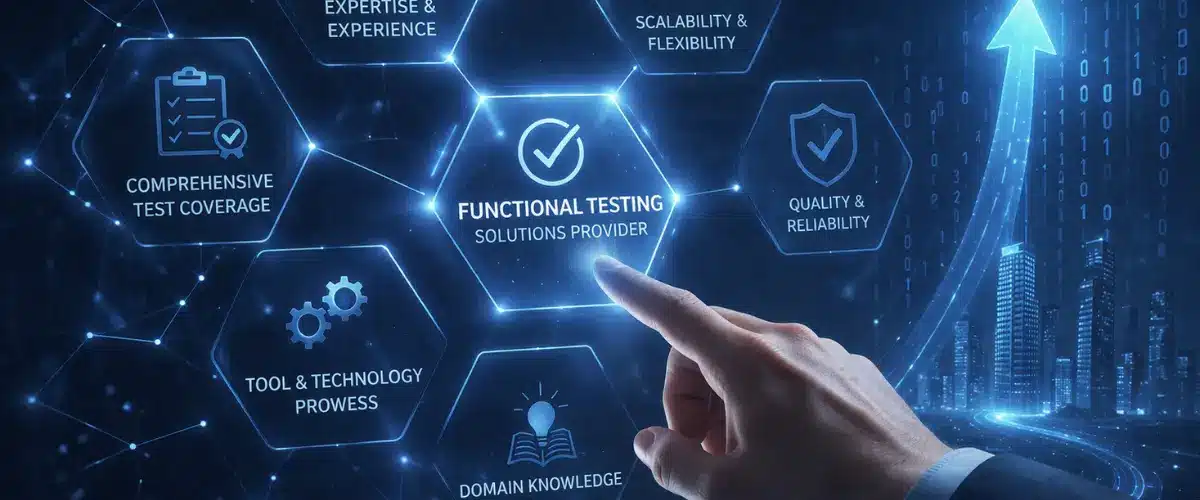
Quick Summary:
Selecting the right functional testing partner has a direct impact on how enterprise systems perform under real business conditions. A capable provider ensures accurate validation of workflows, integrations, and user journeys while supporting continuous delivery cycles. This blog outlines how enterprises can evaluate functional testing services, identify capability gaps, and implement structured validation approaches that reduce functional risks and strengthen system reliability.
Table of Contents:
- Introduction
- The Expanding Scope of Functional Testing in Enterprises
- Critical Factors That Define a Strong Testing Partner
- Common Gaps That Indicate a Weak Testing Partner
- Measurable Outcomes of a Well-Aligned Testing Provider
- A Practical Model for Implementing Functional Testing
- Final Thought
Enterprise systems operate through tightly connected applications where each function contributes to a larger workflow. A minor defect in one module can disrupt multiple dependent processes, affecting operations and decision-making. This is why functional testing services have become a core validation layer rather than a supporting activity in enterprise environments.
Selecting the right provider for software functional testing services requires a balance between execution depth and strategic alignment. Enterprises must rely on teams that combine manual functional testing services with automated functional testing services to ensure both accuracy and repeatability. Well-structured functional QA testing services help maintain release discipline and reduce functional risks across complex systems.
ImpactQA delivers advanced functional testing services to improve release reliability.
The Expanding Scope of Functional Testing in Enterprises
Enterprise systems now demand validation that extends beyond isolated features to interconnected workflows, integrations, and real-world execution conditions. Functional testing must reflect how applications operate across complex environments and dependencies.
The following aspects define how functional testing services are expanding in scope and execution:
End-to-End Workflow Validation: Functional testing services must validate complete business processes across interconnected systems. Software functional testing services should ensure that each transaction flows correctly to maintain data consistency and operational accuracy across modules.
Integration-Centric Validation: Enterprise systems rely heavily on APIs and third-party integrations. Functional QA testing services must verify these interactions to ensure that data exchange and system dependencies function correctly under varying conditions.
Role of Manual Testing in Complex Systems: Manual functional testing services provide critical insight into user behavior and workflow execution. They help identify logical inconsistencies and usability gaps that automated scripts may not be able to capture effectively.
Automation for Scale and Consistency: Automated functional testing services enable repeated execution of regression scenarios across environments. This improves testing speed and consistency while supporting large-scale validation efforts within enterprise systems.
Continuous Validation Across Releases: Functional testing services must align with continuous delivery cycles. Ongoing validation ensures that defects are detected early to prevent accumulation and reduce the risk of disruptions during deployment.
Critical Factors That Define a Strong Testing Partner
Selecting the right testing partner requires evaluating how well they align validation with business workflows, system complexity, and release expectations. Execution capability alone is not sufficient without structured and scalable testing practices.
The following factors help determine the effectiveness of a functional testing solutions provider:
Business Workflow Understanding: The provider must map test scenarios to real operational processes. Software functional testing services should reflect how systems are used in practice, ensuring that validation aligns with actual business execution.
Structured Testing Methodology: Functional QA testing services should follow a defined lifecycle that includes requirement mapping, test design, execution, and reporting. This structure ensures consistency and traceability across multiple releases.
Strength in Manual Testing: Manual functional testing services should focus on exploratory and scenario-based validation. This approach allows testers to evaluate workflows dynamically and identify issues beyond predefined test cases.
Automation Capability and Scalability: Automated functional testing services must support regression testing at scale. A strong provider builds frameworks that are maintainable and adaptable to evolving application requirements.
Use of Functional Test Automation Solutions: The provider should implement functional test automation solutions that integrate with development pipelines. This ensures continuous validation while maintaining efficiency across testing cycles.
Actionable Reporting and Insights: Functional QA testing services must deliver clear and meaningful insights. Reports should highlight defect trends, risk areas, and validation status to support informed release decisions.
Common Gaps That Indicate a Weak Testing Partner
Ineffective testing practices often result in incomplete validation, delayed defect detection, and increased production risks. Identifying these gaps early helps enterprises avoid disruptions and maintain consistent system performance.
The following indicators reveal limitations in functional testing services and execution quality:
Limited Business Scenario Coverage: Functional testing services that focus only on primary workflows often miss critical edge cases. Software functional testing services must include exception handling to ensure comprehensive validation.
Overdependence on Automation: Automated functional testing services without strategic planning can lead to gaps in validation. Manual functional testing services remain essential for identifying usability and logical issues.
Inconsistent Test Design: Functional QA testing services that lack structured test design fail to ensure traceability. This results in incomplete validation and increases the risk of defects going undetected.
Weak Integration Validation: Functional testing services that overlook system interactions create risks in interconnected environments. Proper validation of APIs and third-party integrations is essential for system stability.
Lack of Continuous Improvement: Testing approaches that do not evolve based on defect analysis limit effectiveness. Functional QA testing services must incorporate feedback loops to refine strategies over time.
Measurable Outcomes of a Well-Aligned Testing Provider
A well-aligned testing provider establishes structured validation across complex workflows, ensuring that business logic, integrations, and data dependencies are consistently verified before release. This approach strengthens control over execution accuracy and minimizes inconsistencies across systems.
The following outcomes demonstrate how effective functional testing services translate validation efforts into measurable enterprise impact:
Improved Release Confidence: Functional testing services ensure that applications are validated thoroughly before deployment. This reduces uncertainty and allows enterprises to release updates with greater control and predictability.
Higher Functional Accuracy: Software functional testing services validate workflows against business requirements. This ensures that applications behave correctly and maintain consistency across different operational scenarios.
Efficient Testing Cycles: Automated functional testing services reduce the time required for regression testing. Manual functional testing services complement this by focusing on complex scenarios, improving overall efficiency.
Reduced Production Risks: Functional QA testing services identify defects early in the development cycle. This minimizes the likelihood of critical issues appearing in production environments.
Scalable Testing Frameworks: Functional testing services designed for scalability to support enterprise growth. They ensure that testing processes remain consistent and adaptable as systems expand.
A Practical Model for Implementing Functional Testing
A structured implementation approach ensures that functional testing services deliver consistent and measurable outcomes. It enables enterprises to align testing with system complexity and evolving business requirements.
The following steps outline a practical model for implementing effective functional testing:
Define Testing Scope Clearly: Functional testing services should begin with identifying critical workflows and system dependencies. This ensures that testing efforts are focused on high-impact areas of the application.
Design a Balanced Testing Strategy: Software functional testing services must combine manual functional testing services with automated functional testing services. This balance ensures both depth and efficiency in validation.
Execute Across Environments: Functional QA testing services should validate applications across multiple environments. This helps identify issues that may arise due to configuration or integration differences.
Monitor and Optimize Continuously: Functional testing services must evolve through continuous analysis of defects and performance. This helps improve test coverage and ensures long-term effectiveness.
ImpactQA offers structured functional QA testing services for complex enterprise systems.
Final Thought
Selecting a partner for functional testing services requires a clear assessment of how effectively they validate business logic across interconnected systems, not just individual features. Enterprises must prioritize providers that ensure traceability between requirements and execution, maintain consistency across regression cycles, and systematically validate integrations, workflows, and data dependencies to prevent functional breakdowns in production environments.
As the best test automation services provider, ImpactQA delivers software functional testing services designed to meet enterprise-scale validation demands. Our approach combines manual functional testing services with automated functional testing services to ensure accurate workflow validation, scalable regression coverage, and consistent execution across complex systems. By aligning functional QA testing services with business processes and integration requirements, we enable organizations to achieve sustained system performance.
Share this post


Related Posts
Our Case Studies