
The year 2023 was highly productive for Kubernetes. Adoption rates climbed, and container orchestration gained ground across multiple sectors. This shift reflected a broader interest in scalable and resilient software delivery models.
Kubernetes earned recognition from research firms like Gartner and Forrester. It’s now seen as a core driver for software innovation. As we move through 2025, key trends are reshaping how businesses build, deploy, and manage their digital systems.
Let’s explore five critical trends shaping the future of Kubernetes and Cloud Native ecosystems.
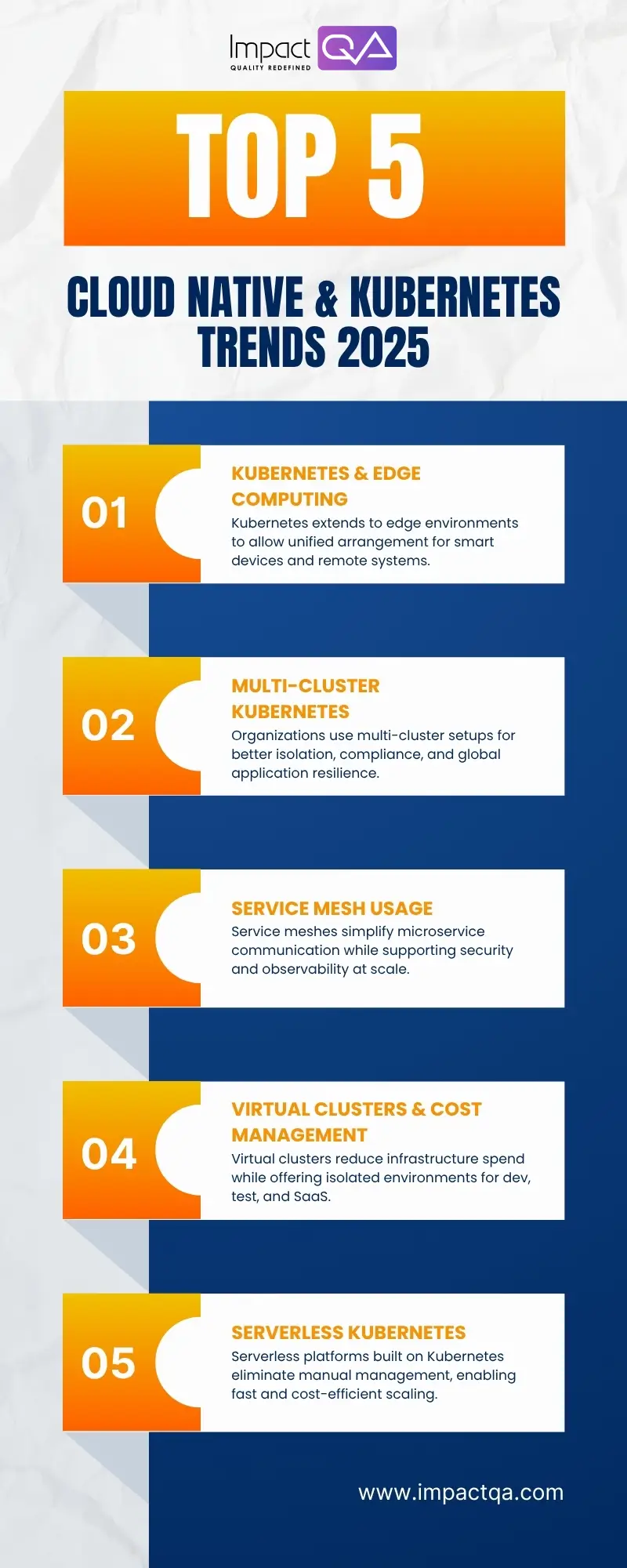
Kubernetes & Edge Computing
Kubernetes is now reaching the edge. Companies are increasingly using Kubernetes to manage distributed clusters that run smart devices – connected vehicles, industrial systems, smart home technology, and IoT sensors.
Edge nodes operate outside of centralized infrastructure. Kubernetes helps control, automate, and orchestrate these environments with consistency and reliability.
The ability to maintain the same developer tools across both centralized and remote deployments improves workflow and reduces onboarding time. Lightweight Kubernetes variants like K3s and MicroK8s are designed specifically for edge use cases, offering support in low-power and low-latency conditions.
Energy usage is another growing concern. With power constraints in remote environments, organizations are exploring how Kubernetes can operate efficiently without compromising reliability.
Multi-cluster Kubernetes
More enterprises are adopting multi-cluster configurations to support growth, security, and compliance. Instead of managing multiple workloads within a single cluster, they are creating distinct clusters based on geography, department, or workload type.
This setup leads to more predictable performance and isolation. Teams avoid the “noisy neighbor” problem, where one workload impacts another’s behavior. It also simplifies implementing jurisdiction-specific compliance rules.
Multi-cluster environments reduce risk by containing failures in a single cluster. They also allow for traffic routing based on proximity or load and improve application availability during regional outages.
This method supports global scalability while maintaining a defined separation between systems, teams, or customers.
Service Mesh Usage
The growing use of Kubernetes has increased the adoption of service mesh technologies. These frameworks simplify how services within an application communicate with each other.
With features like encryption, traffic routing, retries, and failure handling built in, service meshes move operational logic away from application code. Teams no longer need to build these functions from scratch.
This separation helps developers focus on building features while operations teams manage performance and policy. It also supports network-level observability – an important factor in maintaining uptime.
Service mesh frameworks contribute to zero-trust architectures, which are especially important for distributed applications operating in regulated sectors.
Virtual Clusters and Cost Management
Running Kubernetes at scale can be expensive. Virtual clusters offer a more economical way to deliver isolated environments without deploying multiple physical clusters.
This approach works well for internal development, testing, or multi-tenant SaaS platforms. Multiple teams can run workloads in separate virtual clusters, all backed by the same underlying physical resources.
Teams benefit from faster provisioning, simplified resource governance, and reduced infrastructure costs. Security is maintained through namespace-level policies and network segmentation.
As cost pressures increase, more businesses are turning to this model to avoid overprovisioning while maintaining flexibility.
Serverless Kubernetes
Kubernetes is powerful but not always simple. Serverless platforms built on Kubernetes are reducing the need for deep configuration and constant oversight.
These platforms allow developers to focus entirely on writing code. The system automatically handles provisioning, scaling, and event processing.
This is especially effective for workloads with unpredictable traffic patterns. Applications automatically scale to meet demand and scale back when idle, lowering both cost and complexity.
Serverless integration also supports rapid experimentation. Teams can deploy new services without having to manage infrastructure layers manually.
Kubernetes Observability and Telemetry
With systems becoming more distributed, observability is no longer an afterthought. Teams need real-time insights into what their clusters are doing – where failures happen, how workloads behave, and whether resource use is within acceptable limits.
Kubernetes observability now includes detailed metrics, logs, and tracing. These helps track service health, latency, and resource usage in a granular way.
Monitoring is increasingly integrated with automation tools. This allows for quicker reactions – automated rollbacks, scaling decisions, or targeted alerts.
Full visibility across clusters also supports audit readiness, cost control, and better performance tuning. As deployments become larger, this level of insight becomes critical for reliable operations.
Talk to our experts and streamline your transformation with tested and proven methods.
Looking Ahead
Each of the trends we’ve explored – edge integration, multi-cluster adoption, service mesh usage, virtual clusters, serverless workloads, and deeper observability – shows how Kubernetes is no longer limited to early experimentation. It’s now central to how modern systems are built and managed.
But scale brings challenges. Without a defined testing and validation approach, Kubernetes can introduce friction instead of reducing it. From security misconfigurations to service disruptions and inconsistent cluster behavior, the risk of operational issues increases as environments become more distributed and complex.
That’s where ImpactQA steps in. We support enterprises at every step – from Kubernetes adoption to ongoing operations. Our QA professionals offer tailored validation for cloud-native and microservices systems. Our testing strategies are built around real-world usage and cover performance, resilience, scalability, and security.
We understand the technical demands of these environments. Our expertise includes service mesh validation, edge deployment verification, serverless function testing, and cluster lifecycle automation.
Let ImpactQA help you validate, test, and monitor your infrastructure across all regions and use cases. Our offerings are designed to support compliance frameworks, CI/CD integration, and site reliability targets. With us, organizations reduce outages, manage costs better, and improve service uptime. If you’re aiming to scale Kubernetes with confidence, start with a QA partner who knows the operational demands of modern containerized systems like ImpactQA.


