
“An ounce of prevention is worth a pound of cure.” In the context of digital transformation, this adage holds significant relevance. Businesses that seek to thrive must view digital initiatives not as isolated projects but as integrated strategies that can significantly boost their ROI. The SAP Business Technology Platform (BTP) serves as a foundation in this evolution, providing an agile framework for developing, integrating, and extending applications. Yet, the challenge remains – how do organizations effectively leverage SAP BTP to achieve measurable results?
Maximizing ROI goes beyond mere implementation. It involves crafting a strategic approach that capitalizes on enhanced data management, streamlined operations, and innovative cloud capabilities. This article explores actionable strategies that enable businesses to fully realize the benefits of SAP BTP, empowering them to achieve sustained growth and remain competitive in an increasingly dynamic market.
The Foundation of SAP BTP: Why It Matters
SAP BTP offers a comprehensive portfolio of tools and services to help businesses innovate, integrate, and manage their SAP environments. It is designed to streamline operations and foster efficiency across multiple domains such as application development, data management, and business process management.
To fully appreciate the importance of SAP BTP, it is essential to understand its core components:
- Application Development & Integration: SAP BTP enables organizations to build, extend, and integrate applications using a flexible and scalable infrastructure.
- Data Management: The platform allows for the management of data across various environments, whether cloud-based, on-premises, or hybrid.
- Analytics & Business Intelligence: With robust tools for analytics, businesses can derive actionable insights from their data to make informed decisions.
- Artificial Intelligence & Machine Learning: SAP BTP incorporates advanced technologies that allow companies to automate processes and generate predictive insights.
Driving Agility with Low-Code/No-Code Development
One of SAP BTP’s key strengths lies in its ability to drive innovation with low-code and no-code development tools. This agility is essential for staying ahead of the competition. Traditional development cycles can be time-consuming, especially for businesses with limited IT resources. SAP BTP addresses this challenge by empowering users – both technical and non-technical – to build and modify applications rapidly, without the need for extensive coding knowledge.
Low-code and no-code platforms reduce the dependency on specialized developers by providing intuitive drag-and-drop interfaces and pre-built modules. This allows teams across departments, such as marketing, sales, or operations, to create custom solutions tailored to their specific needs. As a result, businesses can implement changes faster, respond to market demands with greater agility, and reduce the time-to-market for new products or services.
Moreover, SAP BTP’s low-code/no-code capabilities enable rapid prototyping and testing of new ideas. Teams can experiment with different solutions in a controlled environment, minimizing the risk of failure while maximizing innovation. This iterative approach ensures that businesses can continuously adapt their processes and applications, ensuring alignment with evolving market trends.
By reducing development time, lowering costs, and fostering cross-departmental collaboration, low-code/no-code tools on SAP BTP significantly contribute to maximizing ROI. Organizations that leverage these tools can innovate more quickly and stay agile in a competitive digital market.
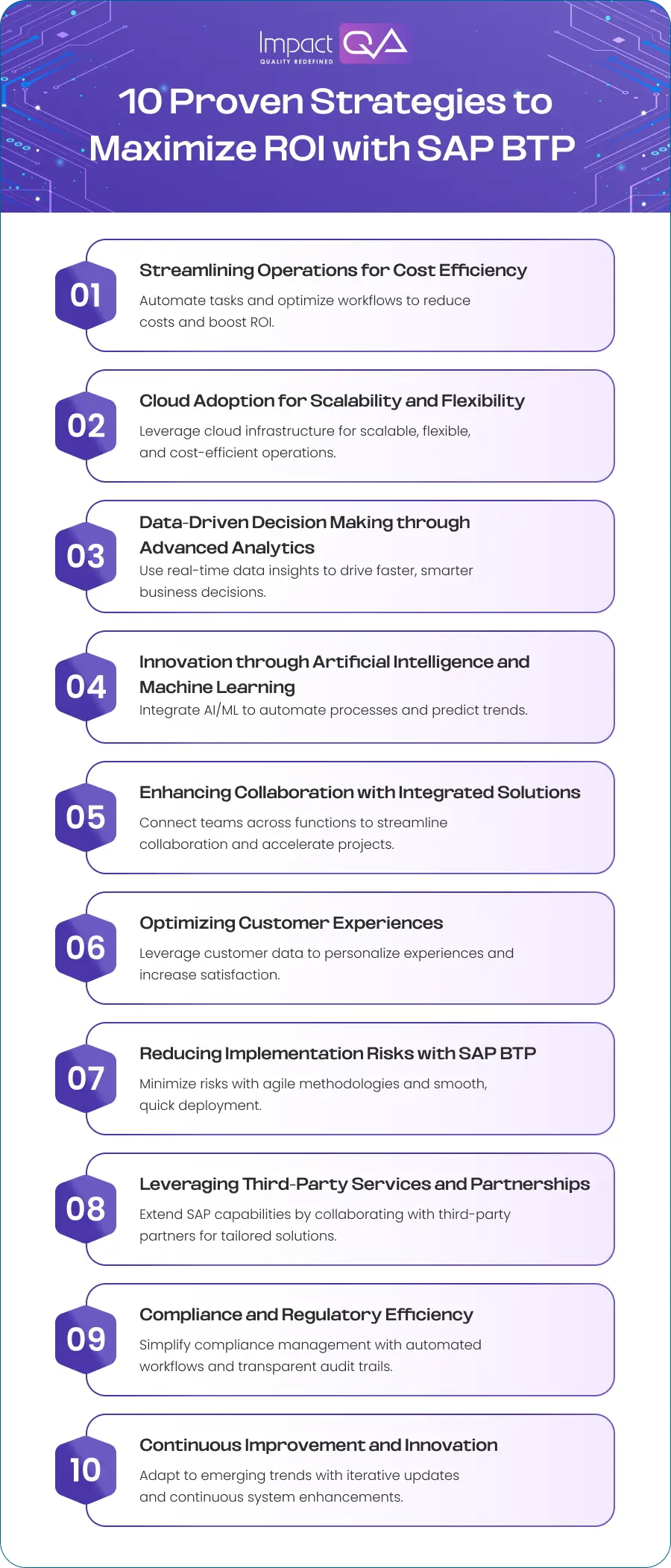
10 Proven Strategies to Maximize ROI with SAP BTP
Strategy 1: Streamlining Operations for Cost Efficiency
One of the primary goals of any SAP implementation is to drive cost efficiency. SAP BTP offers tools that help businesses streamline their operations, automate repetitive tasks, and optimize workflows. By reducing manual intervention, businesses can cut down operational costs and improve efficiency.
A clear focus on reducing redundant processes, leveraging automation through SAP BTP’s services, and maintaining streamlined workflows helps businesses avoid unnecessary expenditures while maximizing their ROI.
Strategy 2: Cloud Adoption for Scalability and Flexibility
The cloud is at the heart of SAP BTP’s success. Migrating to cloud infrastructure ensures scalability, giving businesses the flexibility to adjust their resources according to demand. This eliminates the need for upfront capital investment in hardware and reduces ongoing maintenance costs.
Cloud-native deployment also makes it easier for businesses to scale up when there is a spike in demand and scale down during off-peak periods, ensuring that they only pay for what they use. SAP BTP allows seamless integration with other SAP solutions and third-party applications, providing an additional layer of agility.
Cloud adoption does not only address scalability but also strengthens data security and disaster recovery capabilities. This allows businesses to maintain smooth operations even during unforeseen events.
Strategy 3: Data-Driven Decision Making through Advanced Analytics
Data is the backbone of every business decision in the digital age. SAP BTP’s built-in analytics tools enable businesses to unlock the full potential of their data by transforming it into actionable insights. Leveraging SAP Analytics Cloud or SAP HANA on SAP BTP, companies can consolidate data from various sources, perform in-depth analyses, and visualize trends in real-time.
Effective data management and analytics strategies lead to quicker decision-making, allowing businesses to respond swiftly to market changes and customer demands. In turn, this can drive revenue growth, improve customer satisfaction, and optimize the supply chain.
Strategy 4: Innovation through Artificial Intelligence and Machine Learning
Artificial intelligence (AI) and machine learning (ML) are essential drivers of innovation in today’s marketplace. SAP BTP integrates these advanced technologies to help businesses automate decision-making processes, predict customer behaviors, and optimize operational workflows.
For example, AI-driven automation can streamline complex tasks like demand forecasting, pricing models, or customer service chatbots. These efficiencies can directly improve ROI by reducing manual intervention and boosting productivity.
Organizations that invest in AI and ML capabilities on SAP BTP also benefit from better resource management and the ability to predict future trends, which can guide business strategies more effectively.
Strategy 5: Enhancing Collaboration with Integrated Solutions
In any organization, collaboration across departments is critical to success. SAP BTP enables cross-functional teams to work together more effectively by integrating business processes across applications and platforms.
Through seamless integration, all departments—whether sales, finance, operations, or human resources—can access real-time data and insights. This transparency encourages collaboration, speeds up project timelines, and enhances decision-making. Integration leads to a more cohesive and productive work environment, ultimately driving ROI.
Strategy 6: Optimizing Customer Experiences
Customer experience is increasingly becoming the primary differentiator in business. With SAP BTP, businesses can create personalized experiences by utilizing customer data more effectively. Whether it’s optimizing the customer journey, tailoring marketing efforts, or delivering more relevant products and services, SAP BTP helps businesses enhance customer satisfaction.
Satisfied customers are likely to be repeat buyers, which directly impacts ROI. With tools like SAP Customer Data Cloud and SAP Commerce Cloud, businesses can use insights to engage customers more effectively and improve retention rates.
Strategy 7: Reducing Implementation Risks with SAP BTP
One of the major concerns for businesses during a digital transformation is the risk associated with the implementation of new technologies. However, SAP BTP minimizes these risks by providing a structured environment that supports integration and development without disrupting existing business operations.
Through the use of agile methodologies and pre-configured services, businesses can quickly deploy new applications and systems, reducing the downtime typically associated with digital transformations. By ensuring smooth implementation, businesses can avoid common pitfalls and keep their focus on growth and innovation.
Strategy 8: Leveraging Third-Party Services and Partnerships
Maximizing ROI with SAP BTP is not just about what’s within the platform but also about how it integrates with third-party services. SAP BTP offers numerous opportunities for businesses to work with SAP partners and third-party service providers to extend their capabilities.
For instance, businesses can leverage SAP’s vast partner network for consulting, implementation, and support services. SAP partners help organizations tailor their SAP BTP solutions to specific business needs, which further drives ROI by ensuring the platform is aligned with operational goals.
Strategy 9: Compliance and Regulatory Efficiency
Staying compliant with industry regulations and standards is a major concern for businesses operating in highly regulated industries such as healthcare, finance, and manufacturing. SAP BTP simplifies compliance management by offering tools and services designed to help businesses stay up-to-date with regulatory requirements.
By automating compliance workflows and ensuring transparent audit trails, businesses can significantly reduce the risk of non-compliance, which can lead to fines or reputational damage. Additionally, the use of SAP BTP’s security and risk management tools help businesses safeguard their operations from potential threats.
Strategy 10: Continuous Improvement and Innovation
Maximizing ROI with SAP BTP isn’t a one-time effort – it requires a commitment to continuous improvement. As the digital landscape evolves, businesses need to ensure that their SAP BTP strategies are aligned with emerging trends and innovations. SAP BTP’s modular nature allows businesses to constantly evolve their applications and processes without major disruptions.
Regular audits of system performance, the inclusion of emerging technologies such as IoT and blockchain, and iterative updates to business processes help maintain SAP BTP’s effectiveness. This ongoing process ensures that businesses continue to generate value from their investment over time.
Conclusion
SAP BTP is more than a tool for operational efficiency; it is a strategic asset that drives sustainable growth. By implementing SAP BTP and success strategies, businesses can not only optimize their existing processes but also innovate and prepare for future challenges. The key to maximizing ROI lies in a tailored approach that integrates SAP BTP’s capabilities with specific business objectives.
Investing in the right training, technology, and partnerships ensures that the value derived from SAP BTP continues to grow over time. SAP BTP offers a unique opportunity for businesses to stay ahead of the curve, and those who embrace it with a strategic mindset will be best positioned for long-term success. ImpactQA, with its deep expertise in SAP systems and quality assurance, ensures that organizations maximize their SAP BTP implementations. Through comprehensive testing strategies and tailored solutions, ImpactQA helps businesses optimize performance and mitigate risks.


