
While multi-cloud environments offer flexibility, scalability, and redundancy, they also introduce significant testing challenges. Performance, security, and reliability can become complicated variables when applications are distributed across multiple cloud environments. The integration of public and private cloud components necessitates testing across these conditions to avoid degradation of performance through intra-compatibility, slow application response, or in a worst-case scenario a security vulnerability.
Hybrid cloud testing is requisite to deal with these issues. Hybrid cloud testing assesses an application’s functionality across multiple cloud environments to ensure optimal interoperability and limits outages and interruptions. Moreover, hybrid testing specifically investigates performance verification, secure data interchange between cloud applications, and seamless data integration of cloud applications. As more companies advance their multi-cloud initiatives, hybrid cloud testing becomes a necessary step to ensure that results are replicable and that risk is eliminated.
Understanding Hybrid Cloud and Multi-Cloud Architectures
Hybrid Cloud Testing begins with understanding the different cloud models. The term “cloud computing” broadly refers to the delivery of computing resources such as storage, networking, and processing over the internet. Within this space, businesses can leverage different cloud architectures to suit their needs.
- Public Cloud: A cloud service where computing resources are owned and operated by a third-party provider. The resources are shared among several organizations.
- Private Cloud: A cloud infrastructure used exclusively by one organization, typically hosted on-premises or at a third-party data center.
- Hybrid Cloud: A blend of public and private clouds that work together. In this model, an organization can move workloads between the public and private clouds as needed for greater flexibility and optimization based on the needs of the business.
- Multi-Cloud: The use of two or more cloud services (public or private) from different providers. This model aims to avoid vendor lock-in, optimize performance, and ensure redundancy.
For a successful hybrid cloud testing strategy, organizations must thoroughly assess how applications behave in both on-premises and public cloud environments. This ensures that applications can run without disruptions regardless of where they are hosted.
ImpactQA can help you with expert hybrid cloud testing services.
The Role of Hybrid Cloud Testing in Multi-Cloud Applications
When working with multiple clouds, businesses face distinct performance hurdles affecting their applications’ usability, speed, and security. Hybrid cloud testing ensures that performance remains consistent regardless of the platform. It also ensures seamless service delivery across different environments.
1. Managing Performance and Load Balancing
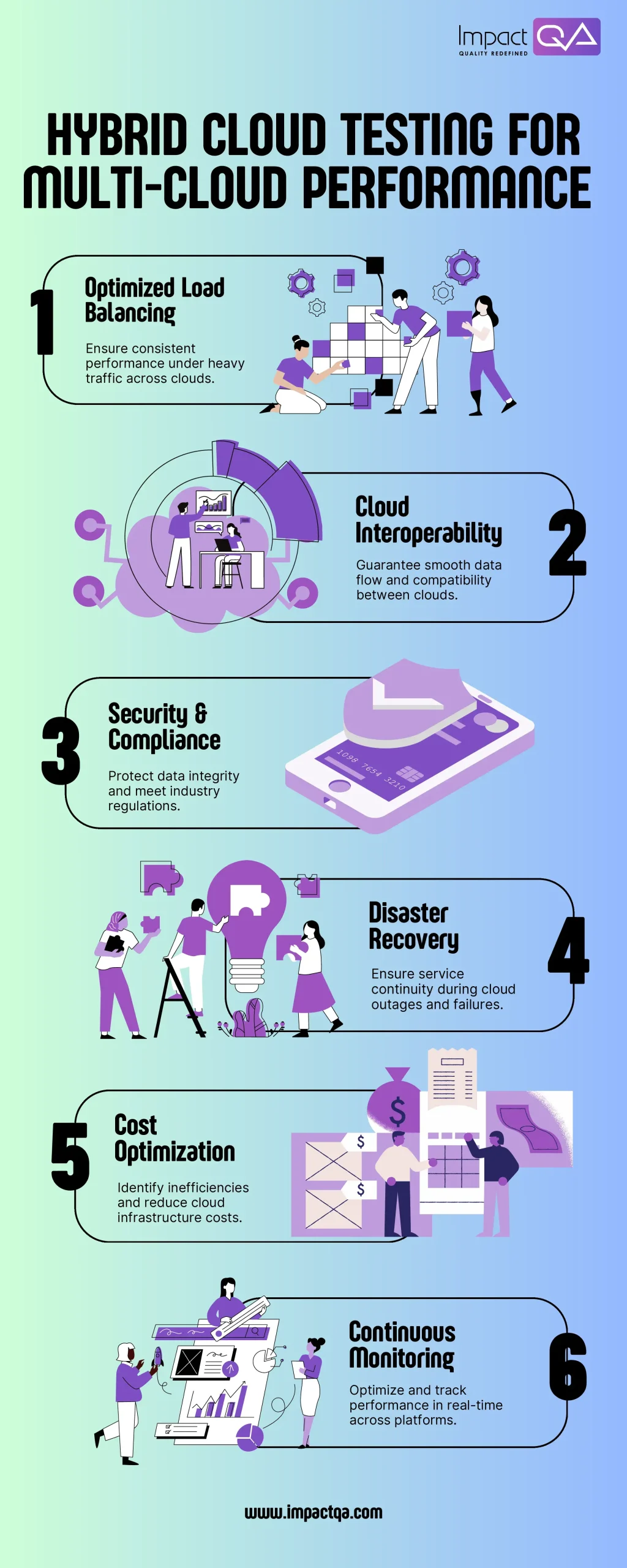
In a multi-cloud environment, load balancing is essential to ensure that no single cloud platform becomes overloaded with requests. By testing hybrid cloud systems, businesses can evaluate the behavior of their application when traffic is distributed across multiple clouds. Hybrid cloud testing verifies that load balancing mechanisms are effective and that the performance of the application remains high even under heavy traffic conditions.
2. Ensuring Interoperability Between Clouds
When applications span multiple cloud environments, ensuring that each cloud service can communicate effectively with the others is crucial. Hybrid cloud testing helps test the interoperability of different cloud platforms. It checks whether data flows seamlessly between public and private clouds and if applications can adapt to varying cloud-native services.
3. Security and Compliance Testing
One of the greatest concerns when using multiple clouds is security. With data flowing between different cloud environments, sensitive information can become vulnerable to cyber threats. Hybrid cloud testing includes rigorous security testing to ensure that data remains encrypted and protected when transferred between clouds. Additionally, compliance testing verifies that applications meet regulatory requirements and data protection standards, which can vary between clouds.
4. Disaster Recovery and Failover Mechanisms
In a multi-cloud environment, businesses are exposed to potential service outages or failures from a particular provider. Hybrid cloud testing ensures that disaster recovery and failover mechanisms are in place, so if one cloud platform goes down, the application can still function properly by switching to another cloud. Testing also verifies that data recovery processes work efficiently.
Key Benefits of Hybrid Cloud Testing in Multi-Cloud Environments
Incorporating hybrid cloud testing into your multi-cloud strategy brings several advantages, such as:
1. Cost Optimization
While each cloud service has its own pricing model, running a multi-cloud infrastructure without testing can lead to inefficient resource allocation and higher costs. Hybrid cloud testing helps optimize resource usage across clouds by identifying performance bottlenecks, inefficient processes, and unnecessary expenditures. It helps companies leverage the best features of each cloud platform, thereby optimizing cost without sacrificing performance.
2. Flexibility and Scalability
Hybrid cloud testing ensures that your application can seamlessly scale up or down based on demand. This is particularly useful when different clouds offer distinct scalability features. Testing helps identify which cloud is best suited for specific workloads, thus helping businesses to scale effectively.
3. Faster Time-to-Market
With proper hybrid cloud testing in place, organizations can detect and resolve issues early in the development process. This speeds up deployment times and reduces the chances of encountering issues after release. By testing early and often, companies can ensure their multi-cloud applications are market-ready without unnecessary delays.
4. Improved User Experience
A well-tested multi-cloud application will offer a smoother user experience, regardless of where it is hosted. Hybrid cloud testing helps monitor the performance of applications across one or more cloud provider environments while assuring similar response times, uptime, and user experience satisfaction.
Best Practices for Effective Hybrid Cloud Testing
To get the most out of hybrid cloud testing, organizations must follow a structured approach:
1. Test in Real-World Scenarios
To accurately assess performance, it is important to test applications in scenarios that reflect real-world conditions. This means simulating actual user behavior and workload demands. Testing in real-world conditions ensures that the application will perform well under heavy traffic or stressful conditions.
2. Use Automation for Continuous Testing
Given the complexity of multi-cloud environments, automation is essential for continuous testing. Automated tests can quickly identify performance and compatibility issues, allowing teams to address problems in real-time. Automation also helps run tests consistently across different cloud platforms, reducing the chances of missing critical issues.
3. Integrate Cloud-Native Services
When building a hybrid cloud architecture, it is essential to integrate cloud-native services such as load balancers, auto-scaling, and serverless computing. Testing these services ensures they are properly configured and that they interact with your application as expected. Integration testing ensures your application takes full advantage of cloud-native technologies.
4. Monitor and Optimize Performance Continuously
Hybrid cloud testing should not be limited to the development and deployment stages. Continuous monitoring is necessary to ensure ongoing performance optimization. By continuously tracking performance and usage metrics, organizations can make adjustments to cloud configurations or workflows to ensure continued efficiency.
The Role of ImpactQA in Hybrid Cloud Testing
As businesses move towards more complex multi-cloud environments, choosing the right testing partner is critical. ImpactQA offers a range of hybrid cloud testing services that help organizations ensure their applications perform optimally across multiple cloud platforms. Their expert team uses cutting-edge tools and methodologies to conduct thorough testing and identify performance issues, compliance issues, and provide a smooth user experience.
ImpactQA specializes in performance testing, security testing, disaster recovery testing, and continuous testing, ensuring that multi-cloud applications are always optimized. With a strong focus on real-world scenarios and automation, ImpactQA supports organizations in achieving consistent, reliable performance in a multi-cloud world.
If you’re looking for a trusted partner to optimize your multi-cloud application performance, remember ImpactQA offers top-tier hybrid cloud testing services to help you ensure seamless performance.
ImpactQA offers precise hybrid cloud testing for smooth interactions across platforms.
Conclusion
Hybrid cloud testing offers a strategic advantage to organizations adopting a multi-cloud approach by ensuring applications perform efficiently across multiple cloud environments. With performance, security, and compatibility at the forefront of business priorities, it’s essential to invest in robust testing strategies. Organizations must be proactive in managing cloud complexities to ensure their applications meet both user expectations and business goals.


