Why Real-time Payment Gateway Testing is Crucial for Banking Sector Compliance

Quick Summary:
Real-time payment gateway testing is crucial for ensuring secure, seamless, and compliant transactions in the banking sector. This blog highlights the key testing areas, such as functionality, security, and performance, that help financial institutions safeguard against vulnerabilities and meet regulatory standards. Proper testing not only strengthens system reliability but also builds trust, thus enabling financial institutions to adapt to the demands of an increasingly digital economy.
Table of Contents:
- Understanding Real-time Payment Gateway Testing
- Key Aspects of Real-time Payment Gateway Testing
- Benefits of Real-time Payment Gateway Testing
- Conclusion
The banking industry is undergoing a profound digital transformation, driven by technological advancements and changing consumer expectations. Nowadays, real-time payments, which allow for immediate transaction processing, have become the norm pushing financial institutions to adopt faster and more efficient payment systems. With this shift, the need for robust payment gateways, the systems that process transactions between merchants, customers, and financial institutions, has never been more critical. These gateways must operate seamlessly to handle high transaction volumes, ensure the accuracy of payments, and maintain security at all stages of the transaction process. As payment systems evolve to keep pace with demand, financial institutions are tasked with safeguarding the integrity of these transactions while complying with an increasing number of complex regulatory frameworks.
This blog explores the importance of real-time payment gateway testing as a key strategy for maintaining regulatory compliance and safeguarding customer transactions in the ever-evolving banking landscape. As digital payments continue to grow, comprehensive testing will be essential to ensure that financial institutions can meet the demands of both consumers and regulators without compromising on security or performance.
Learn how we can streamline your payment systems.
Understanding Real-time Payment Gateway Testing
A payment gateway is a technology that facilitates online transactions by securely transmitting payment data between merchants, customers, and financial institutions. Given the rise of instant transactions, real-time payment gateway testing ensures that these systems operate seamlessly, securely, and in compliance with regulatory frameworks.
Payment gateways have to be:
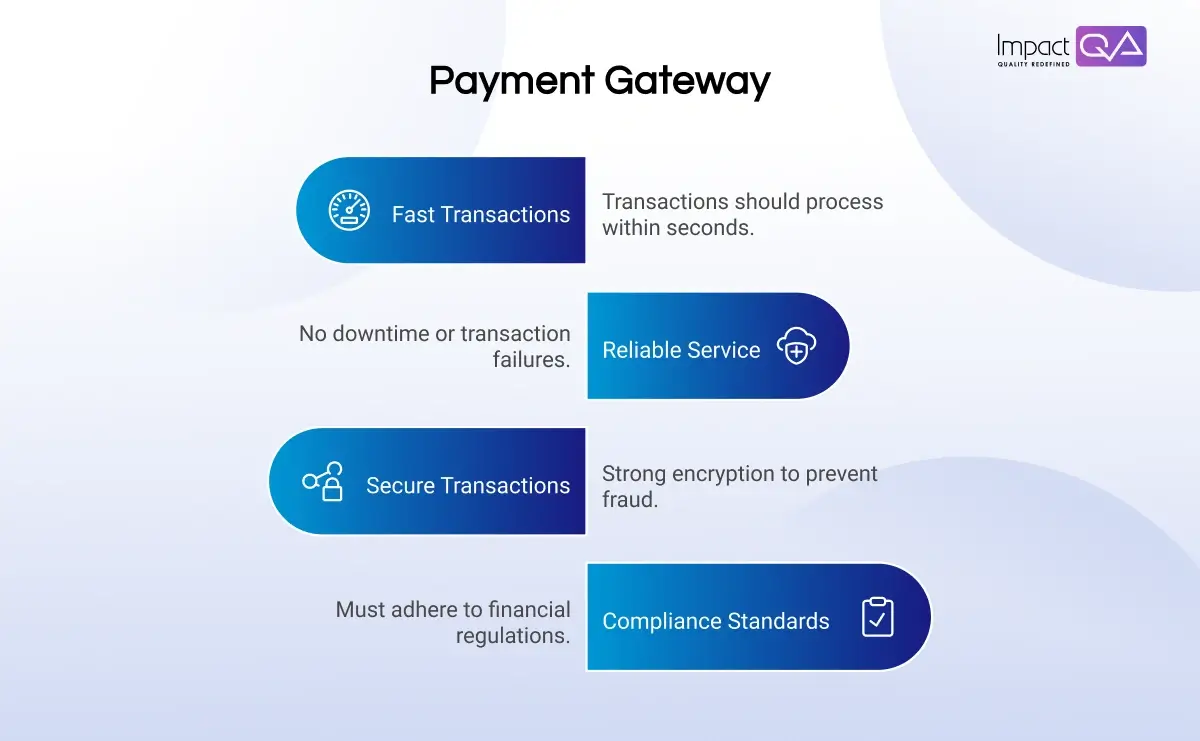
Real-time payment gateway testing plays a crucial role in ensuring that these systems are not only efficient and secure but also compliant with industry regulations, such as PCI DSS, AML, and KYC. Through rigorous testing, financial institutions can identify vulnerabilities before they result in significant breaches, fraud, or compliance failures. Moreover, these tests help financial institutions stay ahead of emerging risks, adapt to new regulatory requirements, and provide customers with fast, secure, and reliable services.
This type of testing involves validating the accuracy, security, performance, and compliance of payment gateways by simulating real-world scenarios and transactions. The primary objectives include:
1. Ensuring Transaction Accuracy: One of the most critical aspects of real-time payment gateway testing is ensuring the accuracy of every transaction. A single error in transaction data, such as incorrect billing information, duplicate payments, or incorrect amounts, can lead to severe consequences for both merchants and customers. Testing verifies that the payment gateway processes each transaction correctly, from the moment the customer initiates the payment to the confirmation of transaction success or failure. This includes validating the communication between the merchant’s system, the payment processor, and the bank.
2. Maintaining Security and Fraud Prevention: Security is one of the most important concerns when it comes to handling financial data. Payment gateways are prime targets for cyberattacks, making fraud prevention and the protection of sensitive information crucial. Real-time payment gateway testing involves evaluating the effectiveness of the security measures in place, ensuring they meet industry standards such as PCI DSS (Payment Card Industry Data Security Standard).
3. Adhering to Financial Compliance Standards: The financial regulatory landscape is complex, with various laws and regulations governing the processing of payments. Financial institutions and payment processors must comply with regulations such as the Revised Payment Services Directive (PSD2) in Europe, PCI DSS, and Anti-money laundering (AML) guidelines. Non-compliance can lead to hefty fines, reputational damage, and loss of customer trust.
Real-time payment gateway testing ensures that the payment system meets all relevant legal and regulatory requirements. Testing verifies that the payment gateway adheres to regional or national laws, including those governing data privacy, transaction limits, and authentication requirements.
4. Enhancing System Reliability and Performance: For real-time payment gateways to be effective, they must be reliable and capable of handling a high volume of transactions. Downtime, delays, or slow processing can result in lost revenue and frustrated customers. Therefore, performance and system reliability are also key focuses of testing. This involves simulating peak transaction loads to assess the gateway’s ability to process payments quickly and efficiently, even under high-demand scenarios. Ensuring that the payment system can scale, process transactions without delay, and recover from failures quickly is crucial for both customer satisfaction and business operations.
Key Aspects of Real-time Payment Gateway Testing
To ensure compliance, financial institutions must focus on several critical aspects of payment gateway testing:
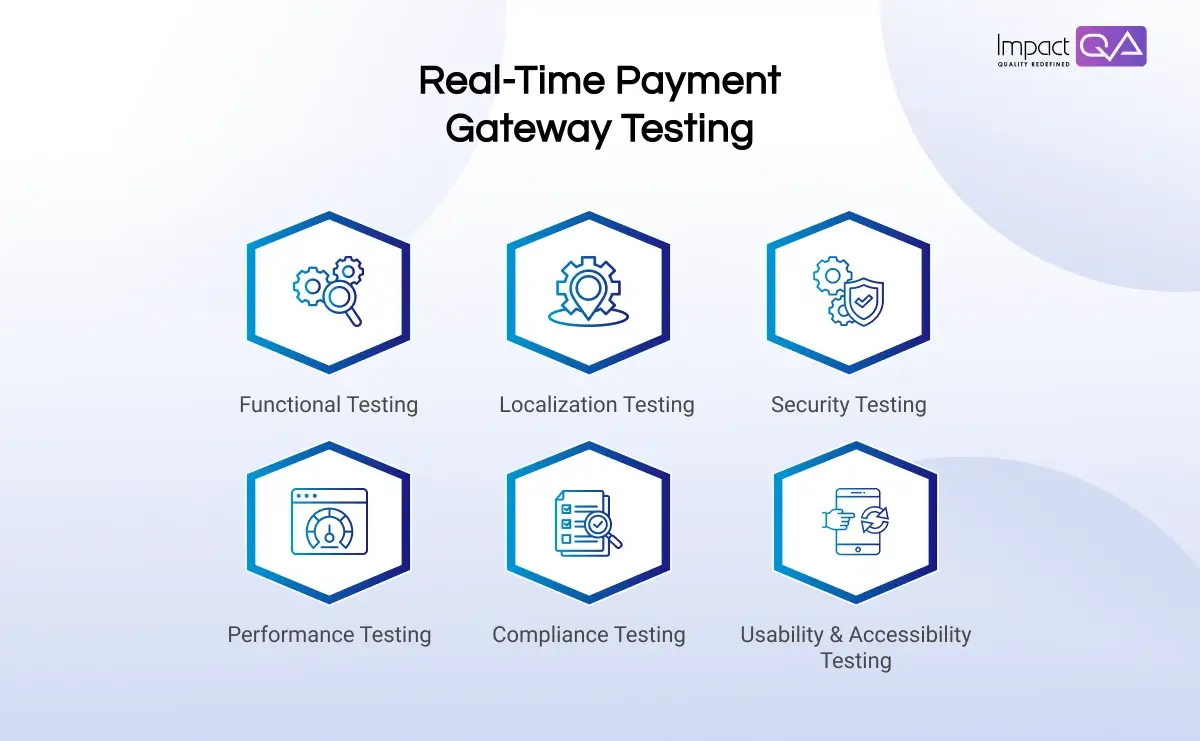
1. Functional Testing
Functional testing ensures that the payment gateway performs as expected in various real-world conditions. It validates the basic functionality of the system, ensuring it can handle all types of transactions correctly.
Key Focus Areas in Functional Testing:
- Transaction Success and Failure Handling: The gateway should be able to process both successful and failed transactions correctly. Testing verifies that transactions are correctly authorized, settled, or declined and that appropriate responses are generated (e.g., error messages and success notifications).
- Multi-Currency and Multi-Payment Method Support: Real-time payment gateways must support multiple currencies and payment methods, such as credit/debit cards, digital wallets, bank transfers, etc. Functional testing ensures that the gateway can handle different payment methods accurately across different regions and currencies.
- Payment Reversals, Refunds, and Chargebacks: Payments are sometimes reversed, refunded, or disputed. Testing ensures that the gateway can handle these situations, including correctly processing chargebacks and refunds according to the appropriate rules and timelines.
- API and Third-Party Integration Validation: Many payment gateways rely on integrations with third-party APIs, such as fraud prevention tools, currency converters, and payment processors. Functional testing ensures that the payment gateway and its integrated systems work seamlessly together to provide a smooth transaction experience.
Tools:
- Selenium, Playwright, Cypress, Tricentis Tosca, and OpenText UFT One for UI automation and validation of transaction workflows.
- Postman and Rest Assured for API automation.
- WireMock, Tricentis Tosca Service Virtualization, and OpenText UFT One Built-in Service Virtualization for AP automation and mock service validation.
2. Localization Testing
With the increasing globalization of digital payments, real-time payment gateways must cater to users across different countries, languages, and currencies. Localization testing ensures that a payment gateway provides a seamless experience for users in different regions. Thus, maintaining functionality, accuracy, and compliance with local financial regulations.
Key Focus Areas in Localization Testing:
Language and Content Validation: Ensuring the payment gateway supports multiple languages without grammatical or contextual errors. Also, making sure that success messages, error prompts, and notifications are accurately translated and culturally appropriate.
- Currency and Pricing Format Validation: Ensuring users can pay in their local currency without errors in conversion. Displaying currency symbols and decimal separators as per the locale. Verifying exchange rate calculations when payments involve currency conversions.
- Date, Time, and Number Formatting: Ensuring that timestamps follow local format. Handling payments across different time zones to prevent incorrect timestamps or settlement issues. Also, ensuring decimal and thousand separators are used correctly per region.
Tools:
- Google Translate API for basic translation verification of UI elements, notifications, and error messages.
- Postman, Selenium, Playwright, Cypress, Tricentis Tosca, and OpenText UFT one for validating multi-currency support and exchange rate calculations.
3. Security Testing
With the rise of cyber threats and data breaches, security has become crucial in payment gateway testing. Financial institutions must guarantee that sensitive financial data is transmitted and stored securely to prevent unauthorized access and fraud.
Key Focus Areas in Security Testing:
- Data Encryption and Transmission Security (SSL/TLS protocols): Payment gateways need robust encryption mechanisms, like SSL/TLS, to safeguard data during transmission between the customer, merchant, and payment processor. Security testing ensures that these protocols are properly implemented to protect transaction data from potential interception or tampering.
- Secure Authentication and Authorization Mechanisms: Payment gateways must include strong authentication measures, such as multi-factor authentication (MFA), tokenization, and biometric recognition, to ensure that only authorized individuals can initiate transactions. Testing verifies the effectiveness of these mechanisms in preventing unauthorized access.
- Fraud Detection and Prevention Systems (AI-driven anomaly detection): The increasing sophistication of fraud tactics calls for advanced fraud detection systems powered by artificial intelligence (AI) and machine learning. These systems monitor transaction patterns and flag any anomalies for further investigation. Security testing evaluates whether these systems are functioning accurately and effectively to prevent fraudulent transactions.
- Compliance with PCI DSS and Other Security Standards: Ensuring that the payment gateway meets the Payment Card Industry Data Security Standard (PCI DSS) is essential for protecting customer card details. Testing checks for compliance with PCI DSS and other relevant security standards to mitigate risks and protect against breaches.
Tools:
- OWASP ZAP, Burp Suite, and Wireshark for security vulnerability scanning.
- Nessus, Veracode, and Fortify for security compliance and vulnerability assessment.
4. Performance Testing
The performance of a payment gateway is a critical factor, especially as transaction volumes increase in real-time payment systems. A payment gateway must be capable of handling high transaction volumes without slowing down or crashing.
Key Focus Areas in Performance Testing:
- Load Testing: This tests the gateway’s ability to handle peak transaction volumes, simulating high user demand to see how the system behaves under normal and heavy traffic conditions. Load testing ensures the system can manage high concurrency without performance degradation.
- Stress Testing: Stress testing goes beyond load testing by simulating extreme conditions to see how the system behaves under heavy stress or failure scenarios. This test helps identify breaking points, resource limitations, and potential system bottlenecks that could occur under unusual traffic spikes or system overloads.
- Latency Testing: In real-time payments, the speed of transaction processing is crucial. Latency testing measures the time it takes for the system to process and complete a transaction. This helps us ensure that the response times remain quick and within acceptable thresholds to meet customer expectations.
Tools:
- LoadRunner, NeoLoad, and JMeter for load, stress, spike, and endurance testing.
- Dynatrace and New Relic for application performance monitoring.
5. Compliance Testing
Compliance with global financial regulations is non-negotiable for payment gateways. Regulatory authorities mandate specific standards to ensure financial transactions are secure, transparent, and ethical. Compliance testing validates that the gateway adheres to all the relevant regulations governing financial transactions.
Key Focus Areas in Compliance Testing:
- Validating Data Privacy and Storage Policies: Payment gateways must comply with data privacy regulations such as the General Data Protection Regulation (GDPR) in Europe. Compliance testing ensures that personal and financial data is stored and processed in a manner consistent with legal requirements and that customers’ privacy rights are respected.
- Auditing Transaction Logs and Reporting Accuracy: Payment gateways must maintain accurate and secure transaction logs for audit and reporting purposes. Compliance testing verifies that the gateway generates correct transaction records and complies with regulatory reporting requirements.
- Ensuring Anti-Money Laundering (AML) and Know Your Customer (KYC) Compliance: Financial institutions must implement mechanisms to prevent money laundering and ensure that they can identify and verify customers to prevent fraud. Compliance testing ensures that AML and KYC protocols are in place and functioning as required.
- Verifying Adherence to ISO 20022 and Other Banking Standards: Financial institutions must often comply with international banking standards such as ISO 20022, which governs the exchange of electronic messages in the financial industry. Compliance testing ensures that the payment gateway can process transactions according to these global standards.
Tools:
- OneTrust and TrustArc for privacy compliance testing.
- FICO Tonbeller, Actimize, and SAS AML for AML/KYC compliance verification.
6. Usability and Accessibility Testing
A seamless user experience (UX) is crucial for both customer satisfaction and regulatory compliance, particularly for individuals with disabilities. Usability and accessibility testing ensure that the payment gateway is user-friendly and inclusive.
Key Focus Areas in Usability and Accessibility Testing:
- Cross-Platform Compatibility: Payment gateways should function smoothly across various platforms, such as desktop websites, mobile apps, and point-of-sale (POS) systems. Testing ensures that the gateway provides a consistent user experience across different devices and operating systems.
- Accessibility Testing for Differently Abled Users (WCAG Compliance): Accessibility is essential to ensure that individuals with disabilities, such as those who are visually impaired or have mobility challenges, can use the payment gateway. Compliance with accessibility standards like Web Content Accessibility Guidelines (WCAG) ensures that the payment interface is navigable and usable for all customers.
- Intuitive Payment Flows to Minimize Transaction Abandonment: A complicated or confusing payment process can lead to abandoned transactions. Usability testing ensures that the payment flow is intuitive and user-friendly, providing customers with clear instructions, easy-to-follow steps, and minimal friction to complete their payments.
Tools:
- BrowserStack, Sauce Labs, and LambdaTest for cross-browser testing.
- AXE, WAVE, NVDA, VoiceOver (iOS), and TalkBack (Android) for accessibility validation.
- Sentry, Loggly, and Datadog for validating backend performance and error handling of payment errors.
Our testing services ensure it stays ahead of the curve.
Benefits of Real-time Payment Gateway Testing
Implementing rigorous real-time payment gateway testing provides numerous advantages. This table encapsulates the core benefits of real-time payment gateway testing, providing a clearer picture of how it enhances security, compliance, efficiency, customer experience, and operational reliability. 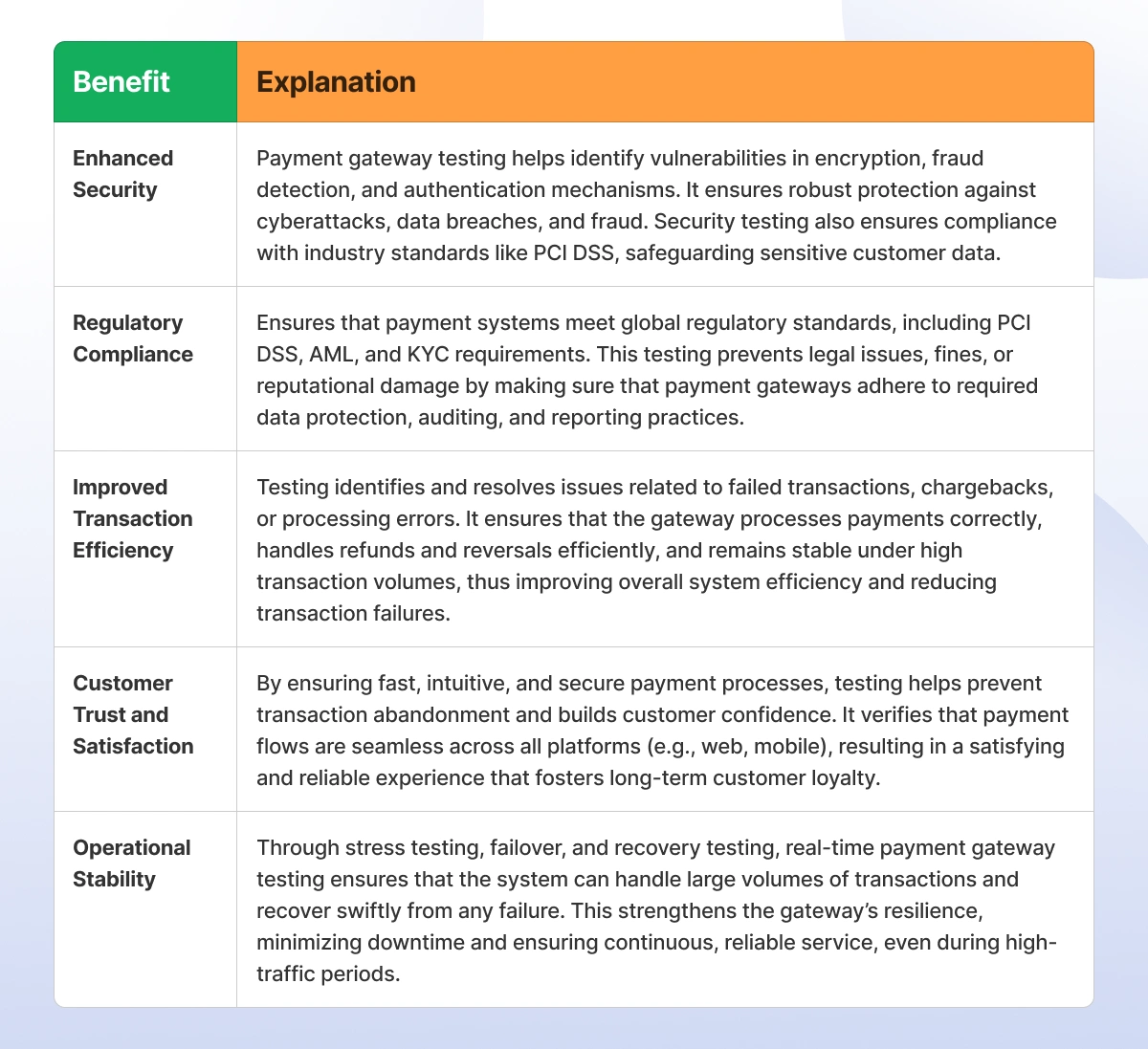
Conclusion
As the banking industry continues to evolve and digital transformation accelerates, real-time payment gateway testing has become a crucial component of financial infrastructure. With increasing demand for instantaneous, secure, and seamless transactions, banks must proactively test and validate their payment systems to meet the highest standards of security, performance, and regulatory compliance. This approach safeguards customer transactions and sensitive data while protecting banks from fraud, cyber threats, and regulatory breaches. In the long term, prioritizing payment gateway testing creates a resilient, scalable infrastructure. With customer trust and regulatory adherence at stake, testing ensures banks can thrive in the evolving digital finance world.
As the need for advanced payment solutions grows, partnering with a reliable testing service provider becomes essential to ensure your systems are always up to the task. This is where a trusted partner like ImpactQA can help. ImpactQA offers comprehensive banking application testing services that help financial institutions optimize their payment systems and ensure seamless functionality, security, and compliance. Our expertise in real-time payment gateway testing guarantees that your systems are robust, efficient, and aligned with global regulatory standards.
Share this post


Related Posts
Our Case Studies