Why Continuous Testing is Essential for Scaling Food Tech Apps with Precision
Quick Summary:
As food tech apps grow, continuous testing becomes crucial for scaling with accuracy. Consumers expect fast, reliable, and seamless experiences, and food tech companies must meet these demands while maintaining app quality. Continuous testing helps ensure that apps are error-free, perform well, and scale efficiently by detecting bugs, improving performance, and supporting regular updates. This blog covers why continuous testing is key for food tech apps, its benefits, and how it helps address industry-specific challenges.
Table of Contents:
- Introduction
- The Role of Continuous Testing in Food Tech Apps
- The Advantages of Continuous Testing in Food Tech
- How Continuous Testing Addresses Common Food Tech Challenges
- Continuous Testing and Automation in Food Tech
- How ImpactQA Supports Continuous Testing in Food Tech
- Final Thoughts
Have you ever wondered what makes the difference between a food tech app users rave about and one they abandon after just one try? With the rapid evolution of food tech, especially in the wake of the pandemic, consumer expectations have skyrocketed. People now expect apps to offer not just convenience but speed, reliability, and seamless experiences. As food tech companies race to keep up with these demands, the challenge isn’t just in developing new features but ensuring the entire system remains error-free, scalable, and robust. This is where continuous testing plays a critical role in maintaining app performance.
Food delivery apps, virtual kitchens, and food ordering platforms have become central to our daily routines, with millions of daily transactions and new features being added regularly. To stay on track and meet consumer demands, food tech companies must embrace continuous testing. This essential practice helps teams detect bugs, improve performance, and streamline updates, all while maintaining an excellent user experience. Without it, scaling a food tech app with precision becomes nearly impossible.
Continuous testing is more important than ever for scaling food tech apps and can help maintain their precision. Whether you’re a startup or an established player, understanding the importance of continuous testing will give you the edge in providing exceptional user experiences and scaling with confidence.
testing? ImpactQA provides the expertise you need to ensure your food tech app runs smoothly, no matter how big it gets.
The Role of Continuous Testing in Food Tech Apps
Continuous testing in food tech is not just about running automated tests after every build or deployment. It’s about embedding quality checks at every stage of the development lifecycle. From conceptualization to post-deployment, continuous testing ensures that your app consistently meets user expectations while scaling with precision. As food tech companies grow, so does the complexity of their apps. Apps need to integrate with third-party services, process large amounts of data, and handle high volumes of traffic, all while maintaining speed and functionality.
For instance, think about how food delivery apps connect users with restaurants, delivery personnel, and payment gateways. Every interaction needs to be smooth. Continuous testing ensures that when updates are made to one area of the app, they don’t disrupt others. It also helps in testing new features, performance under stress, and the scalability of the application, which is especially critical in food tech, where any downtime or disruption can directly affect customer satisfaction and revenue.
The Advantages of Continuous Testing in Food Tech
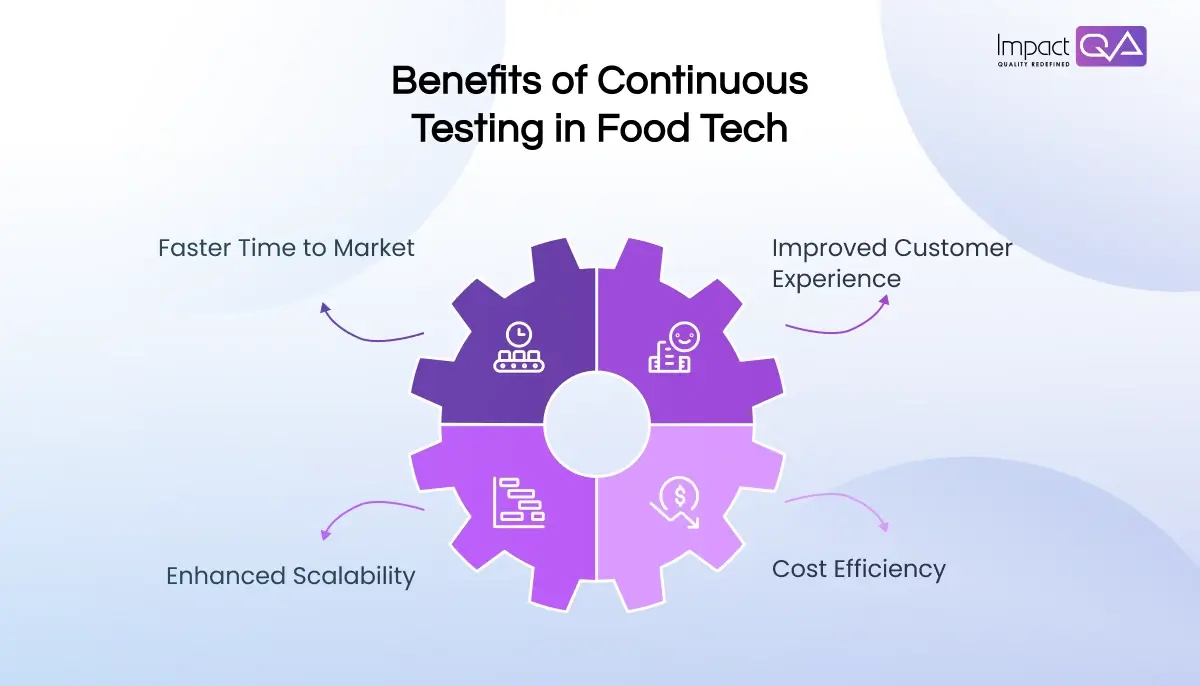
Continuous testing offers many distinct advantages for scaling food tech apps. As food tech companies push the envelope in innovation, they must balance new features, scalability, and quality assurance. Continuous testing helps meet these demands in several ways.
1. Faster Time to Market
In the highly competitive food tech space, being the first to implement a new feature or fix can make a significant difference. If a team can continuously test the platform to identify bugs early in the development process as opposed to waiting until the end, it will reduce the chances of encountering delays during production. By automating test suites and executing them at each stage, food tech companies can release updates more frequently without compromising on quality.
This speed is crucial as customers expect frequent improvements and innovations, especially when it comes to food delivery, app performance, and new features like personalized recommendations or faster ordering.
2. Improved Customer Experience
A seamless user experience is at the heart of successful food tech apps. Continuous testing in food tech ensures that your app behaves as expected across all devices and platforms, minimizing crashes, errors, and performance issues. Whether it’s tracking an order, receiving personalized discounts, or paying for a meal, every aspect of the app must function flawlessly. Continuous testing ensures that these experiences remain intact as new updates or features are rolled out.
A poor customer experience, even for a single feature, can result in app abandonment. Continuous testing reduces the risk of such disruptions and keeps users engaged and satisfied.
3. Enhanced Scalability
Food tech apps often deal with fluctuating user demand, particularly during peak hours like lunchtime or dinner. Continuous testing allows developers to simulate different traffic loads and stress-test the app for performance bottlenecks. By doing this early, teams can address issues like slow load times, crashes, or data syncing errors before they affect a large user base.
As your app grows and your user base expands, continuous testing ensures that your app scales without sacrificing performance. It helps detect problems such as database overloads, inefficient API calls, or memory leaks, which can become critical issues in large-scale applications.
4. Cost Efficiency
Finding bugs after deployment can be costly. Identifying issues in the development phase is far less expensive and time-consuming. Continuous testing reduces the cost of fixing defects later on by catching issues early. In food tech, where operational costs are significant, this can make a huge difference to the bottom line.
Testing in production or post-deployment can disrupt user experiences and hurt the app’s reputation, ultimately resulting in financial losses. By continuously testing throughout the development process, companies can avoid these pitfalls and reduce costs associated with post-launch fixes.
How Continuous Testing Addresses Common Food Tech Challenges
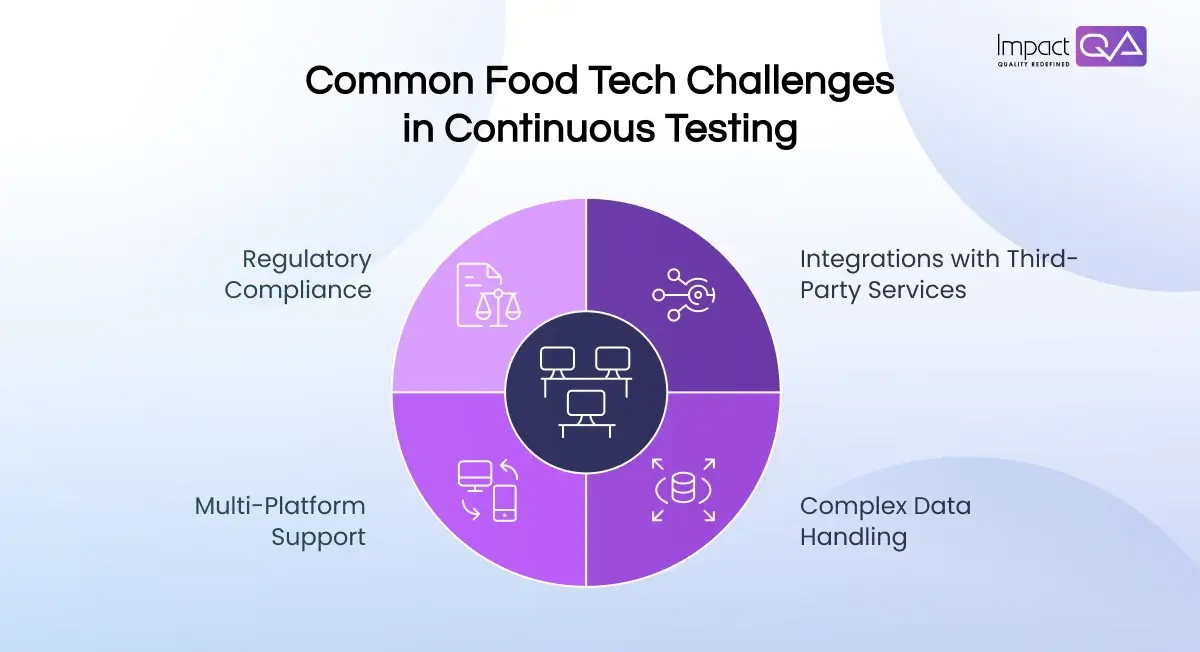
Food tech apps face unique challenges that demand rigorous testing. These challenges often arise from their complex architecture, multiple integrations, and the need to support a large and diverse user base. Continuous testing in food tech directly addresses these challenges to ensure the app stays precise and effective.
1. Integrations with Third-Party Services
Food tech apps are rarely standalone systems; they integrate with third-party platforms like payment gateways, restaurant management systems, and delivery service providers. Each integration adds another layer of complexity that requires continuous monitoring.
Continuous testing ensures that these integrations work smoothly and that any changes in third-party APIs or systems don’t negatively impact the app’s functionality. Automated tests run in real-time, detecting issues such as failed payment transactions or incorrect restaurant data retrieval.
2. Complex Data Handling
Food tech apps often need to process large amounts of data, including user orders, payment details, and delivery routes. Ensuring this data is handled efficiently and securely is essential. Continuous testing allows for real-time monitoring of data processing operations, ensuring accuracy and reducing errors. This can be particularly important in food tech, where errors such as incorrect order deliveries or payment discrepancies can damage customer trust.
3. Multi-Platform Support
Food tech apps typically operate across multiple platforms, including iOS, Android, and web applications. Each platform requires testing to ensure consistent functionality. Continuous testing offers automated testing tools that can execute tests across different platforms simultaneously. This helps identify cross-platform issues early in the development cycle.
4. Regulatory Compliance
Food tech apps must adhere to various regulations, especially when dealing with food safety, payments, and customer data privacy. Continuous testing ensures that these compliance requirements are met throughout the development process. By continuously testing the app’s compliance with laws and regulations, companies can avoid legal troubles and protect user data.
Continuous Testing and Automation in Food Tech
Automation plays a critical role in continuous testing for food tech apps. With hundreds of test cases to cover, performing these tests manually would be time-consuming and error-prone. Automated testing offers speed and accuracy, running repetitive tests at any given time without human intervention.
For example, automated tests can run when new code is pushed to the repository, testing every function from placing an order to completing a payment transaction. Automated testing tools also allow teams to run regression tests, thus ensuring that new features do not break existing functionality. This is particularly valuable in food tech, where continuous updates and new features are the norm.
By integrating automation into the development pipeline, food tech apps can perform consistent tests on different browsers, operating systems, and devices. This reduces the chances of unexpected behavior or bugs affecting the user experience.
How ImpactQA Supports Continuous Testing in Food Tech
Food tech apps are becoming more advanced every day, and when it comes to accuracy and scalability, it requires specialization. This is where ImpactQA comes in with its knowledge of testing. Given its strong understanding of food tech, ImpactQA can provide end-to-end software testing services tailored to the food tech industry.
Whether you’re building a food delivery app or a restaurant management system, ImpactQA’s continuous testing solutions ensure your app runs smoothly across all touchpoints. From functional testing and performance testing to security testing and compliance checks, ImpactQA ensures that every update, integration, and feature works flawlessly. Our automation capabilities ensure that your testing is faster, more efficient, and more accurate so that it allows you to release with confidence.
If you’re looking for a partner to help you scale your food tech app with precision, look no further. ImpactQA offers tailored solutions that meet your specific needs.
Our continuous testing solutions can help you address scalability issues before they impact your users.
Final Thoughts
Scaling food tech apps with precision requires a commitment to continuous improvement, and continuous testing is the way to achieve that. By ensuring your app’s functionality is thoroughly tested at each stage, you can avoid bugs, enhance performance, and offer customers the flawless experience they expect. In a fast-paced industry like food tech, staying ahead of competitors means being proactive in identifying and fixing issues before they escalate.
Share this post


Related Posts
Our Case Studies