Quick Summary:
Accelerating software delivery demands stronger quality validation, not additional testing effort. As applications become increasingly complex, conventional automation creates maintenance and scalability challenges. This blog explores how AI-powered test automation supports modern DevOps and continuous testing through intelligent execution, adaptive automation frameworks, practical implementation strategies, and approaches that improve software quality while reducing operational inefficiencies.
Table of Contents:
- Introduction
- The Shift from Script-Driven Testing to Intelligent Quality Engineering
- How AI Strengthens DevOps and Continuous Testing Pipelines
- Building Sustainable AI-Driven Automation Strategies
- Final Say
Modern software delivery is no longer measured by how quickly code is written. It is measured by how confidently organizations can release software without introducing defects, security gaps, or performance issues. With deployment cycles shrinking from months to days or even hours, conventional validation methods struggle to keep pace. This growing pressure has shifted quality assurance from a final checkpoint to a continuous engineering discipline. Consequently, test automation has become a strategic requirement rather than an operational convenience.
At the same time, software systems have become increasingly distributed, API-driven, and cloud-native. Such complexity demands intelligent validation methods capable of adapting to frequent code changes. This is where AI for automation testing is changing established practices. Instead of relying entirely on static scripts, intelligent automation can prioritize tests, identify unstable cases, and improve execution accuracy. As organizations strengthen DevOps pipelines, investing in advanced test automation Services supported by AI is becoming an important step toward achieving consistent software quality.
At ImpactQA, we help enterprises accelerate DevOps with AI-powered test automation, intelligent quality engineering, and scalable validation services.
The Shift from Script-Driven Testing to Intelligent Quality Engineering
Traditional automation has delivered measurable value by reducing manual effort and improving regression coverage. However, its limitations become evident when applications undergo frequent UI modifications, feature additions, or infrastructure changes. Large automation suites require continuous maintenance, making them susceptible to delays that eventually affect release schedules.
AI introduces a different approach by allowing automation to adapt rather than merely execute predefined instructions. Consequently, modern automation testing is gradually becoming more predictive and self-correcting instead of remaining rule-based.
This transition is influencing software quality in several important ways:
Intelligent Test Prioritization
Rather than executing every test after every code change, AI evaluates code modifications, historical defects, and risk indicators to determine which scenarios require immediate validation. Consequently, teams receive faster feedback while reducing unnecessary execution time.
Self-Healing Test Scripts
One of the largest maintenance concerns in test automation involves broken scripts after interface updates. AI can identify modified elements through contextual understanding instead of depending solely on fixed locators. As a result, maintenance effort decreases without compromising test reliability.
Defect Pattern Recognition
AI continuously studies historical execution reports and identifies recurring defect patterns. Additionally, it predicts modules that are more likely to fail. This allows testers to concentrate on validation efforts where quality risks are highest.
Better Resource Allocation
Automation environments often execute thousands of test cases across multiple platforms. AI optimizes scheduling and infrastructure usage, making execution significantly more efficient while reducing idle resources.
How AI Strengthens DevOps and Continuous Testing Pipelines
Continuous integration and continuous delivery demand uninterrupted validation across development, testing, security, and deployment stages. Manual intervention slows this process considerably. Consequently, intelligent automation is becoming an integral component of modern DevOps practices.
Several capabilities explain this growing adoption.
Continuous Risk Assessment
AI continuously analyzes code commits, production incidents, and previous execution trends. This allows testing activities to focus on business-critical functionality instead of treating every module equally.
Faster Feedback Loops
Developers benefit from receiving defect reports immediately after code integration. AI reduces redundant executions while identifying failures that require urgent attention. Consequently, debugging becomes more efficient and release confidence improves.
Adaptive Regression Testing
Instead of executing complete regression suites repeatedly, AI determines which scenarios have the greatest impact based on recent changes. This significantly reduces execution duration without sacrificing coverage.
Smarter Test Data Management
Generating realistic datasets remains a common testing challenge. AI creates representative data while minimizing duplication and improving validation quality across different environments.
Improved API Validation
Modern applications rely extensively on interconnected services. Therefore, API automation testing has become an important component of continuous validation. AI identifies dependency failures, predicts integration issues, and recommends additional scenarios that conventional automation may overlook.
Building Sustainable AI-Driven Automation Strategies
Adopting AI does not eliminate the need for engineering discipline. Organizations that achieve long-term success treat AI as an extension of existing automation practices rather than a replacement for them.
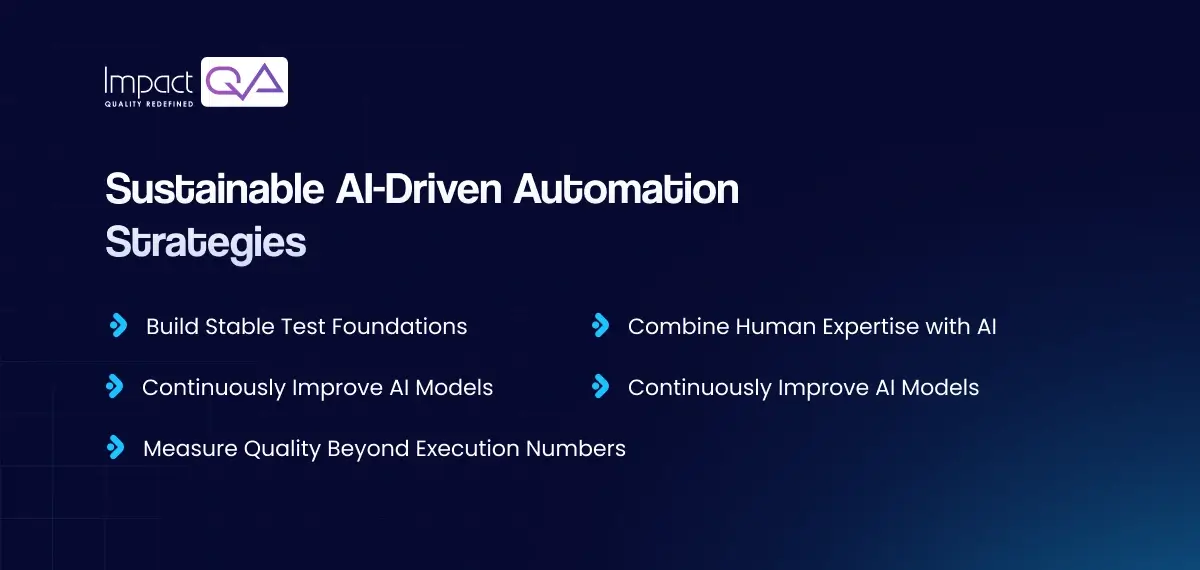
The following strategies contribute to sustainable implementation.
Build Stable Test Foundations
AI delivers stronger results when automation suites already contain reliable, reusable, and modular test cases. Clean architecture reduces complexity while improving AI decision-making accuracy.
Combine Human Expertise with AI
Although AI accelerates execution and analysis, experienced testers remain responsible for business validation, exploratory testing, and scenario design. Human judgment continues to play an indispensable role in maintaining software quality.
Continuously Improve AI Models
AI recommendations improve as they receive additional execution data. Therefore, organizations should regularly review model performance and refine decision criteria based on production feedback.
Measure Quality Beyond Execution Numbers
Execution volume alone cannot demonstrate automation maturity. Teams should monitor defect leakage, execution efficiency, maintenance effort, and production stability to evaluate overall testing effectiveness.
Select Scalable Technology
Organizations should invest in AI automation testing frameworks capable of integrating with CI/CD platforms, cloud infrastructure, reporting systems, and enterprise development tools. Such compatibility supports future expansion without requiring significant redevelopment.
Many enterprises also collaborate with specialized automation testing service providers to accelerate implementation while aligning automation strategies with business priorities. Similarly, automated software testing services offer additional expertise for organizations managing complex enterprise applications and distributed development environments.
We deliver advanced test automation services that improve release quality, reduce maintenance effort, and support faster software delivery.
Final Say
Artificial intelligence is gradually changing the way software quality is engineered. Instead of merely accelerating execution, AI introduces intelligence into planning, maintenance, analysis, and optimization. Consequently, organizations achieve faster feedback and stronger regression coverage without increasing testing complexity. As software ecosystems continue to become larger and more interconnected, AI in test automation will increasingly influence how engineering teams maintain delivery speed while protecting software reliability.
At ImpactQA, we believe successful quality engineering combines domain expertise with intelligent innovation. Our test automation services integrate advanced AI test automation capabilities with scalable engineering practices to help enterprises modernize their delivery pipelines. Whether organizations are expanding enterprise automation testing, implementing AI for automation testing, or strengthening DevOps validation through intelligent test automation, we deliver solutions that improve software quality while supporting sustainable business growth.
Frequently Asked Questions (FAQs)
Share this post


Related Posts
Our Case Studies