Quick Summary:
Mobile applications are becoming more complex, but testing can become more intelligent, adaptive, and targeted. This blog explores how AI is transforming mobile app testing through intelligent test generation, predictive performance analysis, security validation, adaptive automation, connected testing insights, and practical strategies for overcoming adoption challenges.
Table of Contents:
- Introduction
- AI Is Changing How Mobile Applications Are Tested
- AI Is Making Mobile Performance Testing More Predictive
- AI Is Strengthening Mobile Application Security Testing Services
- Mobile App Automation Testing Is Becoming More Adaptive
- How Mobile App Testing Software Is Evolving
- Challenges That Can Limit AI Adoption
- Practical Strategies for Implementing AI in Mobile Testing
- Final Say
Mobile applications in 2026 operate across fragmented devices, operating systems, APIs, cloud services, variable networks, and AI-enabled features. This complexity is increasing the need for more adaptive quality engineering. Gartner forecasts global AI spending to reach $2.52 trillion in 2026, a 44% year-over-year increase. Its impact is now extending into software testing, where AI is being applied to test generation, defect analysis, visual validation, security assessment, and performance diagnostics.
As a result, mobile app testing is moving beyond fixed scripts and broad regression cycles. AI mobile app testing can analyze application changes, historical failures, device behavior, and user journeys to identify relevant testing priorities. This shift is redefining mobile application testing services for complex mobile ecosystems.
Partner with ImpactQA to deliver secure, high performing, and reliable mobile applications.
AI Is Changing How Mobile Applications Are Tested
Traditional mobile app testing relies on predefined cases, fixed scripts, and manual maintenance. However, frequent interface changes, API updates, backend modifications, and operating system upgrades make this approach increasingly difficult to sustain. AI can analyze application changes, historical defects, test results, dependencies, and user flows to identify affected functions and recommend focused validation.
AI is changing mobile testing across four key areas:
1. Intelligent Test Generation: AI tools for mobile app testing can generate scenarios from requirements, user stories, application flows, and existing test assets. They can identify negative conditions, boundary cases, and alternate user paths often missed during manual test design.
2. Change Impact Analysis: AI can analyze application changes and identify related functions, integrations, and test cases. This allows teams to focus on testing affected areas instead of repeatedly executing unrelated scenarios.
3. Self-Healing Automation: When interface elements change, AI can use visual properties, semantic meaning, location, and historical interaction patterns to identify replacement elements. This reduces unnecessary script failures during mobile app automation testing.
5. Visual Validation: Computer vision can identify layout shifts, overlapping elements, truncated text, incorrect spacing, and inconsistent rendering across screen sizes. This is especially useful for applications supporting multiple device configurations.
AI Is Making Mobile Performance Testing More Predictive
Mobile performance depends on response time, device hardware, memory availability, battery condition, network quality, operating system behavior, background applications, and server response. Since no single test environment represents the full range of user conditions, mobile app performance testing must examine patterns across devices, builds, and network scenarios. AI can analyze these variables together, identify gradual changes, and help engineers investigate performance issues before they become widespread application failures.
This predictive approach is particularly valuable across the following performance dimensions:
1. Performance Trend Detection: AI can identify gradual increases in response time, memory consumption, CPU usage, or crash frequency across builds. These patterns may reveal degradation before they become major application failures.
2. Device-Specific Analysis: Testing systems can compare application behavior across hardware profiles and operating systems. This helps identify whether performance issues are limited to specific devices or reflect a wider application problem.
3. Network Condition Analysis: AI can analyze application behavior across different network conditions. It can identify workflows that become unstable during weak connectivity, latency, packet loss, or network transitions.
4. Root Cause Correlation: Performance data can relate to application changes, backend responses, device conditions, and test results. This gives engineers a more focused starting point for investigating performance degradation.
AI Is Strengthening Mobile Application Security Testing Services
Mobile applications handle sensitive data through APIs, local storage, authentication systems, payment services, and third-party integrations, creating multiple points of security exposure. Mobile application security testing services are using AI to analyze application behavior, traffic patterns, code changes, and vulnerability findings. AI can prioritize issues based on exposure, exploitability, affected data, and business impact while identifying unusual API calls, authentication activity, data transfers, and application behavior that conventional rule-based testing may overlook.
This approach strengthens security validation across key areas:
1. Vulnerability Prioritization: AI can classify security findings according to exploitability, application exposure, affected functionality, and data sensitivity. This helps security teams focus on issues requiring faster investigation.
2. Behavioral Monitoring: Testing systems can identify unusual application behavior, including unexpected data transfers, abnormal authentication patterns, or unplanned API interactions.
3. API Security Analysis: AI can analyze API behavior across expected and unexpected inputs. This helps identify authorization weaknesses, abnormal responses, and unusual data exposure patterns.
4. AI Feature Testing: Applications using chatbots, recommendation engines, computer vision, or generative AI require additional validation. Testing must examine response accuracy, consistency, safety, and unexpected outputs.
Mobile App Automation Testing Is Becoming More Adaptive
Automation has long supported mobile testing, but fixed locators and predefined paths can make scripts vulnerable to interface changes. AI enables systems to interpret elements through text, location, visual characteristics, semantic meaning, and prior interactions. This makes mobile app automation testing more adaptive while supporting targeted test selection based on code changes, previous failures, and affected workflows.
1. Adaptive Element Recognition: AI can identify interface elements using visual characteristics, text, location, and semantic context. This reduces dependence on a single fixed locator.
2. Intelligent Test Selection: AI can analyze application changes and historical failures to recommend relevant tests. This helps teams focus execution on functions more likely to be affected.
3. Automated Test Maintenance: When an application interface changes, AI can identify broken automation paths and suggest alternative interactions. Engineers can then review and approve the required updates.
4. Cross Platform Execution: AI can identify device and operating system combinations that are more relevant to a specific change. This helps teams make device testing decisions using application risk.
How Mobile App Testing Software Is Evolving
Mobile app testing software is evolving beyond script execution by connecting test results with historical failure data, application changes, device configurations, and performance findings. This helps teams trace failures to specific builds or changes and distinguish isolated issues from recurring problems across devices, creating a more informed basis for investigation and remediation.
1. Test Data Analysis: AI can analyze historical execution results, failed tests, defect reports, and application changes. This helps identify recurring failure patterns.
2. Defect Prediction: Testing systems can identify modules with repeated defects or higher failure rates. These areas can then receive additional validation during future development cycles.
3. Unified Test Insights: Functional, security, performance, and compatibility results can be reviewed together. This helps teams investigate problems without examining every testing activity separately.
Challenges That Can Limit AI Adoption
Despite these advancements, AI adoption in mobile testing requires more than selecting a tool and connecting it to existing workflows. Enterprises must address data quality, testing complexity, device fragmentation, and the need for engineering oversight before scaling AI across their mobile quality processes.
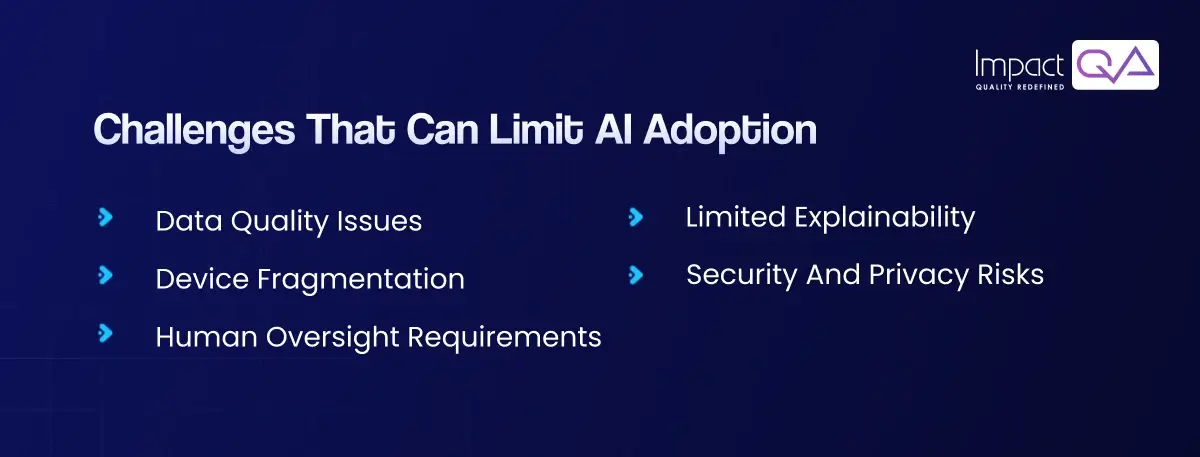
1. Data Quality Issues: Poorly maintained test cases, duplicate defect records, incomplete execution results, and outdated automation assets can produce unreliable AI recommendations and reduce the accuracy of testing decisions.
2. Limited Explainability: QA teams need to understand why an AI system selected a test, prioritized a defect, or identified a risk. Without visibility, automated recommendations become difficult to validate.
3. Device Fragmentation: AI can improve test selection, but enterprises still require a carefully defined device matrix covering operating systems, hardware profiles, screen sizes, and network conditions.
4. Security And Privacy Risks: Testing environments may contain credentials, personal information, payment data, and production like records. Strict access controls and data protection practices are therefore essential.
5. Human Oversight Requirements: AI can identify patterns and recommend actions, but engineers must still assess complex failures, business logic, security implications, and unexpected application behavior.
ImpactQA combines AI-driven testing with proven QA expertise to improve software quality.
Practical Strategies for Implementing AI in Mobile Testing
Enterprises should adopt AI-based on specific testing problems rather than adding AI to every activity. A focused approach produces clearer results and makes adoption easier to measure.
1. Begin With High-Risk Workflows: Start with authentication, payments, checkout, financial transactions, healthcare workflows, and other functions where application failures can create significant business or security consequences.
2. Connect AI With Existing Automation: Existing automation frameworks contain valuable test history and execution data. AI can use these assets for test prioritization, maintenance, and failure analysis.
3. Improve Testing Data Quality: Standardized test results, defect records, requirements, and application changes provide better input for AI-based analysis and recommendations.
4. Measure Technical Outcomes: Track regression duration, test maintenance effort, defect leakage, application crashes, false failures, and production incidents to evaluate measurable improvement.
5. Keep Engineering Oversight: AI recommendations should remain reviewable. QA professionals must assess complex failures, business logic, security implications, and unexpected application behavior before final decisions are made.
Final Say
At ImpactQA, we combine AI-driven testing with expertise in mobile app testing, automation, security, performance, and functional validation. Our mobile application testing services help enterprises evaluate applications across devices, operating systems, APIs, integrations, and changing user workflows. Through intelligent automation and targeted validation, we help organizations identify application risks earlier and deliver more reliable mobile experiences in 2026.
Share this post


Related Posts
Our Case Studies