Testing Solutions for Manufacturing in the Era of Industrial IoT and Automation
Quick Summary:
Industrial IoT and automation are transforming manufacturing. This shift demands rigorous testing to ensure systems run smoothly, safely, and efficiently. This blog explores the critical role of testing solutions for manufacturing, dives into different manufacturing testing methods, and highlights how companies like ImpactQA provide tailored services to meet these growing needs.
Table of Contents:
- Introduction
- The Manufacturing Shift: Industrial IoT and Automation
- Why Testing Solutions for Manufacturing Are Essential
- Key Manufacturing Testing Methods
- Challenges in Testing Industrial IoT and Automation Systems
- Strategies to Build Reliable Testing Solutions for Manufacturing
- Emerging Technologies Impacting Manufacturing Testing Methods
- The Role of ImpactQA in Delivering Advanced Testing Solutions
- Conclusion
What happens when machines talk to each other, make decisions, and control production with little human input? The answer lies at the heart of Industrial IoT (IIoT) and automation. Manufacturing plants now rely on a web of connected devices, real-time analytics, AI algorithms, and automated control systems. This complexity has unlocked higher precision, better efficiency, and predictive maintenance capabilities.
But complexity also invites risks. Any minor defect in code, hardware, or integration can halt production, compromise safety, or damage assets. Testing has moved beyond conventional checks. It now demands specialized solutions that can validate performance, security, and interoperability across the entire manufacturing system.
This blog examines the significance of testing solutions for manufacturing, explores advanced manufacturing testing methods, and offers insights into how organizations can future-proof their production environments through effective testing.
ImpactQA's end-to-end testing services can resolve these complexities.
The Manufacturing Shift: Industrial IoT and Automation
Manufacturing has undergone rapid digitization. Machines, sensors, and control systems now operate as integrated digital units. IIoT platforms collect data continuously, while automation drives autonomous decisions.
- Smart sensors monitor temperature, pressure, and vibrations.
- Predictive maintenance tools analyze data to forecast failures.
- Autonomous robots handle repetitive tasks with high precision.
- Real-time dashboards optimize production planning.
However, this transformation introduces interconnected dependencies. A failure in one component can trigger cascading issues across the production line. Testing every element within this ecosystem has become non-negotiable.
Why Testing Solutions for Manufacturing Are Essential
Manufacturers cannot afford production halts or system downtime. Any glitch can lead to:
- Financial losses
- Safety hazards
- Compromised product quality
- Regulatory non-compliance
Testing solutions for manufacturing help identify vulnerabilities before they disrupt operations. These solutions validate the end-to-end system performance under real-world conditions.
Key focus areas include:
- Functional correctness of automation systems
- Real-time data processing accuracy
- Communication reliability between devices
- Cybersecurity resilience
- Scalability under peak loads
- Failover and recovery mechanisms
As IIoT platforms expand, testing must validate both individual components and complete integrated workflows. With the growing use of AI-driven automation, machine-to-machine communication, and predictive analytics in industrial operations, testing also needs to cover the accuracy of data insights, model training consistency, and intelligent decision-making processes. The ability to simulate complex scenarios becomes crucial to prepare manufacturing systems for unexpected conditions while maintaining operational efficiency.
Key Manufacturing Testing Methods
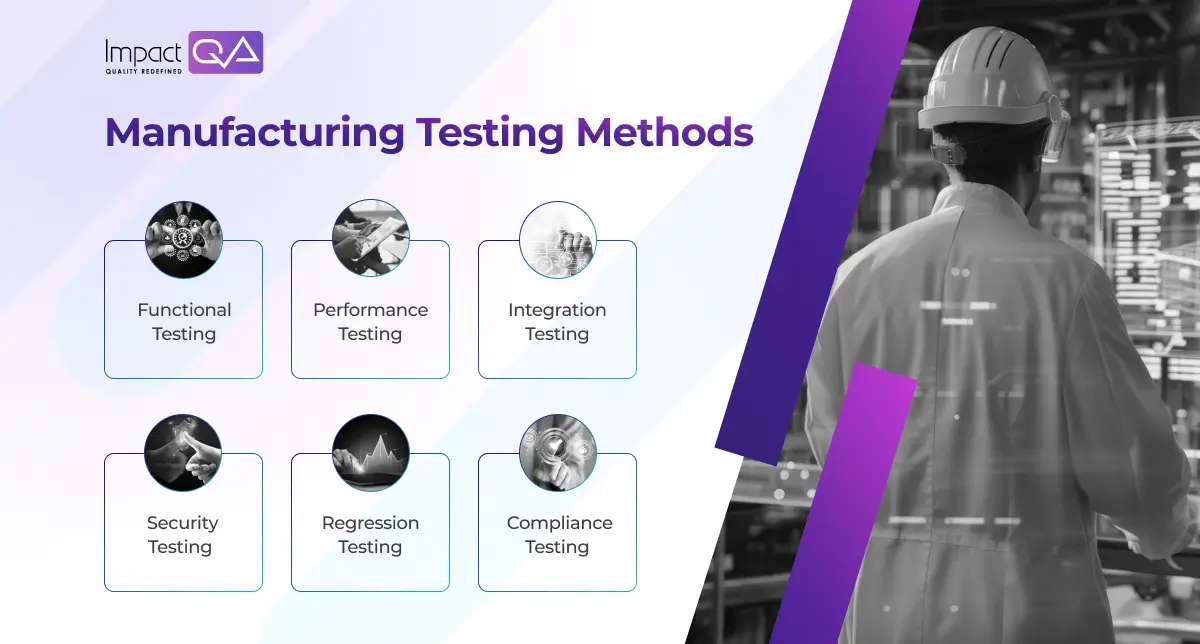
Modern manufacturing relies on a combination of automation, software, hardware, and data systems. Testing each layer requires specific manufacturing testing methods. These methods ensure that the entire production system runs without errors or disruptions.
1. Functional Testing
The first step is to verify whether individual systems perform as intended. Every machine, sensor, and automation unit must follow its programmed logic.
- PLC (Programmable Logic Controller) logic validation: This confirms that control logic executes each command accurately. Machines must follow the correct sequence, whether during production or when responding to faults.
- HMI (Human Machine Interface) checks: The interface must display accurate information. It should respond quickly to user inputs and allow safe manual overrides when required.
- Machine control sequence verification: Every task must occur in the right order. This keeps robots, conveyor belts, and processing equipment synchronized, even when product specifications change.
2. Performance Testing
Performance testing helps manufacturers understand how systems behave under different loads. Stable performance under all conditions is crucial to avoid downtime.
- Response time analysis: Sensors and controllers must react instantly to input signals. Delays can disrupt production and cause safety risks.
- Throughput validation: The system must handle peak production volumes. High throughput keeps output steady without overloading equipment.
- Resource utilization monitoring: This checks CPU, memory, and network usage. Efficient resource allocation ensures consistent production without slowdowns.
3. Integration Testing
Manufacturing involves multiple systems working together. Integration testing ensures smooth data exchange across all connected components.
- Device-to-device communication: Machines share data over protocols like OPC-UA, MQTT, or Modbus. Reliable communication keeps operations coordinated.
- SCADA (Supervisory Control and Data Acquisition) platform integration: SCADA systems must collect real-time data from equipment. They provide accurate oversight for operators and management teams.
- MES (Manufacturing Execution System) connectivity: The MES connects shop floor activity with enterprise software like ERP. Accurate data flow supports production tracking, resource planning, and inventory control.
4. Security Testing
As systems become more connected, protecting manufacturing networks from cyber threats becomes a priority. Security testing identifies risks before they cause harm.
- Network vulnerability assessments: Industrial networks, both wired and wireless, need protection from external attacks and internal breaches.
- Access control verification: Every user and device must have the right level of access. Encryption and authentication prevent unauthorized entry.
- Secure firmware and OTA update validations: Firmware updates often happen remotely. Secure update processes prevent the introduction of new weaknesses.
5. Regression Testing
Manufacturing systems receive constant updates. Regression testing ensures that updates don’t interfere with existing operations.
- Automated regression suites: After every change, these suites re-run existing test cases. This confirms that all previous features continue to work correctly.
- Continuous validation cycles: With continuous integration, regression testing runs automatically. This allows quick releases without risking stability.
6. Compliance Testing
Manufacturing operates under strict regulations. Compliance testing ensures every system meets industry and legal requirements.
- ISO 9001, ISO/IEC 27001: These certifications verify that quality management and data security processes meet international standards.
- Industry-specific certifications: Sectors like medical, automotive, and industrial automation require specific approvals. Standards such as FDA, IATF 16949, and IEC 62443 confirm that systems operate safely and reliably.
Challenges in Testing Industrial IoT and Automation Systems

The unique nature of IIoT-driven manufacturing introduces several testing complexities:
- Massive Device Diversity: Each machine, sensor, and controller uses different hardware, firmware, and protocols.
- Real-Time Processing: Systems must process data with low latency to avoid production delays.
- Security Vulnerabilities: Connected devices widen the attack surface.
- Simulation Difficulties: Replicating real-world manufacturing conditions for testing is challenging.
- Continuous Updates: Frequent software updates demand repeated testing cycles.
Without a specialized testing framework, these challenges can overwhelm internal QA teams.
Strategies to Build Reliable Testing Solutions for Manufacturing
Building effective testing solutions for manufacturing requires a layered approach.
1. Create Digital Twins
Digital twins replicate physical manufacturing systems virtually. They allow testers to simulate different scenarios and identify weaknesses without risking actual production downtime.
2. Implement Continuous Testing Pipelines
Automated testing integrated into the CI/CD pipeline ensures ongoing validation as systems evolve.
3. Use Protocol-Aware Testing Tools
IIoT devices use various communication protocols (Modbus, OPC-UA, MQTT). Tools that understand these protocols can test communication pathways effectively.
4. Leverage Edge Testing
Test computing units deployed at the edge of networks. Edge testing ensures localized processing behaves accurately before integrating into the main system.
5. Adopt Risk-Based Testing
Prioritize testing for high-impact areas such as safety-critical equipment, high-value assets, and key control processes.
6. Perform Multi-Layered Security Testing
Secure all access points, from device firmware to cloud platforms. Test for both known vulnerabilities and emerging threats.
Emerging Technologies Impacting Manufacturing Testing Methods
Technology advances are reshaping manufacturing testing methods and creating new opportunities.
AI-Powered Testing
Machine learning algorithms can predict system failures based on historical data patterns. Predictive analytics help organizations address issues before they escalate.
Autonomous Testing Frameworks
Automated bots simulate user and system interactions across IIoT platforms, reducing manual testing efforts and increasing test coverage.
Robotics Simulation Platforms
Simulating robot behavior before deployment prevents costly mistakes. These platforms test coordination, precision, and fault tolerance.
Blockchain for Data Integrity
Blockchain ensures tamper-proof logs of test results and production data, simplifying audit trails and compliance verification.
5G-Driven Low-Latency Testing
5G networks enable ultra-fast data transfers, allowing testers to validate real-time communication between machines, even across distributed facilities.
The Role of ImpactQA in Delivering Advanced Testing Solutions
Manufacturing systems rely on multiple technologies to work together. As these systems grow more connected, testing needs to address every layer. ImpactQA offers services designed to meet these demands, helping manufacturers keep operations stable and efficient.
1. IIoT Testing Across Connected Devices
Manufacturing environments use thousands of devices sharing data in real-time. ImpactQA tests these Industrial IoT platforms across sensors, gateways, and cloud systems. Our protocol-specific tests validate that devices exchange accurate data and remain fully interoperable across the system.
2. Automation Testing for Industrial Systems
Automation controls everything from simple machines to full production lines. ImpactQA tests PLCs, HMIs, MES, and SCADA systems to verify functional accuracy. Our tests also check how these systems integrate and maintain uptime during daily operations.
3. Cybersecurity Testing for Manufacturing Networks
IIoT systems increase the surface area for cyber-attacks. ImpactQA performs detailed security assessments across networks, devices, and control layers. Our experts check for vulnerabilities and validate that the right protections exist to keep production secure.
4. Compliance Testing for Global Standards
Manufacturing operations must follow strict regulations. ImpactQA supports manufacturers in meeting quality standards like ISO and industry-specific regulations. Our audit-ready test frameworks help maintain compliance across global markets.
5. Performance and Stress Testing for Production Stability
High production demands can overload systems if not tested properly. ImpactQA runs load and stress tests that simulate maximum operating conditions. This helps manufacturers avoid outages and performance drops during peak production.
Partner with ImpactQA for robust security testing.
Conclusion
Industrial IoT and automation continue to reshape manufacturing operations. However, with growing complexity, the importance of reliable testing only increases. Traditional methods are no longer sufficient. Manufacturers must adopt specialized testing solutions for manufacturing that can validate the full spectrum of performance, security, integration, and compliance demands.
Future manufacturing success depends on rigorous validation across both physical assets and digital systems. Digital twins, autonomous testing frameworks, AI-driven analytics, and 5G networks will redefine how tests are conducted. These advancements will create smarter, safer, and more resilient production environments.
ImpactQA stands at the forefront of this shift. Our tailored services combine domain expertise, advanced tools, and global experience to deliver reliable testing across complex IIoT-driven manufacturing systems. Whether securing connected devices, validating automation workflows, or ensuring regulatory compliance, ImpactQA enables manufacturers to scale confidently.
Share this post


Related Posts
Our Case Studies