Quick Summary:
Choosing an SAP testing partner is one of the bigger decisions you’ll make before the 2027 ECC maintenance deadline. This blog breaks it down into eight things to check, from a test strategy that fits your implementation path to end-to-end process coverage, change-based regression and automation that works on both SAP GUI and Fiori. It also looks at how to judge agentic AI in SAP, data migration, performance and security, and the KPIs a provider should commit to. Each point comes with one question to ask in vendor workshops. We close with how ImpactQA’s SAP testing services line up against the list.
Table of Contents:
- Introduction
- 8-Point Checklist for Choosing an SAP Testing Services Provider
- Final Say
- FAQs
SAP runs the financial close and the supply chain for thousands of enterprises, and right now the calendar is setting the pace. SAP ends mainstream maintenance for ECC on December 31, 2027, and Gartner’s count at the end of 2024 showed 39% of the 35,000 ECC customers holding an S/4HANA license. Do the math and you can see why demand for SAP testing services will bunch up inside a short window.
A conversion is hard to test because so much moves together. Custom ABAP written years ago meets years of master data, and a single untested transport can hold up order-to-cash or put a wrong figure in the ledger.
Your testing partner decides how early you find those defects. Agentic AI in SAP adds speed as well, because agents can now draft test cases from process documents and rank regression by change risk. What follows is how we’d judge a provider on all of this.
Get a test strategy written for your implementation path.
8-Point Checklist for Choosing an SAP Testing Services Provider
Bring this list to your vendor workshops and score as you go. The question under each point is there to get you past the sales deck.
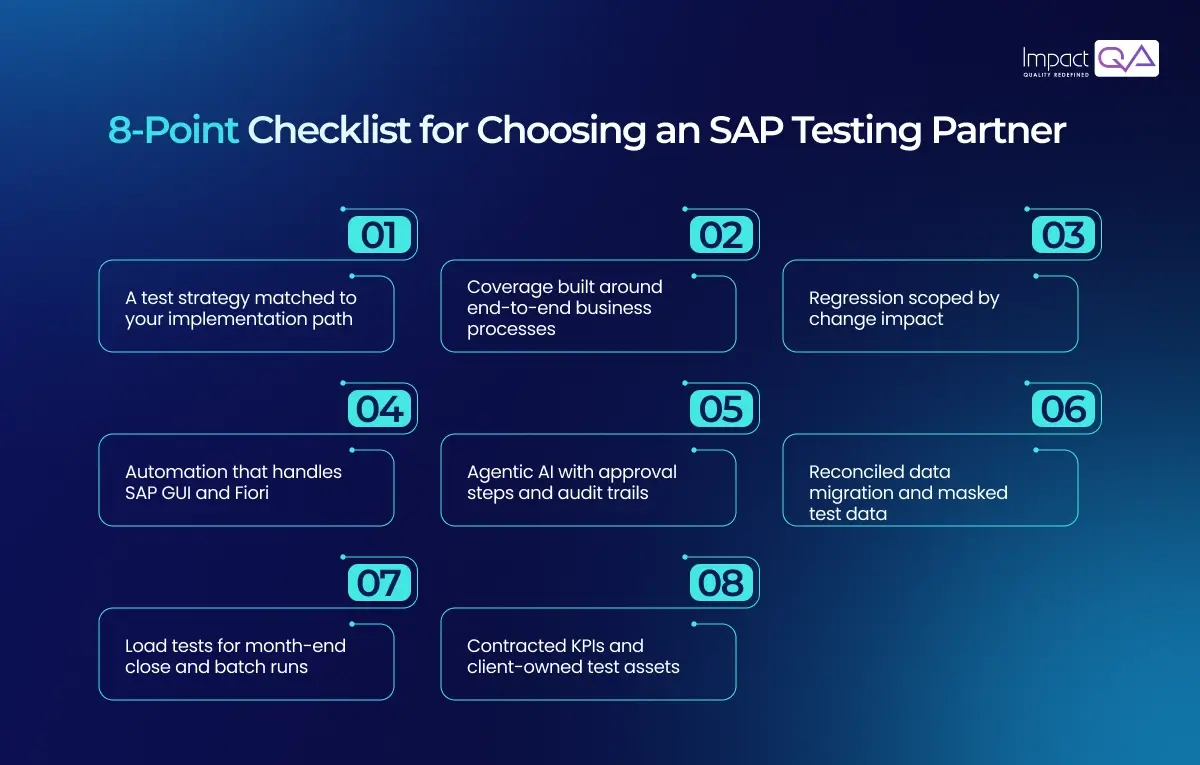
Checklist #1: A Test Strategy Matched to Your Implementation Path
Ask three vendors about test strategy and you may see the same slide three times. It shouldn’t be the same, because your path changes the risk. In a brownfield conversion, the system goes through Software Update Manager (SUM) and comes out on S/4HANA, so the job is functional-equivalence regression: proving each process works the way it did before. A greenfield build has no “before”. Testers validate newly designed processes end to end, along with the data loads that feed them. Selective transitions carry their own mix of both. Strong SAP test strategy services begin with this conversation.
Ask: Show us the test strategy you would write for our path.
Checklist #2: End-to-End Process Coverage
SAP modules rarely fail alone. A pricing condition can pass every check in SD and still post to the wrong account in FI, which is why the costliest defects tend to sit where modules meet. SAP functional testing confirms that one module follows its configuration. Integration testing picks up a whole flow, such as order-to-cash, and follows it across IDocs, BAPIs, OData services and middleware. Look for a partner that plans coverage around your business processes, the way SAP integration testing services for seamless enterprise workflows are scoped.
Ask: How do you map our top business processes to test cases?
Checklist #3: Regression Scoped by Change Impact
A transport here, a support pack there, and S/4HANA Cloud adds two major releases a year with feature updates in between. Re-running everything each time isn’t practical. Change-impact analysis reads the objects inside a transport and traces them to the processes they can affect. SAP regression testing services built on that analysis run those tests first, so the cycle gets shorter even while coverage grows.
Ask: How do you size regression for a single transport?
Checklist #4: Automation Built for SAP’s Interfaces
Scripts that run fine on SAP GUI can fall over on Fiori. SAPUI5 often generates dynamic element IDs, so a locator that worked yesterday may find nothing today. Stable locators or self-healing solve that. Ask to see the numbers too: mature SAP test automation services report maintenance effort per release as a matter of course, and their SAP automated testing tools cover both interfaces.
Ask: What share of scripts needed repair after your last client upgrade?
Checklist #5: Agentic AI in SAP, With Governance
Agentic AI in SAP does more than run a script faster. An agent can read a functional specification or process flow, draft manual test cases, turn the approved ones into automation and triage what fails. The results are real, and the agentic AI cutting SAP testing cycles shows how far they reach. Whether those gains hold is a governance question. Each agent action needs an approval step and an audit trail someone can follow later.
Ask: Which agent decisions need human sign-off, and how are they logged?
Checklist #6: Data Migration and Test Data Discipline
Record counts are the easy part of migration testing. The harder proof is that open items and financial balances match between source and target once the load is done. Your test systems also need masked production copies or synthetic data, which keeps regulated fields protected. Ask a partner for reconciliation reports from earlier programs, and read them.
Ask: How do you prove financial balances match after a mock load?
Checklist #7: Performance and Security Depth
Passing functional tests tells you little about a month-end close. SAP S/4HANA testing has to reach batch-heavy periods too, such as an MRP run, along with Fiori response times. Security needs the same attention. That means static analysis of custom ABAP, plus authorization checks so one user can’t both create a vendor and approve its payment. That’s segregation of duties in practice.
Ask: How do you load-test our month-end close?
Checklist #8: Measurable Commitments and Asset Ownership
Good SAP QA testing services will put numbers in writing. We’d want three in the contract: defect leakage into production, regression cycle time and automation coverage of critical processes. Settle ownership early as well. When the engagement ends, the test assets and frameworks stay with you.
Ask: Which KPIs will you report each release, and who owns the test assets?
Get reconciliation and regression built into every cycle.
Final Say
SAP landscapes won’t sit still after 2027. Cloud releases keep coming, agents are starting to work inside business processes, and testing has to move at that rhythm. If you score partners on strategy, governance and measurable outcomes now, you’ll keep that habit long after the deadline.
At ImpactQA, we write a separate test strategy for greenfield, brownfield and bluefield programs, and our SAP testing services apply functional-equivalence regression to system conversions. Our agentic AI automation builds manual and automation test cases directly from business requirements and SAP process flows, while SAST and DAST cover security across the custom ABAP and SAPUI5 layers. Programs run this way have delivered 4X testing productivity and 90% lower test script maintenance.
Download the full case study and see how it works in action.
Share this post


Related Posts
Our Case Studies