
Quick Summary:
Blockchain applications run on code that is hard to change once deployed, so defects reach users with real money attached. This article explains what blockchain application testing services cover, including smart contract testing, node and consensus checks, integration with wallets and oracles, performance benchmarking and penetration testing. It also walks through the tools QA teams use, how automated testing fits into blockchain delivery and what to look for when choosing a blockchain testing company, with each area anchored to 2025 loss data.
Table of Contents:
- Introduction
- What Are Blockchain Application Testing Services?
- Why Does Blockchain Testing Matter?
- What’s Included in Blockchain Application Testing Services?
- How Do Blockchain Penetration and Performance Testing Work?
- Which Blockchain Testing Tools Do QA Teams Use?
- How Do You Choose a Blockchain Testing Company?
- Final Say
- Frequently Asked Questions
A lending protocol ships an upgrade on Tuesday. By Thursday, an attacker has called an admin function that nobody restricted and drained the pool. The transactions have been confirmed, and recovering the funds may be extremely difficult.
That’s the core reason blockchain application testing services exist. Blockchain testing validates smart contracts, nodes, integrations and performance before code reaches a live network, where mistakes are expensive and permanent. This guide breaks down what a full engagement includes, which tools teams rely on and how to pick the right partner.
What Are Blockchain Application Testing Services?
Blockchain application testing services are structured QA engagements that verify every layer of a decentralised application: smart contracts, nodes and consensus, APIs, wallets and the user interface. They confirm the application behaves correctly, performs under load and resists attack before deployment to a live network.
Blockchain software testing differs from standard web QA in three ways. Deployed smart-contract code is generally immutable, while upgradeable designs rely on mechanisms such as proxy contracts or controlled redeployment and migration. Every node must reach the same result from the same input. And each transaction costs gas, so inefficient code carries a direct fee.
Map your coverage gaps with our blockchain testing specialists.
Why Does Blockchain Testing Matter?
Blockchain defects turn straight into financial loss. Funds move the moment a flawed contract executes, and reversing a confirmed transaction is close to impossible. Testing before deployment is the cheapest point to find access control gaps, logic errors and integration faults.
The OWASP Smart Contract Top 10:2026 analysed 122 smart contract incidents from 2025, totalling roughly $905.4 million in losses. Access control vulnerabilities rank first, with business logic vulnerabilities second. Both are testable. A role check missing from a mint function shows up in a negative test case long before an attacker finds it.
What’s Included in Blockchain Application Testing Services?
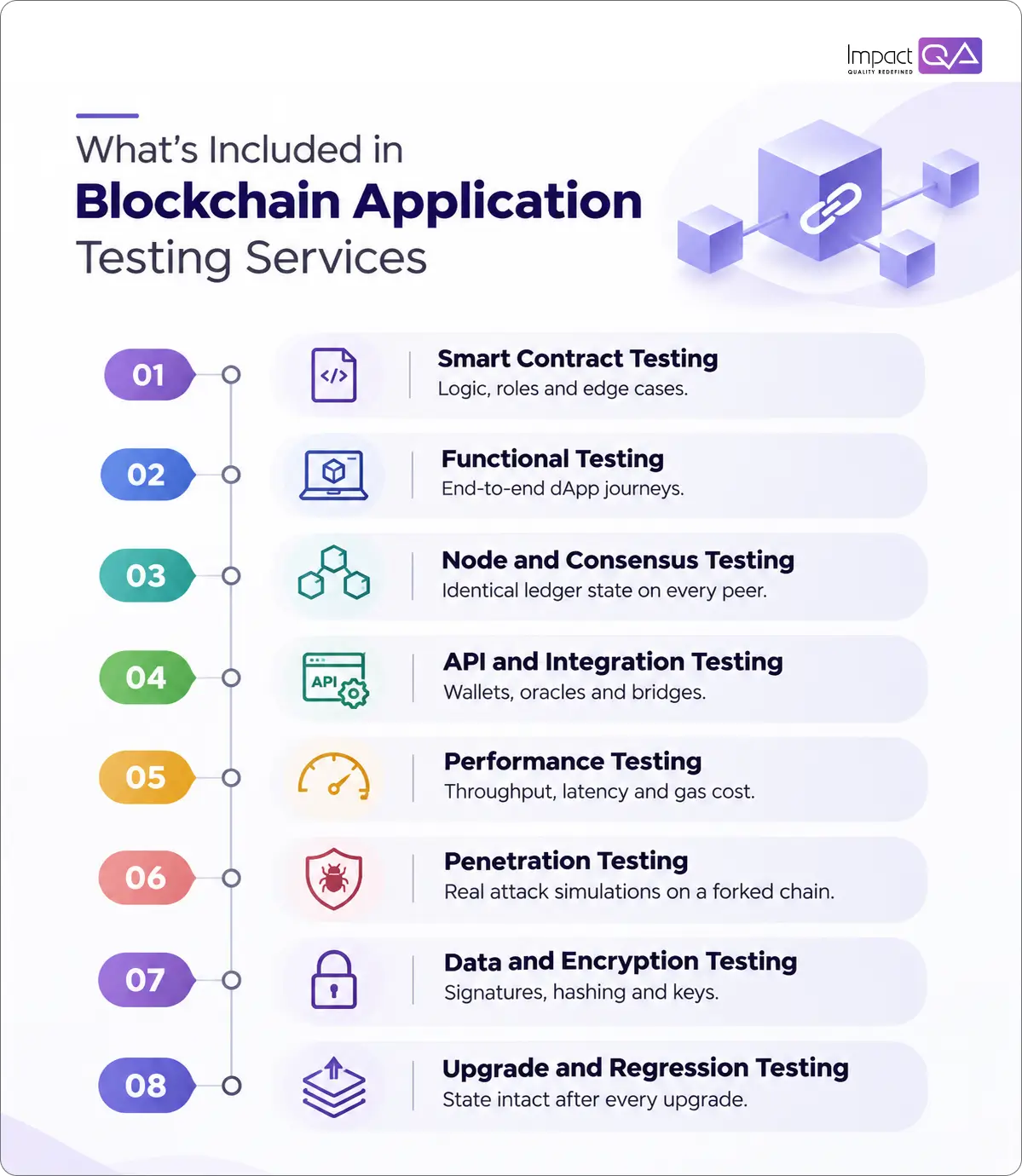
A complete engagement covers eight testing areas, each targeting a different failure point. Smart contract and security testing protect the funds, node and consensus testing protect data integrity, and performance and integration testing confirm the application holds up under real usage.
Testing Area |
What It Validates |
Example Check |
| Smart contract testing | Platform expertise | Logic, access roles, edge cases |
| Functional testing | Implementation capability | End-to-end dApp journeys |
| Node and consensus testing | Domain Knowledge | Ledger consistency across peers |
| API and integration testing | Functional testing | Wallets, oracles and bridges |
| Performance testing | Integration testing | Throughput, latency and gas |
| Security and penetration testing | Regression | Exploitable flaws |
| Data and encryption testing | Automation | Signatures, hashing, key handling |
| Upgrade and regression testing | Performance | Proxy upgrades, storage layout |
Smart contract testing carries the most weight. Unit tests check individual contract functions, while fuzz and invariant testing exercise contracts with generated inputs and transaction sequences to uncover unexpected behavior. For example, teams can check whether a token’s total supply remains consistent with the sum of user balances throughout the tested operations.
How Do Blockchain Penetration and Performance Testing Work?
Blockchain penetration testing attacks the application the way a real adversary would, targeting contracts, keys, nodes and front ends. Blockchain performance testing measures transaction throughput, processing latency, confirmation or finality time, and execution costs such as gas on applicable networks.
Penetration Testing
Pen testers can simulate oracle manipulation, flash-loan attacks, reentrancy and signature replay against a forked copy of the live chain. This reproduces a selected contract state in a controlled environment without putting real funds at risk. A broader assessment can also examine admin-key storage, multisig controls and the dApp front end.
The scope reaches past the code, too. OWASP tracks non-contract attack vectors in a separate Web3 list, so a full blockchain penetration test also probes admin key storage, multisig setups and the dApp front end.
Performance Testing
Public chains and private networks need different approaches. On Ethereum-compatible chains, teams measure gas per function and confirmation time under congestion. On Hyperledger Fabric or Besu networks, they push transaction volume until latency climbs, which shows the real throughput ceiling for the chosen consensus setup.
Which Blockchain Testing Tools Do QA Teams Use?
Most teams combine a development framework for unit and fuzz tests, a static analyser for known vulnerability patterns and a benchmarking tool for performance. Each tool covers one layer, so mature blockchain QA testing runs several together inside the CI pipeline.
Foundry and Hardhat are widely used frameworks for Solidity work, with mainnet forking, local test networks and, in Foundry’s case, built-in fuzzing. Slither scans contracts for known vulnerability patterns in seconds. Echidna runs property-based fuzzing to break invariants. For permissioned networks, Hyperledger Caliper reports success rate, throughput and latency across Fabric, Besu and Ethereum.
Automated testing for blockchain ties these together. Every pull request runs unit, fuzz and static checks, and a failed invariant blocks the merge, just as a failed unit test does in any other codebase.
Speak with ImpactQA about testing your application before it goes live.
How Do You Choose a Blockchain Testing Company?
Choose a partner with hands-on smart contract experience, coverage across both public and permissioned chains, and the ability to fold blockchain testing into your existing CI/CD and broader software testing services. Clear, reproducible reports matter as much as the findings themselves.
Ask three questions before signing. Which chains and languages has the team tested in production? How do they prove a fix works, through a regression test or a re-run exploit? And does the engagement include performance testing alongside security? A secure contract that burns too much gas still loses users.
Final Say
Blockchain applications leave little room for post-launch fixes, so quality has to be proven before deployment. Strong blockchain application testing treats contracts, nodes, integrations, performance and security as one connected effort. ImpactQA’s blockchain testing services cover smart contract, peer and node, API, performance and security testing, backed by chain code reviews and smart contract test reports. Teams building on public, private or consortium blockchains get coverage matched to their architecture.
Download the full case study and see how it works in action.
Frequently Asked Questions (FAQs)
Share this post


Related Posts
Our Case Studies
