Quick Summary:
Scripted test automation grows harder to sustain as interfaces change, suites expand and authorship stays with a few engineers. No-code, agentic platforms answer this by turning plain-English scenarios into executed tests. Falcon, ImpactQA’s agentic test automation platform, uses Claude AI to read each screen and act step by step across web browsers, real Android devices, REST APIs and documentation-grounded chatbot checks. Self-healing absorbs routine UI changes, confidence scores surface flaky tests, and CI/CD integrations place every run inside existing pipelines with step-level evidence.
Table of Contents:
- Introduction
- 9 Reasons Why Teams Are Switching to Falcon for Scriptless Test Automation
- Where Does Falcon Fit in an Enterprise Automation Strategy?
- How Can Teams Get Started with Falcon?
- Final Say
- Frequently Asked Questions
A regression suite of 800 scripted tests looks like progress until the next interface release. A renamed button or a relocated filter breaks dozens of locators, and the sprint planned for new coverage goes to repairs. Script authorship also stays with a few automation engineers, so business knowledge waits in a queue.
That pattern explains why teams are evaluating a no-code test automation platform for regression work. Falcon, ImpactQA’s agentic test automation platform, takes a plain-English test description and lets Claude AI work through the application step by step. Here are nine engineering reasons teams give it a closer look.
Check every answer against approved content with Falcon.
9 Reasons Why Teams Are Switching to Falcon for Scriptless Test Automation
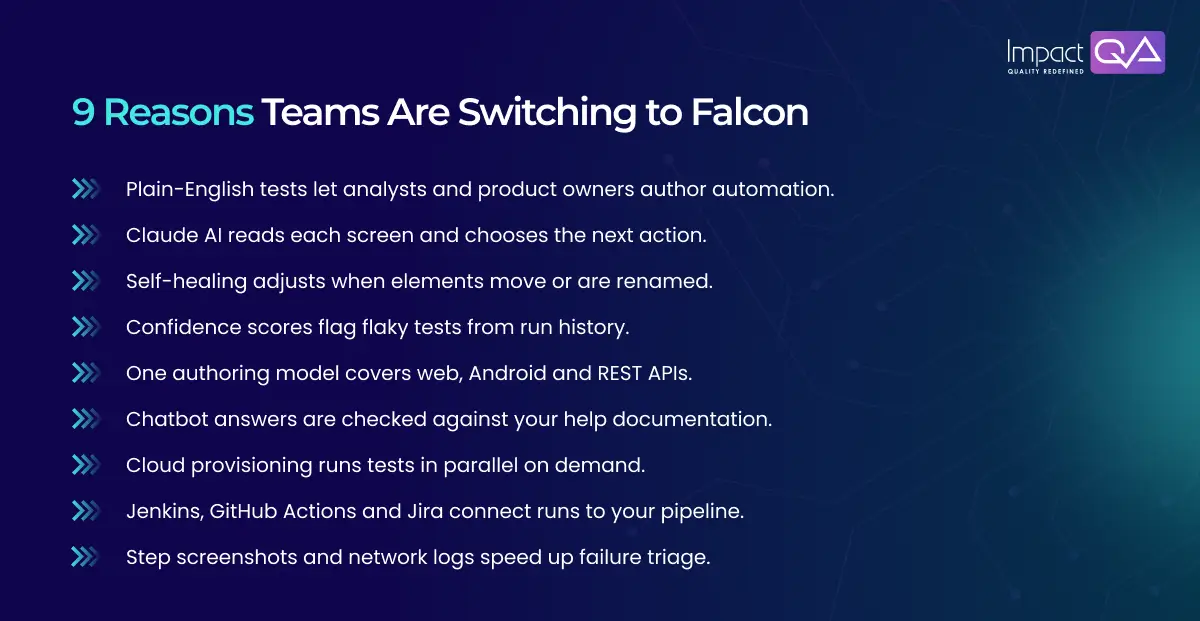
Teams move to scriptless automation when script maintenance outpaces test coverage. Falcon uses plain-English scenarios and AI-driven execution, with self-healing, confidence scoring and CI/CD integration to simplify test automation.
1. Plain-English Test Authoring Expands Test Participation
Scripted suites depend on engineers who know selectors and frameworks. In Falcon, a test reads like a user story: log in as a returning customer, search for “wireless headset”, add the first result to the cart and verify the checkout summary shows one item. That is how Falcon’s no-code platform simplifies test creation, letting QA analysts and product owners turn workflow knowledge into tests with codeless QA automation software.
2. Agentic Execution Handles the Interaction Sequence
A recorded script replays a fixed sequence. Falcon works as an agent. Claude AI reads the current screen, reasons about the next step toward the goal, then taps, types or moves between screens and reads the result before acting again. This observe, reason, act loop lets an instruction like “apply the student discount” adapt when a promo banner appears first.
3. Self-Healing Reduces Routine UI Maintenance
Locator-based scripts break when “Submit” becomes “Place order” or a filter panel moves to a sidebar. Falcon handles these shifts at run time through dynamic error handling, correcting its path when elements move or are renamed. A nightly suite against a storefront that ships weekly loses fewer runs to cosmetic changes. Workflow changes, such as a new checkout step, still call for an updated scenario.
4. Confidence Scoring Adds Context to Test Results
A pass or fail captures one run. Falcon builds a per-test confidence score from run history and flags scenarios that pass inconsistently. A login test passing 9 of 10 runs reads differently from one passing 10 of 10, pointing engineers toward flaky behaviour before release reviews. It complements assertion results and root-cause analysis.
5. One Authoring Model Supports Multiple Testing Environments
Teams often maintain separate frameworks for web, mobile and API testing, increasing the effort required to create, manage and execute tests. Falcon uses one plain-English authoring model across these platforms. It supports web applications through Playwright on Chromium, Firefox and WebKit, real Android devices connected through ADB (Android Debug Bridge), and codeless REST API testing with request and response validation. One checkout journey can be verified in a browser, on a physical phone and at the order API. Mainframe/CICS terminal testing is listed as coming soon.
6. Doc-Grounded Chatbot QA Extends Automation to AI Applications
Chatbot answers vary in wording, which strains fixed assertions. Teams point Falcon at their help documentation; it generates test cases from that content and flags chatbot responses that contradict it. A banking assistant asked about card replacement fees is checked against the published fee page, surfacing hallucinated answers early. Model safety and security testing run as separate workstreams.
7. Cloud-Ready Execution Supports Parallel Testing
Falcon supports parallel test execution by provisioning cloud-based environments on demand. Tests run across automatically provisioned images and containers, with results streaming back in real time. A 300-scenario regression pack can spread across concurrent environments, reducing execution time. Actual run time still depends on scenario length and application response speed.
8. Built-In Integrations Fit Existing QA and CI/CD Workflows
Falcon connects with Jenkins and GitHub Actions to trigger suites on each build, Jira for defect management, Slack for alerts and BrowserStack for wider device coverage. These integrations automate test execution, reporting and notifications within existing development workflows. A pull request can start a smoke pack, post results to the team channel and open a Jira ticket for a failed assertion.
9. Execution Evidence Improves Test Visibility and Release Assessment
Failure investigation usually starts with reproduction. Falcon records evidence during the run, including live console output, a screenshot at every step and network monitoring of API calls, response times and errors. When a payment step fails, an engineer can check the rendered screen and see the payment API’s 500 response.
These artifacts speed up triage, give release reviewers a clear record and help QA teams distinguish application defects from environment issues, inconsistent test behavior and API failures before release approval.
Scriptless Automation vs. Traditional Script-Based Testing
Scriptless automation does not eliminate the need for coded testing in every scenario. Instead, Falcon provides an alternative for teams looking to automate frequently changing workflows, expand test participation and reduce the effort associated with routine regression maintenance.
Evaluation criteria |
Traditional script-based automation |
Falcon |
| Test creation | Requires scripting and framework knowledge | Plain-English test descriptions |
| Test execution | Replays predefined instructions | AI-driven interaction based on the current screen |
| UI changes | Often require locator or script updates | Dynamic error handling adapts to routine UI changes |
| Test maintenance | Requires manual script maintenance | Reduces routine maintenance through self-healing |
| Test participation | Primarily automation engineers | QA analysts and other team members can author scenarios |
| Platform coverage | May require separate frameworks | One authoring model across supported web, Android and API environments |
| Test reliability visibility | Depends on framework and reporting configuration | Confidence scoring identifies inconsistent execution |
| Failure investigation | Depends on available logs and reporting | Screenshots, console output and network monitoring provide execution evidence |
Scriptless automation does not replace coded testing in every scenario. Falcon offers an alternative for teams automating frequently changing workflows, expanding test participation and reducing routine regression maintenance.
Where Does Falcon Fit in an Enterprise Automation Strategy?
Falcon fits best where test scenarios change frequently, span multiple application types or involve teams beyond automation engineering. It complements existing coded frameworks across web, Android, API, chatbot and CI/CD testing.
- Business workflow automation: Plain-English authoring enables teams to create automated scenarios without scripting.
- Changing interfaces: Self-healing reduces routine maintenance when UI elements move or change.
- Test reliability: Confidence scoring helps identify inconsistent test execution.
- API validation: Codeless REST automation supports request and response checks.
- AI chatbot testing: Documentation-grounded validation identifies responses that contradict approved content.
- Release automation: CI/CD integrations enable automated testing within existing development workflows.
Our automation specialists can map it to your current workflows.
How Can Teams Get Started with Falcon?
A structured pilot helps teams evaluate Falcon before a wider rollout. Start with one repeatable, high-value scenario, run it several times and review the evidence. Connect stable scenarios to the CI/CD pipeline once results hold steady.
- Pick a repeatable, high-value scenario.
- Confirm platform compatibility.
- Define expected outcomes and assertions.
- Write the scenario in plain English.
- Run it and review the evidence.
- Check the confidence score across repeated runs.
- Add stable scenarios to your CI/CD pipeline.
The free tier includes three full test runs with no credit card or setup, enough to trial this test case scenario automation platform on a real workflow.
Final Say
Scriptless automation suits teams with fast-changing applications and growing regression packs. Falcon, ImpactQA’s agentic test automation platform, combines plain-English authoring with Claude AI-driven execution, self-healing, confidence scoring and step-level evidence. For teams evaluating a no-code test automation platform, piloting one live workflow offers a practical way to assess its fit. Explore Falcon or start with the free tier.
Download the full case study and see how it works in action.
Frequently Asked Questions (FAQs)
Share this post


Related Posts
Our Case Studies