Quick Summary:
A no-code test automation platform lets you describe a test in plain language while the platform does the clicking. Every leading platform now carries AI agents. Falcon and Testsigma lead with plain English. Tricentis and Leapwork suit packaged enterprise estates. A short pilot on one real flow beats any feature sheet.
Table of Contents:
- Introduction
- What Makes a Platform Truly No-Code?
- 6 Best No-Code Test Automation Platforms for 2027
- How to Choose a Test Case Scenario Automation Platform
- Final Say
- FAQs
There were times when lines of code ruled every domain. Take any field, from cybersecurity to keeping a satellite in orbit, and somewhere behind it sat a person typing those lines by the thousand. Testing followed the same rule.
Yet the year is 2026, and for a while now, a quieter shift has been under way. Tests are being written in sentences. Plain ones, the kind you would use with a new colleague over coffee.
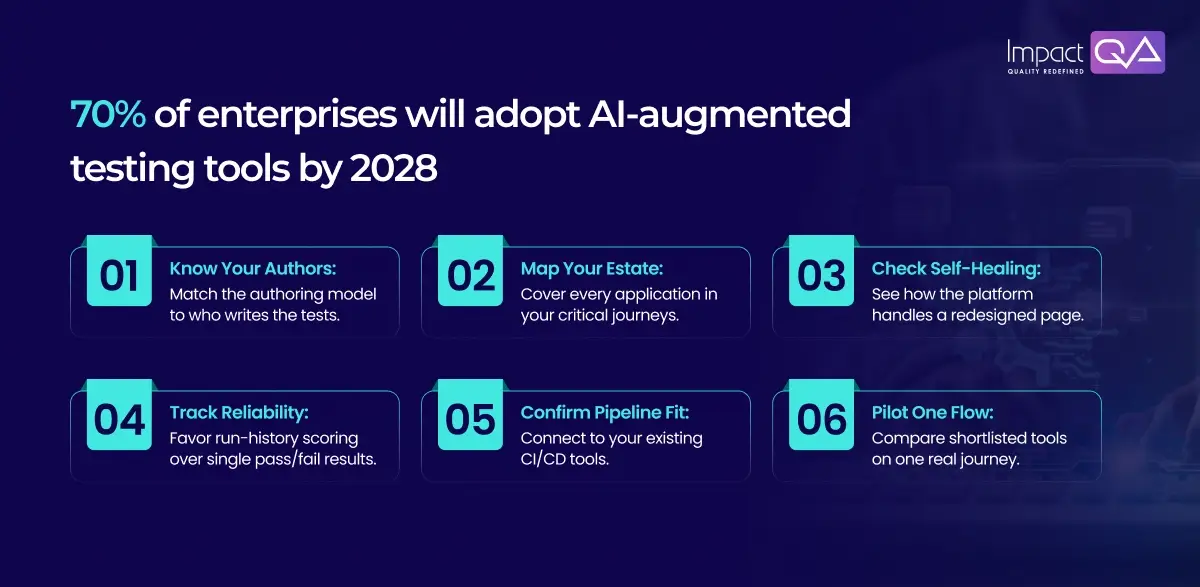
According to Gartner, 70% of enterprises will have AI-enabled testing tools in their toolchains by 2028, from 20% in early 2025. Therefore, the question as we approach 2027 is a practical one. Which no-code test automation platform works for you? We will look at six of them.
What Makes a Platform Truly No-Code?
Think back to the last sprint where a button got renamed. A small change. Yet a scripted test somewhere had stored that button as an ID or an XPath, and the next morning someone spent an hour fixing it. That stored address is called a locator, and most test upkeep begins there.
The no-code platform offers two different approaches to handle the locator system. The visual builders, which people call low-code, let users drag blocks onto a canvas before they assign each block to its corresponding element. Plain-English platforms advance a step further. You write down a sentence, and the AI agent parses the screen in real time looking for elements based on labels and roles, just like you do. Therefore, the renamed button is read in the same way by the agent as you would.
And why is it important right now? The World Quality Report 2025-26 states that the automation process is applicable to one-third of the test cases. All the other tests are done by business analysts and manual testers, who have a better understanding of the business processes than anyone else. Codeless QA automation enables such people to create automated tests themselves.
Choose a journey your team re-tests every sprint, describe it in one sentence, and watch ImpactQA’s AI agent run it end to end.
6 Best No-Code Test Automation Platforms for 2027
1. Falcon by ImpactQA
Falcon asks you for one thing: a sentence. Then, Claude AI goes about its reasoning, showing you its work via screenshots streamed to a live console.
Falcon was originally introduced as a low-code automation platform based on drag-and-drop elements. Now, the entire process operates via plain language, and the way its no-code automation platform simplifies test creation shows the shift clearly. The test creation process is covered both for web and real Android devices, in addition to codeless REST APIs. New releases include Oracle Forms and Mainframe/CICS.
Test reliability is ensured through coverage, which generates a reliability score for every test throughout its run history. Doc-grounded chatbot QA verifies whether your AI-based chatbot is aligned with your help documentation.
Best fit: Teams interested in analysts writing automation, with chatbot validation on the same platform.
2. ACCELQ
Analyst recognition is where ACCELQ shines. Forrester named it a Leader in its Q4 2025 Wave, with the top Current Offering score. Its Autopilot agents guide the test case from discovery through to healing, and Converse, which came in at Dreamforce 2026, makes the entire journey into one ongoing conversation.
Best fit: Large packaged-application estates, Salesforce in particular.
3. Tricentis Tosca with Agentic Test Automation
Already running Tosca? This one will feel familiar. Agentic Test Automation generates complete test cases from natural-language prompts, with Vision AI recognizing visual elements across platforms. Early adopters, Tricentis reports, saw up to 85% time savings.
Best fit: SAP-centered estates that want agentic generation with central governance.
Side-by-Side Comparison:
Platform |
Authoring Model |
Standout Capability |
| Falcon | Plain-English sentences | Confidence scoring, chatbot QA |
| ACCELQ | Codeless editor plus conversation | Converse interface |
| Tricentis Tosca | Model-based with prompts | Vision AI |
| Leapwork | Visual flows | Mainframe reach |
| mabl | Low-code | Automated failure triage |
| Testsigma | Plain-English steps | Tests from Jira and Figma |
4. Leapwork
There are teams that prefer visuals. Leapwork will fit them like a glove, because all tests are created visually with blocks connected together. The latest Continuous Validation Platform by Leapwork, introduced in April 2026, covers web and desktop testing, up to mainframes; the company claims a 50-70% decrease in maintenance efforts.
Best fit: Visual thinkers with desktop and legacy applications in scope.
5. mabl
Shipping web releases several times a week? Then mabl probably sits on your shortlist already. It leans low-code, and its April 2026 Active Coverage release moved toward tests that triage and repair themselves.
Best fit: Engineering-led product teams working inside CI pipelines.
6. Testsigma
Plain-English steps built Testsigma’s reputation. Its Atto AI coworker now generates test cases from Jira stories or Figma files, reaching across web and mobile.
Best fit: Mid-size teams wanting natural-language authoring with test management.
How to Choose a Test Case Scenario Automation Platform
1. Start With Who Writes the Tests
Authorship decides adoption. Analysts thrive with plain English while automation engineers often prefer low-code for finer control.
2. Map Your Application Estate
A checkout might cross a web store, an Android app and a payment API. The right test case scenario automation platform covers that full path.
3. Watch Self-Healing on a Redesigned Page
Some platforms score attribute similarity when a locator changes, while agentic ones re-read the screen every run. Therefore, ask each vendor for a live demo on a redesigned page.
4. Pilot One Real Flow
A scriptless automation testing framework proves itself fastest on a journey your team knows by heart. It is also how most enterprises are switching to AI-driven test automation: one flow at a time.
Our automation engineers integrate Falcon into your current CI/CD infrastructure and position it next to your existing test suites.
Final Say
No-code testing is settling on one idea. Tests carry business intent, and AI agents carry out the work. Enterprise budgets are following, toward platforms that widen authorship. And while this goes on, coverage keeps stretching into AI chatbots and legacy systems.
ImpactQA’s test automation services meet this change with Falcon, where Claude-powered agents run plain-English tests on real Android devices, confidence scoring flags unstable tests, and engineers connect Falcon to existing Selenium and Playwright suites through Jenkins or GitHub Actions.
Frequently Asked Questions (FAQs)
Share this post


Related Posts
Our Case Studies