The Role of Healthcare Software Testing Companies in Securing Patient-Centric Platforms

Quick Summary:
With the growing demand for seamless and secure digital health solutions, healthcare software testing companies play a critical role in ensuring the reliability, compliance, and safety of patient-centric platforms. This blog examines how they address functional complexity, regulatory demands, and system performance through structured testing strategies. It also highlights how ImpactQA delivers tailored solutions, including EPIC testing, to support scalable and secure healthcare ecosystems.
Table of Contents:
- Introduction
- Testing Complexities in Patient-Centric Healthcare Applications
- Role of Functional and Compliance Testing
- Interoperability and Integration Testing
- Performance and Load Testing Challenges
- Security Testing for Patient Data Protection
- Usability and Accessibility Verification
- Final Thoughts
How do we make sure digital health tools are safe and dependable for both patients and doctors? With over 60% of healthcare providers now using online platforms for remote care, getting accuracy, security, and ease of use right has never been more important. Healthcare software applications involve multi-layered systems, regulatory standards, and user experience expectations that demand precise testing strategies. That’s why testing firms specializing in healthcare have stepped up – they help make sure that top-notch tech and good patient care go hand in hand.
The increasing shift to remote diagnostics, telemedicine, and electronic health records (EHR) adds layers of complexity to validation procedures. With errors in software having a direct impact on patient health and privacy, QA practices can no longer rely on traditional or linear approaches. This blog examines the multifaceted role healthcare software testing companies play in securing and improving patient-centric platforms, particularly in the United States.
Testing Complexities in Patient-Centric Healthcare Applications

Patient-centric platforms are intricate systems connecting electronic medical records, diagnostics tools, mobile apps, wearable devices, and patient portals. Each component interacts with different technologies and user environments. Testing these systems requires more than verifying features – it involves validating dynamic workflows, user actions, regulatory constraints, and data transmission across platforms.
Key Challenges in Testing:
- Multiple touchpoints: Applications often connect labs, pharmacies, insurance providers, and clinics.
- Variable data structures: Integrating real-time health data from wearables and diagnostic tools.
- Regulatory mandates: Systems must comply with HIPAA, HITECH, GDPR, and regional policies.
- Diverse user personas: From tech-savvy users to older patients with accessibility needs.
Healthcare software testing companies in the USA build domain-specific test strategies that map complex workflows while checking for boundary conditions, data mismatches, and exception handling. These strategies go beyond functional testing, focusing on end-to-end behavior in live healthcare settings.
Let ImpactQA streamline your testing pipeline for smooth data exchange.
Role of Functional and Compliance Testing
Healthcare applications are often task-oriented, such as booking appointments, accessing test results, or managing medications. Functional testing validates that these workflows execute as intended. It’s also important for ensuring backward compatibility with older systems used by hospitals and clinics.
Compliance testing checks if the platform meets healthcare regulations. This includes:
- HIPAA: Protects patient data confidentiality and transmission.
- GDPR: Ensures data control, transparency, and consent, particularly in cross-border services.
- FDA 21 CFR Part 11: Focuses on electronic records and signatures in clinical trials and diagnostics.
Common Testing Types and Benefits
Here’s a table summarizing key test types and their impact on platform integrity:
Sr. No. |
Testing Type |
Key Benefit |
| 1. | Functional Testing | Validates medical workflows for accuracy and completeness |
| 2. | Compliance Testing | Ensures HIPAA and GDPR alignment |
| 3. | Performance Testing | Maintains application stability during high load scenarios |
| 4. | Interoperability Testing | Supports seamless data flow across multiple systems |
| 5. | Usability Testing | Improves accessibility for patients and healthcare staff |
| 6. | Security Testing | Protects sensitive health data from threats |
Functional and compliance testing serve as the foundation for software reliability. They are essential in making sure that patient interactions are error-free, and that audit trails are consistently maintained across modules.
Interoperability and Integration Testing
Modern healthcare platforms operate as collaborative ecosystems. Testing must verify the accuracy of interactions between systems like EHR, LIS (Laboratory Information System), PACS (Picture Archiving and Communication System), and even third-party insurance platforms.
Key Integration Testing Focus Areas:
- Data exchange format validation (HL7, FHIR, CDA)
- Real-time sync across mobile, web, and backend systems
- Handling of mismatched patient IDs or redundant data entries
- Bi-directional communication with APIs and cloud services
Integration testing conducted by healthcare software testing companies helps uncover API failures, schema mismatches, and workflow deadlocks that may go unnoticed during unit-level testing.
Performance and Load Testing Challenges
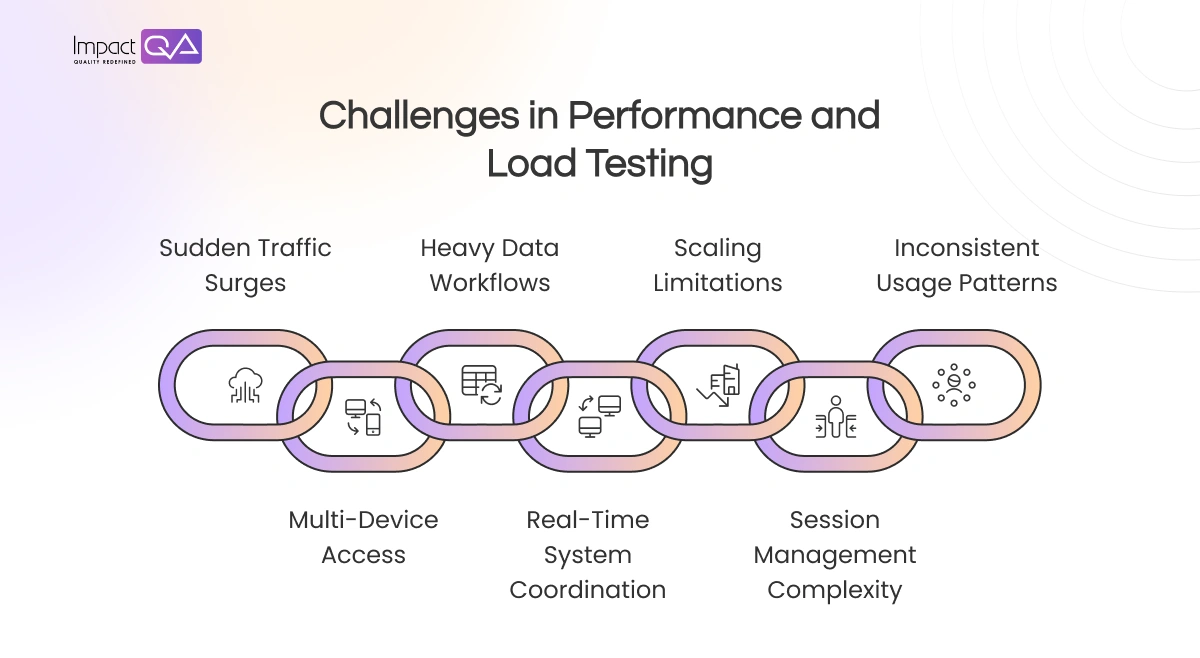
Healthcare platforms must stay responsive even during unexpected spikes in user activity. This can happen during vaccination drives, major health alerts, or seasonal appointment peaks. Ensuring performance under these conditions brings several real-world testing challenges that go beyond basic load handling.
Major Challenges in Performance and Load Testing:
Sudden Traffic Surges
Platforms often face unpredictable increases in users accessing features like lab results, video consultations, or appointment booking. Simulating these patterns accurately is difficult but necessary to prevent slowdowns or outages.
Multi-Device Access
Users interact with platforms through mobile apps, desktop portals, and tablets. Each device type may trigger different performance behaviors, and ensuring consistency across all of them is a key challenge.
Heavy Data Workflows
Healthcare applications regularly process large files such as EHR records, scanned documents, and diagnostic images. High data volume can impact loading speed and system stability during peak usage.
Real-Time System Coordination
Multiple components like lab systems, patient records, and scheduling modules must work together in real time. Any delay in processing or response can interrupt the care workflow.
Scaling Limitations
As new users join or facilities expand, the platform must handle increased traffic without degrading performance. Lack of proper scaling mechanisms can result in slower response times or service disruptions.
Session Management Complexity
Maintaining secure and stable user sessions, especially during extended tasks, adds to the testing challenge. Timeouts, login failures, and session drops can all affect patient trust.
Inconsistent Usage Patterns
When historical usage data is limited or irregular, defining accurate test benchmarks becomes harder. This makes it challenging to plan effective performance testing scenarios.
Security Testing for Patient Data Protection
Healthcare data remains one of the most targeted in cybercrime. From ransomware to phishing attempts on login portals, security flaws in digital systems pose a severe threat to patient confidentiality and institutional integrity.
Key Areas in Security Testing:
- Encryption validation (data in transit and at rest)
- Authentication and multi-factor login checks
- Access control testing based on user roles
- Vulnerability scanning and ethical hacking simulation
Healthcare software testing companies employ tools and techniques that simulate attack vectors, including SQL injection, cross-site scripting, and session hijacking. Periodic security audits allow platforms to stay aligned with both internal policies and external mandates.
Usability and Accessibility Verification
A patient-centric platform is successful only when it is accessible to users across demographics. Testing for usability goes beyond interface design; it includes workflow intuitiveness, response accuracy, and task completion time.
Important Test Scenarios:
- Screen reader and WCAG 2.1 compliance
- Large button accessibility for elderly users
- Multilingual interface testing
- Form navigation for mobile users with impairments
What Usability Testing Uncovers:
- Dropdowns and forms that break on mobile devices
- Incomplete confirmation dialogs for critical actions
- Cluttered views that confuse patients during appointment booking
- Broken links on medical education pages
Through usability testing, testers simulate real user journeys and offer recommendations for UI/UX improvements that align with patient safety and engagement goals.
Connect with ImpactQA for domain-specific regulatory validation.
Final Thoughts
The role of healthcare software testing companies extends beyond bug detection. They define the quality, compliance, and responsiveness of systems that carry life-altering information. In the United States, the demand for precision-focused test strategies is increasing as regulations evolve and technology expands.
ImpactQA brings years of experience in healthcare application testing with specialized services tailored for hospitals, diagnostics platforms, and wellness ecosystems. One of our core offerings is EPIC Testing, where we verify integrations, patient workflows, and compliance modules of EPIC EHR systems. The process includes validating user access controls, test case automation for clinical modules, and ensuring release readiness for EPIC upgrades.
At ImpactQA, we apply a modular test strategy, enabling validation across standalone apps, multi-device interfaces, and large-scale EHRs. Every project involves robust security testing protocols, including static and dynamic code analysis. We understand that each healthcare client requires a specific QA roadmap depending on its services, region, and risk profile. Our goal is to deliver healthcare platforms that consistently support safe, seamless, and reliable digital patient care.
Share this post


Related Posts
Our Case Studies