The Role of Software Testing in Addressing New SAP Security Trends

When it comes to safeguarding valuable business data, organizations often find themselves in a high-stakes game. With cyber threats lurking around every corner, how can organizations ensure their most critical systems remain secure? Imagine investing time and resources into a top-of-the-line SAP system, only to discover that shortly thereafter it had been subjected to malicious attacks linked to potentially unaddressed vulnerabilities. It’s a risk that no organization can afford. The importance of SAP security has reached an all-time high, and for good reason. According to recent surveys, 63% of organizations report facing increasing cybersecurity threats, with SAP systems being prime targets. As these attacks grow in sophistication, the need for robust and proactive security strategies has never been clearer.
With the rise of new SAP security trends, the challenge becomes more complex. SAP systems, deeply embedded in business processes, now face heightened risks in the face of evolving technology and threat landscapes. Cloud migrations, automation, and new data regulations have redefined the security requirements for SAP solutions. To stay ahead, businesses must ensure their SAP environments are not only protected but continuously monitored and tested. One key approach to achieving this level of security is effective software testing – acting as the organization’s first line of defense against potential threats.
In this blog, we will explore the critical role software testing plays in securing SAP systems and adapting to the new SAP security trends.
Understanding SAP Security Trends
SAP systems are at the core of business operations for many organizations, handling everything from financial data to supply chain logistics. Consequently, they become prime targets for cyberattacks. Over the past few years, SAP security trends have shifted significantly, with a growing emphasis on cloud security, data protection, and threat detection.
The trend toward cloud-based SAP solutions, while offering advantages in scalability and flexibility, has also introduced new security concerns. Cloud environments are more prone to attacks due to the nature of shared resources and the increasing sophistication of cybercriminals. This has prompted SAP to introduce various new security features to address these challenges. For example, the SAP Cloud Platform now integrates advanced encryption methods, role-based access controls, and continuous monitoring to ensure that customer data remains protected.
Simultaneously, SAP systems are becoming more complex, integrating with a wider range of applications, both on-premises and in the cloud. This interconnectedness creates potential vulnerabilities that can be exploited by malicious actors. As a result, organizations must pay more attention to securing their SAP environments.
Why Software Testing is Crucial for SAP Security
With security becoming an increasing concern, software testing has a critical role to play in safeguarding SAP systems. In particular, security testing is essential to identify and address vulnerabilities before they can be exploited. This proactive approach allows organizations to stay ahead of potential threats.
Software testing helps verify that the security measures integrated into SAP systems are functioning correctly. For example, security testing can ensure that encryption protocols are working as expected, access controls are enforced, and user roles are properly defined. Testing also helps uncover any gaps or weaknesses in the security architecture that could be exploited by attackers.
Moreover, with the rise of AI and machine learning, SAP systems are increasingly relying on automation to optimize business processes. This reliance on automation brings new security challenges, as the systems can introduce vulnerabilities that may not be immediately apparent. Here again, rigorous software testing is necessary to ensure that automated systems are secure and that they do not inadvertently expose the organization to cyber threats.
Key SAP Security Trends in Focus
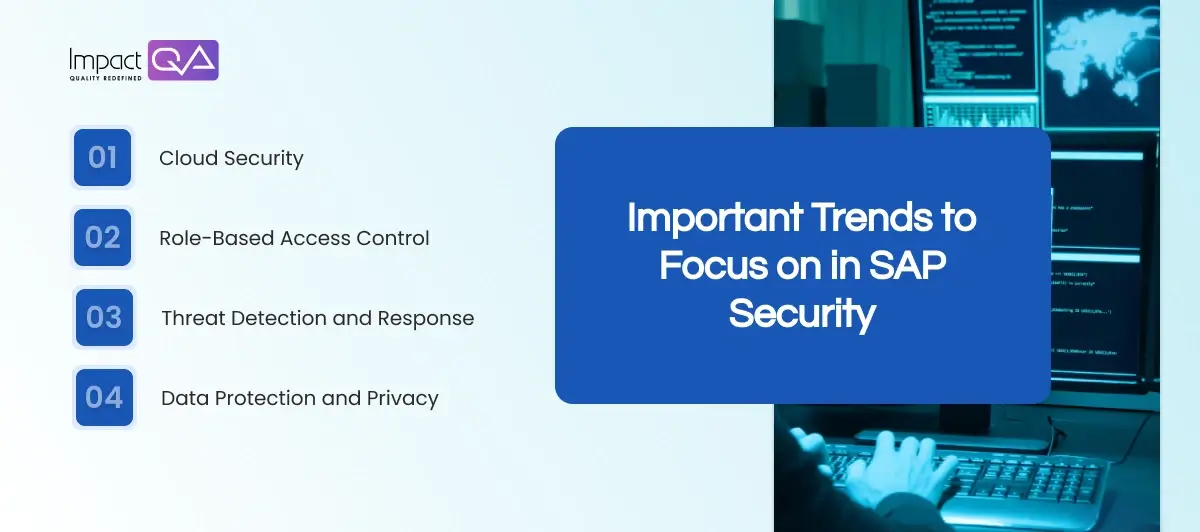
1. Cloud Security
As mentioned earlier, SAP’s shift to cloud-based services is one of the most significant security trends. Cloud security is a top priority for organizations as they move their data and applications to cloud environments. Testing SAP systems for cloud-specific vulnerabilities is essential to ensure data integrity and prevent unauthorized access.
A major aspect of cloud security testing involves ensuring that data is encrypted both at rest and in transit. Software testing ensures that the SAP cloud environment adheres to best practices in encryption and data protection. Additionally, organizations need to test their cloud security configurations regularly to detect any changes or misconfigurations that could expose their systems to attack.
2. Role-Based Access Control (RBAC)
One of the most effective ways to control access to sensitive SAP systems is through role-based access control (RBAC). With this approach, users are granted access only to the data and functionalities that are relevant to their role.
However, even well-defined roles can present security risks if not properly tested. For instance, an unauthorized user could be assigned a higher-level role or a role with excessive privileges. Regular software testing of SAP systems helps verify that roles are correctly assigned and that users cannot bypass access restrictions.
3. Threat Detection and Response
As cyber threats become more sophisticated, organizations must implement systems that can detect and respond to potential attacks in real-time. SAP offers built-in threat detection tools, such as SAP Enterprise Threat Detection, that help identify and monitor suspicious activities.
Software testing is crucial in determining the performance of these threat detection systems. Proper testing is a must for making sure that the system detects a wide range of attack scenarios, and that a reasonable and prompt reaction takes place to avert damage. Testing for alarms and logs guarantees that there are no false impressions. This functionality allows security teams to respond to threats faster.
4. Data Protection and Privacy
With data breaches becoming more common, organizations must ensure that their SAP systems comply with data protection regulations such as GDPR and CCPA. Software testing is critical to verify that personal data is properly protected and that the system adheres to privacy laws.
Testing data protection mechanisms, such as anonymization, encryption, and secure data access protocols, help identify any weaknesses in the system’s ability to protect sensitive information. Organizations can also perform penetration testing to simulate real-world attacks and see how well the SAP system stands up to a breach attempt.
How Software Testing Addresses SAP Security Challenges

Software testing addresses many of the challenges posed by new SAP security trends. By rigorously testing security measures, organizations can ensure that their SAP systems are protected from the growing number of cyber threats. Here’s how:
- Proactive Security Validation: Regular security testing enables organizations to detect potential vulnerabilities before attackers can take advantage of them. This proactive approach is crucial to maintaining a secure SAP environment.
- Automation of Security Testing: Automation can help accelerate the testing process, especially in environments with complex integrations. Automated security tests can quickly detect issues such as weak encryption, misconfigured roles, or unauthorized access attempts.
- Realistic Attack Simulation: Penetration testing and ethical hacking simulations allow organizations to understand how their SAP systems would stand up to a real-world attack. These tests help uncover vulnerabilities that may not be obvious in traditional testing scenarios.
- Compliance Assurance: For organizations operating under strict data protection regulations, software testing ensures that their SAP systems comply with legal requirements. Testing also helps avoid costly penalties due to non-compliance with laws like GDPR.
Conclusion
Emerging SAP security trends require that organizations work double-time to prevent future threats through ongoing testing of their systems. Security testing must be an integral part of an organization’s planning, not just for compliance, but also for fortifying SAP environments against changing cyber risks. This is what makes ImpactQA extremely valuable. With immense expertise in SAP systems and security best practices, ImpactQA helps organizations test the security of their SAP environments rigorously and hence maintain the data and operations to defend against the most sophisticated threats.
Share this post


Related Posts
Our Case Studies