Top Software Testing Trends to Focus in 2025

Quick Summary:
Software testing in 2025 is moving beyond traditional models. Organizations are prioritizing smarter, more scalable testing approaches driven by artificial intelligence, cybersecurity requirements, QAOps, and continuous automation. This blog outlines the most impactful testing trends of 2025, helping businesses align their quality assurance strategies with modern digital demands while addressing speed, security, and efficiency challenges.
Table of Contents
- Introduction
- Why Software Testing is a Business Priority
- AI and ML-powered Testing Intelligence
- Scriptless Test Automation Takes the Lead
- QAOps: Bridging Development and Testing
- Performance Engineering as a Core Discipline
- Advancements in Cybersecurity Testing
- Big Data and IoT Testing Practices
- Scalable Cloud-Native Testing Models
- Digital Accessibility Testing at Scale
- Conclusion
Software testing is entering a transformative phase in 2025. Traditional QA practices are being replaced with smarter, integrated approaches that keep pace with rapid development cycles and evolving user expectations. The emphasis is shifting from defect detection to proactive quality engineering, where speed, resilience, and security are embedded across the development lifecycle.
This year, businesses are leaning into automation, AI, and cross-functional testing practices to drive continuous improvement. With the growing adoption of microservices, cloud-native platforms, and compliance mandates, testing has become a strategic enabler rather than just a checkpoint. The trends outlined in this blog highlight where testing is heading – giving QA teams and engineering leaders the clarity to adapt, evolve, and stay ahead.
ImpactQA’s AI-driven automation and scriptless frameworks deliver stability and speed across your pipelines.
Why Software Testing is a Business Priority
The complexity of software ecosystems, combined with rising user expectations, makes quality assurance a boardroom-level concern. Applications must deliver secure, performant, and consistent experiences across multiple devices and platforms. Frequent releases, dynamic architecture, and compliance obligations have made continuous testing indispensable.
Testing teams now work closely with engineering and product teams to support fast feedback cycles. Beyond bug detection, QA is involved in ensuring application stability, data accuracy, API responsiveness, and compliance validation. The evolution from reactive testing to strategic quality engineering is key to supporting business continuity and innovation.
AI and ML-powered Testing Intelligence
Artificial Intelligence and Machine Learning are reshaping QA into a smarter, more context-aware function. In 2025, AI in testing extends beyond test automation to areas such as:
- Autonomous test script generation from user behavior data
- Visual testing that identifies layout or UI regressions using image recognition
- Defect prediction models using historical code and test patterns
- Test case optimization based on risk-based prioritization
These capabilities reduce manual intervention and allow QA teams to focus on exception handling and strategic oversight. As models learn from production data and test results, they can suggest regression test coverage, identify flaky tests, and auto-update scripts post-deployment changes.
Scriptless Test Automation Takes the Lead
Scriptless or codeless automation has matured into a mainstream testing strategy. By using drag-and-drop workflows, natural language inputs, or model-based test design, these tools:
- Lower entry barriers for non-developers
- Reduce the time spent on test maintenance
- Increase collaboration across QA, business analysts, and development
Advanced scriptless platforms now include self-healing test mechanisms, where test elements automatically adapt to UI or endpoint changes. This is particularly effective in CI/CD environments where frequent UI updates often break traditional test scripts.
QAOps: Bridging Development and Testing
QAOps integrates quality assurance within DevOps pipelines, ensuring continuous quality feedback as code is written, built, and deployed. In 2025, QAOps adoption is increasing through practices like:
- Pre-commit validation checks in version control systems
- Trigger-based test suites for specific code paths or modules
- Environment-aware testing that dynamically matches test cases to environments
QAOps ensures that feedback on functionality, performance, and security happens early in the lifecycle. It also aligns QA efforts with deployment velocity, supporting microservices-based architecture and cloud-native strategies.
Performance Engineering as a Core Discipline
Traditional performance testing conducted before release is no longer sufficient. In 2025, performance engineering will be integrated throughout the design and development phases to ensure applications are built for speed and resilience from the start. Key focus areas include:
- Load modeling based on actual user traffic patterns
- Benchmarking client-side performance across web and mobile interfaces
- Simulated failover and resilience testing in distributed environments
Modern observability tools and real-time monitoring dashboards are helping QA teams detect performance bottlenecks earlier in the cycle. This continuous approach not only enhances user experience but also prevents regressions that could impact production stability.
Advancements in Cybersecurity Testing
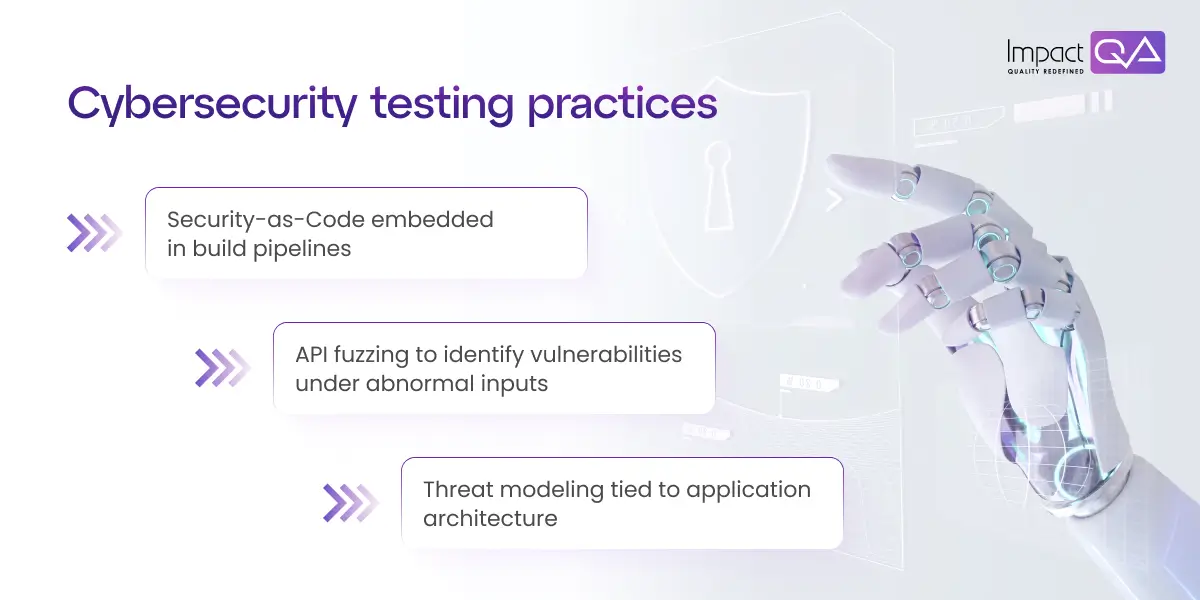
Security testing is moving left in the SDLC. With increasing ransomware attacks, regulatory penalties, and privacy concerns, QA teams are integrating security validation throughout the release cycle. New cybersecurity testing practices include:
- Security-as-Code embedded in build pipelines
- API fuzzing to identify vulnerabilities under abnormal inputs
- Threat modeling tied to application architecture
Security testing tools now leverage intelligence from global threat databases, ensuring coverage against current vulnerabilities and exploit techniques. This supports not just resilience, but also regulatory compliance with standards like GDPR, HIPAA, and PCI-DSS.
Big Data and IoT Testing Practices
Large-scale data platforms and IoT networks require dedicated testing strategies to maintain data integrity and ensure device interoperability. Key focus areas for 2025 include:
- Data pipeline testing for transformation and ingestion stages
- Validation of distributed storage systems like Hadoop and NoSQL
- Device-simulation frameworks for scalable, real-time IoT testing
QA for Big Data now includes volume-based performance testing, anomaly detection in data sets, and consistency checks across streaming services. With billions of connected devices, IoT testing validates firmware updates, sensor accuracy, and cross-device communication protocols.
Scalable Cloud-Native Testing Models
As enterprises move to Kubernetes-based and containerized applications, QA must match the speed and dynamism of cloud-native delivery. Leading practices in this space include:
- Service mesh-aware testing for inter-service communication
- Ephemeral test environments spun up using IaC templates
- Cross-cloud compatibility testing for multi-cloud deployments
Cloud-native test platforms support parallel execution, scalability under peak loads, and seamless integration into DevOps toolchains. This ensures that tests run continuously across development branches and deployment stages, without infrastructure constraints.
Digital Accessibility Testing at Scale
Digital accessibility is now a compliance and ethical obligation. Enterprises are expanding accessibility testing to cover a broader range of use cases, including:
- Automated audits for color contrast, ARIA tags, and DOM structure
- Usability testing with users who rely on assistive technologies
- Localized accessibility validation to match regional legal requirements
Advanced testing platforms now integrate WCAG checklists into the CI process and allow teams to report and fix accessibility issues early. These efforts directly support inclusivity, user retention, and compliance with mandates like Section 508 and EN 301 549.
ImpactQA integrates DevSecOps practices to embed real-time security checks into your CI/CD process.
Conclusion
Software testing in 2025 demands more than test execution – it requires intelligence, adaptability, and alignment with business priorities. This is where ImpactQA plays a defining role. As a global software testing and quality engineering leader, ImpactQA offers domain-specific, scalable, and technically advanced services tailored to enterprise needs.
ImpactQA’s key service areas include:
- AI-powered test automation that shortens testing cycles through self-healing, predictive models
- Cloud-native testing strategies built for microservices and container-based architectures
- DevSecOps integration with real-time security feedback in CI/CD pipelines
- Performance engineering frameworks that validate applications under realistic usage conditions
- Accessibility testing solutions with WCAG compliance and inclusive user research
- IoT, Big Data, and edge environment testing at scale, across device ecosystems
ImpactQA goes beyond traditional QA services. It helps clients engineer quality into every layer of their digital product – from backend APIs to front-end interfaces. With proven experience across energy, healthcare, BFSI, e-commerce, and various other industries, the team offers end-to-end support for testing transformation aligned with agile and cloud-first delivery models.
Share this post


Related Posts
Our Case Studies