Quick Summary:
AI now drives defect detection, predictive quality and production decisions on many factory floors. Each of those decisions depends on a model, its data and the systems that carry its output, and AI testing in manufacturing validates all three. Statistical metrics such as precision, recall and false negative rate show how often a model is right. Data checks, drift baselines and computer vision test sets help hold that accuracy steady as materials and equipment change. Integration, performance and workflow testing across MES, ERP and edge devices then confirm that every correct prediction becomes a correct production action.
Table of Contents:
- Introduction
- What Does AI Testing in Manufacturing Actually Involve?
- 7 Critical Areas to Validate in AI-Powered Manufacturing Systems
- How Should Manufacturers Build an AI Testing Strategy?
- Final Say
- Frequently Asked Questions
An AI-powered quality inspection camera on a machining line assigns a cracked bearing housing a defect probability of 0.48. The rejection threshold is 0.50, so the part moves on to assembly. The model ran as built. Its threshold, training images and station lighting decided the outcome.
That space between a running model and a correct decision is where AI testing in manufacturing earns its place. Rockwell Automation’s 2026 State of Smart Manufacturing Report, drawn from more than 1,500 manufacturing leaders across 17 countries, found that 34% of operations are already AI-augmented, with quality among the leading applications.
Below are seven validation areas for AI-enabled manufacturing systems, followed by a lifecycle testing strategy your QA team can adapt.
Get a structured test plan for your vision-based quality checks.
What Does AI Testing in Manufacturing Actually Involve?
AI testing in manufacturing is the structured validation of machine learning models, their input data and the production systems they connect to. It confirms that predictions are accurate for the intended use, stay accurate as conditions change and reach ERP, MES and shop-floor workflows correctly.
Functional testing checks deterministic rules: input A returns output B every time. A machine learning model returns a probability, so its correctness is measured statistically across thousands of samples. NIST’s AI Risk Management Framework lists “valid and reliable” as a core AI characteristic and treats validation as objective evidence that a system meets its intended use.
AI model validation therefore sits inside broader manufacturing software testing. A correct prediction creates value only when it reaches the right system on time.
7 Critical Areas to Validate in AI-Powered Manufacturing Systems
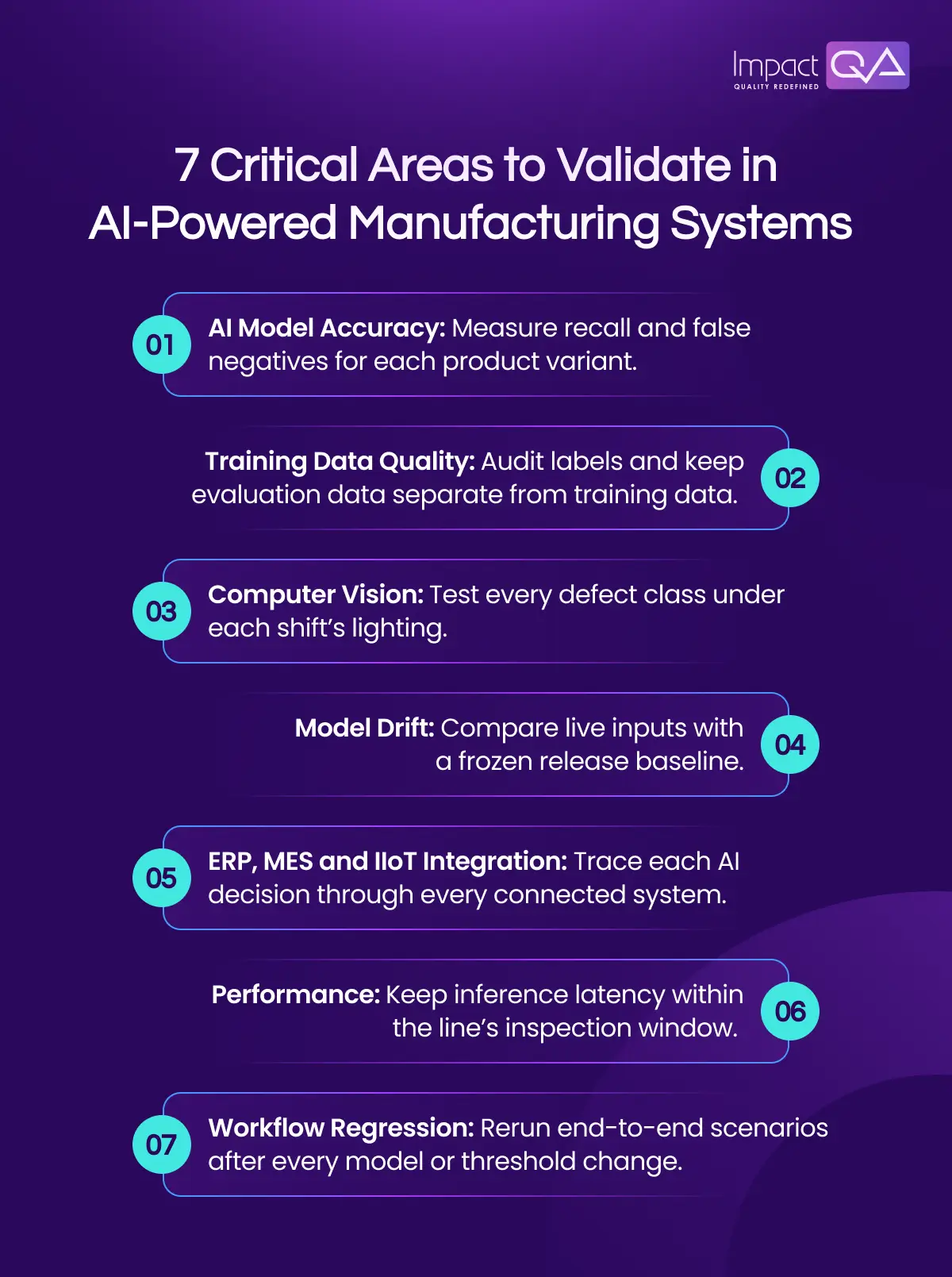
Each area targets a different point of risk. Model metrics show how often predictions are right, data checks explain why, and drift monitoring shows when accuracy shifts. Integration, performance and workflow tests then confirm that a correct prediction becomes a correct production action.
1. AI Model Accuracy and Prediction Reliability
Accuracy is the share of correct predictions. Precision is the share of flagged parts that are truly defective. Recall is the share of real defects caught, and F1-score is the harmonic mean of the two. A confusion matrix shows true and false positives beside true and false negatives.
Accuracy alone can mislead. On a line where 1 in 200 parts is defective, a model that passes everything scores 99.5% accuracy and catches nothing. Testers report recall and false negative rate per product variant, then set thresholds against error cost. A missed defect risks a field recall. A false rejection adds scrap.
2. Training Data Quality and Data Validation
A model learns only what its training data contains. A label audit re-inspects a sample of annotated images to estimate annotation error. Leakage checks keep images of one physical part in a single dataset split, since overlap inflates scores. Distribution comparisons check that production data matches training data in value ranges and product mix. For predictive quality testing, sensor timestamps must align with the batch they describe.
In a 2025 Manufacturing Leadership Council survey, 62% of manufacturers cited unstructured or poorly formatted data as an AI challenge.
3. Computer Vision and Automated Defect Detection
Image classification labels a part good or defective. Object detection locates and names each defect. Both depend on resolution, lighting and camera position.
Take a stamped-metal panel line inspecting for scratches, dents and burrs. The test set holds labelled images for each defect class and severity, captured under every shift’s lighting. Testers sweep the confidence threshold and plot false acceptance against false rejection to choose the operating point. A lens swap or new LED panel calls for a rerun. Missed burrs reach the customer, while excess rejections slow the line.
4. Model Drift and Continuous Performance Monitoring
Data drift is a change in inputs, such as a new steel supplier’s surface finish. Concept drift is a change in the correct answer, such as a revised tolerance that redefines a defect. Both erode accuracy while the code stays unchanged.
QA teams freeze a release baseline of per-class metrics, input statistics and a reference dataset. In production, the Population Stability Index (PSI) compares live inputs with that baseline, and sampled manual inspections track real recall. Every retrained model passes the regression suite before promotion. Monitoring extends pre-deployment validation for the life of the model.
5. ERP, MES and Industrial IoT Integration
Trace one rejected part. An edge device runs inference on the camera image and publishes the result over MQTT, a lightweight publish-subscribe protocol. The Manufacturing Execution System (MES), which tracks shop-floor work orders, logs the rejection against the serial number. The Enterprise Resource Planning (ERP) system then adjusts inventory and raises a replacement order. Machine data may arrive through OPC UA, a standard for structured equipment communication.
Integration testing checks API contracts, payload schemas, field mapping and timestamps at every hop. Injected broker outages and duplicate messages confirm that retries and reconciliation keep ERP stock aligned with the physical line.
6. Performance, Scalability and Operational Reliability
Model evaluation checks correctness. Performance testing checks speed and stability under load.
A bottling line running 600 bottles per minute leaves about 100 milliseconds per inspection. Testers measure 95th and 99th percentile inference latency, throughput and recovery time after a fault. A latency spike at peak production means bottles pass uninspected or the line slows. Edge AI hardware adds memory and thermal limits, so tests simulate concurrent camera streams, network drops and safe-state failover.
7. Functional Testing, Regression and End-to-End Workflow Validation
Functional testing confirms the business rules around the model. A rejected part should move to quarantine, create a non-conformance record and alert the quality lead. An operator override should require a reason code and an audit entry.
End-to-end scenarios run these paths across connected applications, including a model timeout. Regression testing repeats them after every change to the application, model version or threshold. Test automation within a continuous testing pipeline keeps the suite practical as releases speed up.
Speak with ImpactQA's manufacturing software testing team about a validation plan built for your connected systems.
How Should Manufacturers Build an AI Testing Strategy?
Build AI testing for manufacturing applications around the AI lifecycle. Define measurable acceptance criteria first, validate data and models before integration, then test the full application under production-like conditions. Every model update re-enters the cycle through regression, and production monitoring feeds evidence into the next release.
Testing Stage |
Validation Objective |
Expected Evidence |
| Requirements | Set acceptance criteria per use case | Signed-off recall and latency targets |
| Dataset and model validation | Confirm data quality and model metrics | Data report, per-class confusion matrix |
| Test environment | Mirror production interfaces | Virtualized ERP and MES endpoints |
| Functional and integration | Verify rules and data flow | Results traced to requirements |
| Performance and reliability | Confirm latency and recovery | Load and failover reports |
| Model updates | Hold quality steady after retraining | Regression against the reference set |
| Production monitoring | Detect drift | Drift reports, inspection audits |
Final Say
Manufacturers expect AI to support more than half of operations by the end of the decade. As that share grows, validation evidence becomes part of every rollout. AI testing in manufacturing supplies it for the model, its data and each system that acts on its decisions.
ImpactQA’s AI-led quality engineering for manufacturing software brings functional and integration testing to ERP and MES environments, supported by IoT-enabled labs. Service virtualization and model-based testing let teams validate AI-driven workflows early under shift-left practices, so plants can scale new AI use cases with confidence.
Frequently Asked Questions (FAQs)
Share this post


Related Posts
Our Case Studies