Quick Summary:
Agentic AI testing services cover two connected jobs. The first uses AI agents to plan and maintain tests. The second validates the AI agents an enterprise builds into its own products. This guide breaks down what a mature engagement includes the eight questions QA and procurement leaders should put to any provider alongside the OWASP framework for agentic security.
Table of Contents:
- Introduction
- What Do Agentic AI Testing Services Include?
- Inside a Mature Agentic AI Testing Services Engagement
- Before You Buy: 8 Questions for Any Agentic AI Testing Services Provider
- Final Say
- FAQs
An agentic AI testing proposal can look impressive on paper. It may promise autonomous execution, adaptive testing, and faster maintenance. The harder question is what the provider will actually test once those agents enter a real enterprise QA environment.
Gartner’s October 2025 Magic Quadrant for AI-Augmented Software Testing Tools projects that 70% of enterprises will have these tools in their engineering toolchain by 2028, up from roughly 20% in early 2025.
Buying agentic AI testing services well comes down to knowing what belongs inside the scope. This guide lays out the components of a mature engagement and the questions that separate a working agent from a well-designed demo.
What Do Agentic AI Testing Services Include?
Agentic AI testing services generally cover two directions.
Agentic AI in Software Testing
In this model, agents become part of the QA process.
An agent receives a goal such as: “Validate the checkout flow for risks introduced by this release.”
It can inspect the change, identify affected journeys, create scenarios, execute tests, investigate failures, and recommend follow-up coverage. Our earlier analysis of how agentic AI is transforming software testing walks through that loop inside a CI/CD lifecycle.
AI Agent Testing
Here, the AI agent itself becomes the system under test.
An enterprise agent might access a CRM, query an internal knowledge base, create a ticket, approve a workflow, or interact with external APIs. Testing needs to examine whether it interprets its objective correctly, selects appropriate tools, respects permissions, handles failures, and reaches the intended business outcome.
NIST’s 2026 TEVV-Athlon framework is designed to support customized testing, evaluation, verification, and validation for a broad range of AI systems, including agentic systems.
The distinction matters during procurement. A provider may be excellent at using AI to create tests while offering little depth in evaluating autonomous agents.
Agentic Testing vs. Scripted Automation at a Glance
Agentic testing changes the unit of automation from a fixed sequence to a goal and a set of permitted actions.
Attribute |
Scripted Automation |
AI-Assisted Automation |
Agentic AI Testing |
| Input | Step-by-step script | Script or test drafted with AI | Goal stated in natural language |
| Execution path | Predetermined | Mostly predetermined | Planned at run time |
| Handling change | Script is updated | AI may repair the script | Agent can reassess the path |
| Failure analysis | Rules and logs | AI-assisted analysis | Agent investigates within defined limits |
| Human role | Author and reviewer | Author, reviewer, maintainer | Supervisor, reviewer, exception owner |
| Best fit | Stable regression checks | Faster authoring and maintenance | High-change workflows, exploration, triage |
A stable login check with a clear pass/fail condition still benefits from deterministic execution. Agentic testing becomes more interesting when the testing problem involves changing application states, unfamiliar paths, investigation, or decisions about what to test next.
ImpactQA brings AI-powered automation, intelligent test maintenance, and agentic testing into your existing QE environment.
Inside a Mature Agentic AI Testing Services Engagement
A well-scoped engagement should cover the technology, the testing process, and the controls around autonomous action.
1. Agentic AI Framework Design and Orchestration
Every engagement starts with architecture. An agentic AI framework for testing typically pairs a planning agent, which breaks a goal into steps, with executor agents that drive the application through browser, API, and data tools.
Model selection happens per task. Lightweight models handle locator repair, while larger reasoning models handle test design and triage. Our breakdown of how agentic AI frameworks are changing test automation compares the leading framework patterns.
2. Change-Aware Test Selection Inside CI/CD
Speed comes from scoping. A change-aware agent reads commit diffs, updated services, and configuration files, then maps them to the user journeys they touch. The pipeline runs the tests that matter for that change and schedules the full regression for a quieter window.
This is one area where agentic AI in test automation can reduce unnecessary regression effort by narrowing testing to the changes most likely to matter. It also anchors a wider AI-powered test automation strategy for the enterprise.
3. Self-Healing and Maintenance at Scale
Test maintenance can become a significant part of automation effort as applications change. Self-healing frameworks re-anchor a broken locator by scoring similarity across element attributes such as text, position, and DOM ancestry, then selecting the closest match above a confidence threshold.
The well-designed approach separates two structurally different events. Locator drift means the element moved. Requirements drift means the behavior changed on purpose. The first can be healed automatically. The second routes to a human, because healing it would rewrite the test to match a change nobody has verified. Our deep dive on self-healing frameworks and continuous quality optimization covers the scoring mechanics.
4. Human-in-the-Loop Review Gates
Autonomy works best with defined checkpoints. A graduated model lets agents act freely on low-risk tasks such as generating test data, while production-adjacent actions wait for approval. As the agent builds a track record, the approval threshold moves.
5. Evaluation Harness for Agent Behavior
For enterprises shipping their own agents, this is the core deliverable. The harness holds golden trajectories, multi-trial scenarios, and policy assertions. It runs again every time the underlying model version changes, since a model upgrade can shift agent behavior as much as a code release.
6. Security and Governance Mapping
Agents carry real permissions, so security testing follows a recognized framework. The OWASP Top 10 for Agentic Applications 2026, published in December 2025 with input from more than 100 experts, names risks such as goal hijacking, tool misuse, and memory poisoning. Experienced providers map test cases to each category and tie governance evidence to the NIST AI Risk Management Framework or ISO/IEC 42001.
7. Observability and Reconstructable Evidence
Every agent decision should be replayable. Run logs capture the reasoning step, the tool call, and a snapshot of application state. Regulated industries depend on this record for audit, and engineering teams use it to debug agent behavior in minutes.
Before You Buy: 8 Questions for Any Agentic AI Testing Services Provider
Each question below comes with the shape of a strong answer.
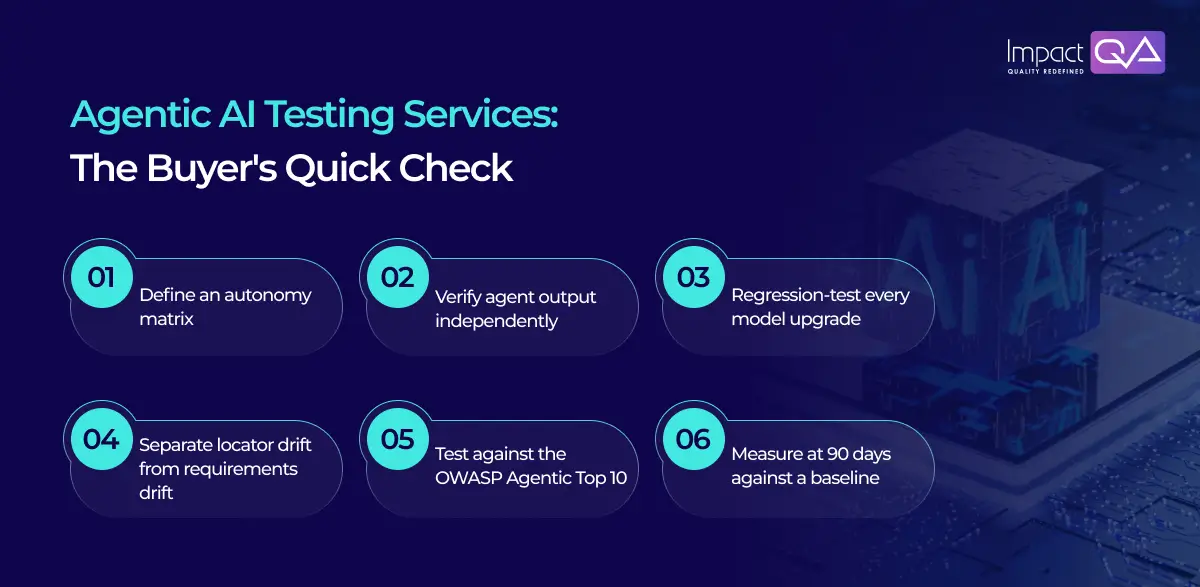
Checklist #1: Which testing decisions will the agents make on their own?
A strong provider hands you a written autonomy matrix. It lists each action type, the autonomy level assigned to it, and who approves exceptions.
Checklist #2: How is agent output verified?
Look for independent oracles. Assertions, reference data, and multi-trial pass rates should grade the agent, so the system producing the work is separate from the system checking it.
Checklist #3: What happens when the underlying model changes?
The answer should describe pinned model versions and a regression suite that runs before any upgrade reaches your pipeline.
Checklist #4: How does the framework separate locator drift from requirements drift?
This question reveals maturity quickly. A good provider explains the confidence threshold for automatic healing and the escalation path for intentional behavior changes.
Checklist #5: Which security risks are tested, and against which framework?
Expect a mapping to the OWASP Top 10 for Agentic Applications, including prompt injection delivered through test data and scoped credentials for every agent.
Checklist #6: Where does test data go?
Ask about data masking, model hosting options, and residency. Enterprises in banking and healthcare often require private model deployment for agentic AI for QA testing.
Checklist #7: Can you show a reconstructable run from a past engagement?
A replayable run log demonstrates observability far better than a slide. It also shows how the provider documents evidence for your auditors.
Checklist #8: How will value be measured at 90 days?
The provider should propose a baseline before the pilot begins. Maintenance hours and release cycle time are the two most reliable early signals.
ImpactQA helps quality engineering teams use agentic testing to respond faster to application changes and evolving testing needs.
Final Say
Agentic AI in test automation is entering its accountability phase. Enterprise investment over the next two years will flow toward programs that can show their agents’ work, with scoped autonomy backed by replayable evidence. Gartner’s forecast of 70% enterprise adoption of AI-augmented testing by 2028 sets the pace, and evaluation discipline will decide who captures the value.
ImpactQA brings this discipline into every engagement through customized agentic AI frameworks for SAP S/4HANA and CTRM landscapes alongside web and mobile applications, DevOps integration blueprints with change-aware automation that reads commit diffs to localize testing scope, and AI Testing and Assurance services that validate the agents enterprises deploy, backed by more than 12 years of quality engineering delivery.
Frequently Asked Questions (FAQs)
Share this post


Related Posts
Our Case Studies