
Quick Summary:
Hiring a blockchain testing company is not the same exercise as hiring a general software testing services vendor, and treating it that way is how gaps slip through. This guide walks through 8 specific questions worth asking before you sign up for blockchain testing services: on smart contracts, consensus behavior, tooling, gas costs, security depth, chain type, node testing, and reporting. Each one is designed to separate a vendor who genuinely understands blockchain from one applying a standard testing playbook to an unfamiliar technology.
Table of Contents:
- Introduction
- Why Blockchain Testing Needs a Different Vendor Conversation
- 8 Questions to Ask Before You Sign Up for Blockchain Testing Services
- Final Say
- Frequently Asked Questions
Blockchain testing proposals tend to look similar on paper. Most cover smart contract testing, security testing, and general blockchain expertise in the opening paragraph, and a buyer comparing two of them side by side often has little else to go on.
That gap matters more as blockchain infrastructure moves further into production. Gartner projects blockchain’s global business value will exceed $3.1 trillion by 2030, a scale that makes choosing a testing partner a real business decision rather than a line item to fill quickly.
This guide works through 8 specific questions worth asking before signing with any blockchain testing company, covering smart contracts, consensus behavior, tooling, security depth, and reporting. Each one is built to help a buyer see past shared language and into what a vendor’s blockchain application testing experience actually covers.
ImpactQA tests contract logic against real adversarial scenarios, not just expected inputs.
Why Blockchain Testing Needs a Different Vendor Conversation
Because skills don’t transfer automatically. One can be genuinely excellent at testing web applications and still have no real experience validating a distributed ledger. Testing a smart contract means simulating adversarial behavior a normal QA cycle never encounters, and testing a consensus mechanism means understanding how a network of independent nodes is supposed to agree on the truth, and recover when they briefly don’t.
ImpactQA has covered this distinction before in how blockchain testing is redefining quality benchmarks in digital transactions, and the pattern holds here too: blockchain QA testing requires a different baseline of expertise than general software QA carries by default.
Ask the standard vendor-vetting questions too, certainly. Just don’t stop there. The questions below are the ones that actually separate blockchain expertise from a general testing company that recently added blockchain application testing services to its list of offerings.
8 Questions to Ask Before You Sign Up for Blockchain Testing Services
Let’s go through them one at a time.
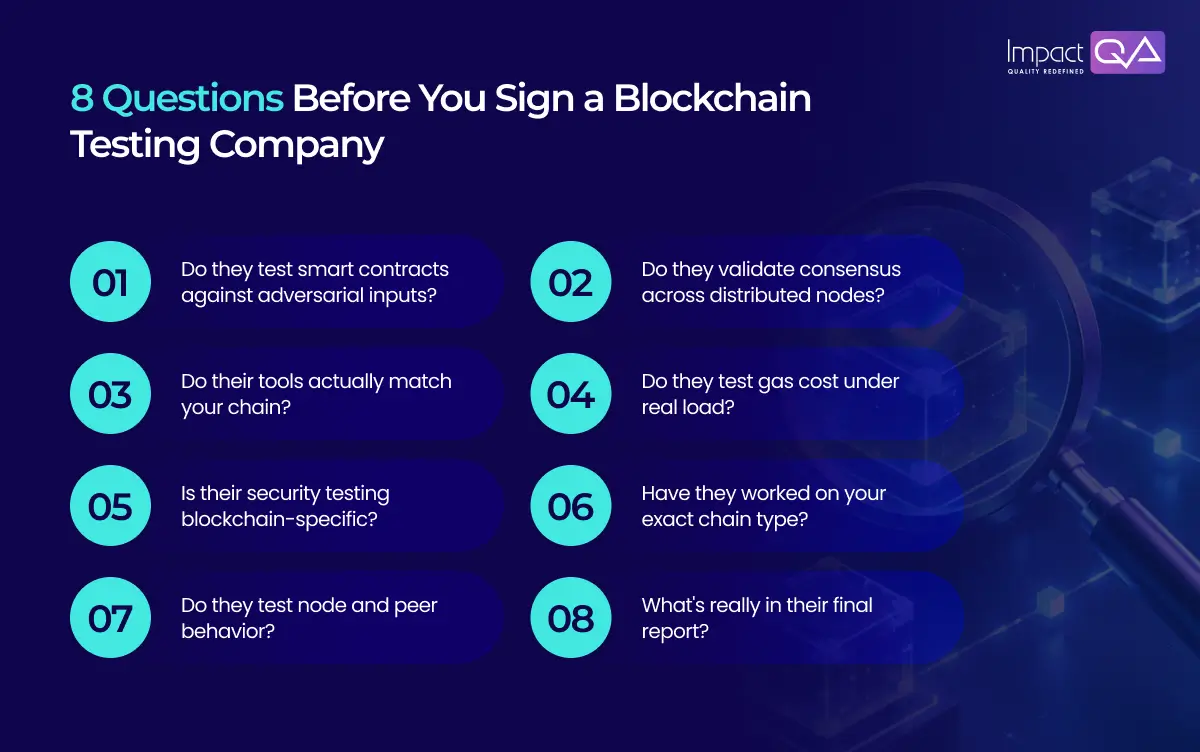
1. Can They Test Smart Contracts Against Adversarial Inputs, Not Just Expected Ones?
A contract that behaves perfectly against every input a developer thought to test can still drain funds the moment someone feeds it a value nobody planned for. Reentrancy bugs and integer overflow exploits are old, well-documented attack patterns, and a vendor offering genuine blockchain application testing services should be running adversarial and fuzz-style scenarios against contract logic as standard practice, not just walking through a demo that only covers the expected path.
2. Do They Validate Consensus Protocol Behavior Across Distributed Nodes?
Consensus is the mechanism that decides which version of the ledger every node agrees is correct, and validating it takes real distributed-systems knowledge that goes beyond standard QA technique.
specific example from a past engagement says more here than a general description of “network testing” would. Decentralized finance platforms make this especially visible, and our article on blockchain testing for secure DeFi applications covers consensus validation in that specific context.
3. Which Tools Do They Actually Use, and Do Those Tools Match Your Chain?
Truffle, Hardhat, Ganache, Ethereum Tester, testnets like Ropsten and Kovan, BitcoinJ — each one fits a different chain and a different testing purpose, and fluency in Ethereum tooling doesn’t transfer to a Hyperledger or Corda environment. Ask the vendor to name the tools they’d use for your specific stack, not blockchain testing in general.
4. Do They Perform Blockchain Performance Testing for Gas and Transaction Costs?
A smart contract that runs fine in a demo can turn expensive fast once real transaction volume hits it. Gas cost testing under simulated load is its own discipline, distinct from general performance testing, and it’s worth asking directly whether a vendor treats it as a core deliverable or something they mention once and never actually benchmark.
Smart contracts rarely fail the way demos show. ImpactQA tests contract logic against real adversarial scenarios, not just expected inputs. Talk to our experts.
5. Is Their Security Testing Blockchain-Specific, or Generic Pentesting Relabeled?
Reentrancy bugs, oracle manipulation, and unverified contract exploits don’t show up on a standard web application penetration test checklist. When a vendor’s security offering reads like the exact same pentest they’d run on any ordinary website, just with “blockchain” added to the title, that’s a fair thing to question directly before signing.
6. Can They Test the Specific Chain Type You’re Running?
A public Ethereum deployment, a private consortium chain shared across three banks, and a semi-private supply chain network each carry different permissioning models, different validation needs, and different ways of failing. A project reference on your exact chain type carries more weight than general blockchain experience alone, and it’s a reasonable thing to ask for directly.
7. Do They Test Node and Peer Behavior, or Only the Application Layer on Top?
An application can look completely fine in the interface while the nodes underneath it quietly disagree about which version of the ledger is correct. Peer and node testing is what catches that gap, and it’s a layer plenty of vendors skip, mainly because it’s much harder to demo convincingly than a working screen.
8. What’s Actually in Their Final Report, Beyond a Pass or Fail?
A genuinely useful report separates a smart contract audit, a security testing summary, and a performance testing benchmark into sections a developer can actually act on, rather than one page that says everything passed. Ask to see a real sample report before signing anything. A description of what a report includes is not the same as the report itself.
ImpactQA covers smart contract, node, security, and performance testing under one blockchain testing engagement.
Final Say
These 8 questions are simple enough to work through in a single conversation. What they buy a buyer is clarity: specifics that predict whether a vendor will catch a real problem before it reaches production, rather than general reassurance alone. A vendor who can walk through all 8 with a concrete example is the one worth signing with.
Get an inside look at the strategy behind the success.
Frequently Asked Questions (FAQs)
Share this post


Related Posts
Our Case Studies
