
Quick Summary:
Gartner projects that by 2027, more than 70% of recently implemented ERP initiatives will fail to fully achieve their original business goals. A large share of that gap traces back to testing that never scaled past the pilot phase. This piece starts with the fundamentals of the Oracle ecosystem, defines what automated testing in Oracle actually means, then lays out a seven-step build for an Oracle test automation strategy designed to hold up as the environment grows, not just at launch.
Table of Contents:
- Introduction
- Oracle Ecosystem, Automation Testing, and More
- Building An Automated Oracle Testing Strategy: The 7-Step Roadmap That Scales
- What to Keep in Mind, and What the Market Is Actually Doing
- Final Say
- Frequently Asked Questions
What actually breaks first when an Oracle environment grows: the testing coverage or the testing process itself?
Most teams assume it’s coverage. They add more test cases as more modules go live, and when regression cycles get too slow, they call that a scaling problem. In practice, the process breaks first. A framework built to validate one module during initial rollout rarely holds up once the same Oracle instance is running finance, HR, procurement, and supply chain together, each on its own quarterly update schedule.
That distinction matters because it changes what “scaling” a testing strategy actually means. It isn’t running more tests. It’s building a process that keeps working as the environment underneath it keeps changing.
About Oracle Ecosystem, Automation Testing, and More
What Is Oracle ERP and the Oracle Application Suite?
Oracle’s enterprise footprint spans several connected product lines:
- Oracle Fusion Cloud ERP for finance and procurement,
- Oracle Cloud HCM for human capital management,
- Oracle SCM for supply chain,
- Oracle CX for customer experience, and
- Oracle E-Business Suite (EBS) still running in many on-premises environments.
According to Apps Run the World’s 2024 ERP applications market data, Oracle overtook SAP as the No. 1 ERP applications vendor for the first time in 2024, posting $8.77 billion in ERP software revenue for a 6.63% market share, narrowly ahead of SAP’s $8.69 billion and 6.57% share. That’s a genuinely close race between two platforms that have defined enterprise ERP for decades, and it places Oracle among the small handful of platforms enterprise IT teams build multi-year strategies around rather than treat as interchangeable software.
These aren’t separate applications bolted together. A single procure-to-pay transaction in Oracle ERP Cloud can touch supplier data in SCM, budget approvals in Finance, and employee records in HCM within one workflow. That interconnection is exactly what makes Oracle testing different from testing a standalone application.
What Is Automated Testing in Oracle?
Automated testing in Oracle means using scripted, reusable test assets, run through purpose-built Oracle testing tools, to validate business workflows without a person manually clicking through every screen each release. That covers functional testing of Oracle applications (does the process still produce the correct output), regression testing (did anything break that used to work), and increasingly, oracle cloud test automation aimed specifically at the quarterly updates Oracle Cloud applications receive on a fixed schedule.
The distinction worth holding onto: automated oracle testing replaces repetition, not judgment. A script executes the same procure-to-pay transaction exactly the same way every time. It doesn’t decide whether a new approval workflow makes business sense, or whether an error message would actually confuse a finance user. That’s still a person’s call.
Building An Automated Oracle Testing Strategy: The 7-Step Roadmap That Scales
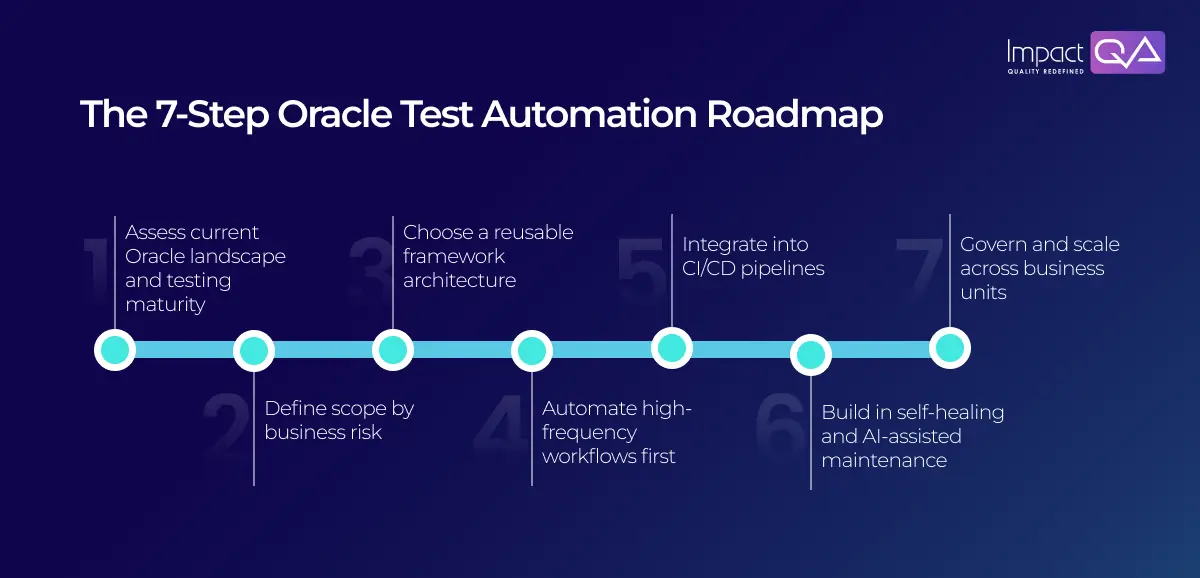
A strategy that scales is a sequence, built in a specific order, where each step makes the next one sustainable rather than adding to the maintenance pile.
Step 1: Assess Current Oracle Landscape and Testing Maturity
Before automating anything, map what’s actually running: which Oracle modules are live, which are on Cloud versus on-premises EBS, and how testing happens today. Teams that skip this step tend to automate whatever’s easiest to script first, rather than what actually carries the most business risk.
Step 2: Define Scope by Business Risk, Not by Module
Procure-to-pay, order-to-cash, and payroll processing touch nearly every regression cycle and carry real financial consequences if they break. A rarely used reporting screen doesn’t carry the same weight. Scoping by risk, rather than by which module happens to be next on the roadmap, is what keeps the automation effort proportional to what’s actually at stake.
Step 3: Choose a Framework Architecture Built for Reuse
This is where a lot of strategies quietly fail later, not at launch. A framework built around individual test scripts for each screen creates a maintenance burden that compounds every quarterly Oracle update. A framework built around reusable components, login, navigation, common business transactions, absorbs those updates in one place instead of forty.
Step 4: Automate the Highest-Frequency Workflows First
Start with the transactions that run in nearly every regression cycle: procure-to-pay, order management, invoice processing, payroll, inventory movements. These provide the fastest visible return and establish the pattern the rest of the automation effort follows.
Step 5: Integrate Testing Into CI/CD and Release Pipelines
Oracle Cloud applications update on a fixed quarterly cadence, and EBS environments still take periodic patches. Testing that runs on a separate schedule from deployment always lags behind what’s actually live. Wiring automated Oracle testing into the release pipeline means validation happens as part of the update process, not after someone notices something’s wrong.
Step 6: Build In Self-Healing and AI-Assisted Maintenance
Quarterly updates change UI elements, field IDs, and navigation paths, which breaks scripts that rely on fixed locators. Self-healing frameworks re-anchor to elements using multiple attributes instead of one brittle identifier, absorbing a large share of that breakage automatically.
In an article about the future of oracle testing, ImpactQA has also covered how AI-driven Oracle testing extends this further with predictive defect detection, adapting to structural changes.
Step 7: Govern and Scale Across Business Units and Modules
The final step is where most “successful pilots” actually stall. An Oracle automation testing framework that works well for one module needs shared standards, naming conventions, and ownership before it can extend to five more without becoming five different, uncoordinated frameworks. This is the step that determines whether the strategy scales or just grows.
What to Keep in Mind, and What the Market Is Actually Doing
A few patterns are worth naming plainly, because they show up across enough Oracle implementations to stop being edge cases.
Script sprawl is the most common scaling failure. Teams automate quickly, hit an early win, and keep adding scripts without governance. Eighteen months later, nobody’s sure which scripts are still relevant, and maintenance eats whatever time automation was supposed to free up. This is precisely the cost pattern that shows up across QA budgets generally: ImpactQA has already broken down how automated software testing services can bring QA costs down by targeting execution, defect-escape, and maintenance cost separately, and Oracle environments follow the same math, maintenance being the category that erodes savings fastest when it’s left ungoverned.
The market itself is moving in a specific direction here. Gartner’s Predicts 2026 report on the future of ERP states that by 2030, more than half of routine ERP tasks will be handled autonomously by AI, a shift already visible in how Oracle testing tools are evolving toward adaptive, self-healing execution rather than static script replay.
Aberdeen Group’s research on ERP implementation found that companies running well-implemented ERP systems report 23% lower operational costs than those without, a gap testing quality contributes to directly, since untested changes are what turn a stable ERP environment into an expensive one. Enterprises further along this path are already treating scale as a first-class requirement rather than an afterthought.
Final Say
Scaling an Oracle software testing strategy is a governance problem wearing a technical costume. The scripting part, the tool selection, the CI/CD wiring, is genuinely the easier half. What determines whether a strategy holds up two years and six quarterly updates later is whether someone owns the framework, whether naming conventions stay consistent as new teams add to it, and whether the automation effort has a plan for the day scope needs to double.
ImpactQA approaches this in a way built to cover exactly that full lifecycle, from initial ERP assessment through framework architecture, AI-assisted maintenance, and long-term governance, so the strategy holds regardless of how many business units or Oracle modules get added along the way.
Everything you need to know, in one download.
Frequently Asked Questions (FAQs)
Share this post


Related Posts
Our Case Studies
