Quick Summary:
SAP S/4HANA migration testing covers data validation, custom processes, integrations, security controls, and business continuity. This article outlines the key testing phases, including functional, regression, integration, performance, and user acceptance testing. It also explores how AI can improve test coverage, accelerate analysis, and identify risks while maintaining essential QA oversight. From planning to go-live validation, this article will discuss all that.
Table of Contents:
- Introduction
- What Does SAP S/4HANA Migration Testing Validate?
- SAP Functional Testing for S/4HANA Migration
- SAP Regression Testing
- SAP Integration Testing Services
- Data Validation Testing
- Performance and User Acceptance Testing for SAP S/4HANA
- Agentic AI in SAP Migration Testing: Faster Analysis, Human Accountability
- Final Say
- Frequently Asked Questions
SAP S/4HANA transformation is not complete when the technical migration ends. Its success is determined when the system performs reliably under the conditions that matter most: the first month-end close, a production order, an outbound invoice, and the many interconnected processes that sustain daily operations. Testing therefore serves not as a ceremonial final approval, but as a disciplined body of evidence that the transformed landscape is accurate, resilient, and fit for purpose.
SAPinsider’s 2025 benchmark reports that 34% of surveyed organisations had completed their S/4HANA transition, while 41% planned to do so before the end of 2027.
This article examines the testing considerations that determine whether an SAP S/4HANA migration is ready for business use, from data integrity and integrations to end-to-end process validation and operational readiness.
ImpactQA helps teams build measurable confidence before SAP S/4HANA go-live.
What Does SAP S/4HANA Migration Testing Validate?
SAP S/4HANA migration testing validates that the target system is operationally ready. It verifies:
- Master data, open transactions, historical balances, and delta loads.
- End-to-end processes across finance, procurement, sales, supply chain, and manufacturing.
- Custom code, Fiori applications, roles, approvals, forms, and reports.
- Interfaces with SAP BTP, middleware, tax engines, banking, CRM, warehouses, and legacy systems.
- Performance during peak volumes, background jobs, cutover, and business-critical processing.
- Business acceptance, audit controls, and reconciliation evidence.
SAP recommends validating migrated objects, checking row counts, running functional and regression testing, and assessing performance under expected load conditions.
SAP Functional Testing for S/4HANA Migration
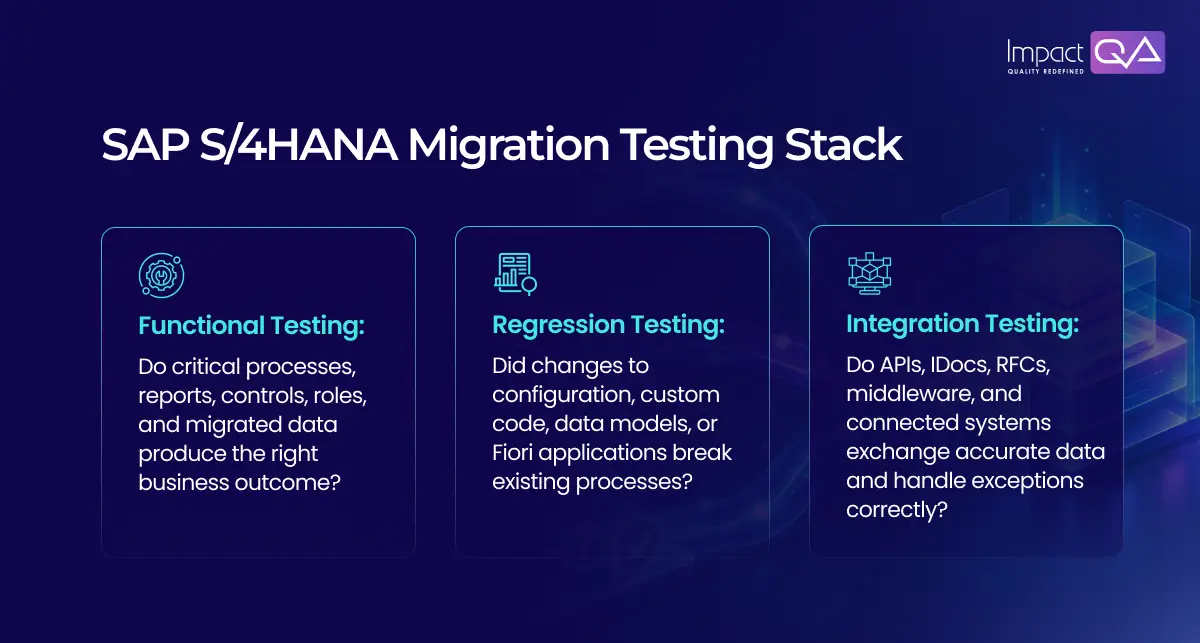
SAP functional testing confirms that configured processes produce the expected business result with production-like migrated data. A successful login or saved transaction is not enough; the downstream document flow, accounting impact, approvals, and reports must also be correct.
Prioritise core business cycles:
Sr. No. |
SAP Business Process / Area |
Key Functional Areas Tested |
| 1. | Record-to-Report | Journal entries, reconciliations, close activities, and statutory reports |
| 2. | Procure-to-Pay | Purchase orders, goods receipt, invoice verification, and payments |
| 3. | Order-to-Cash | Sales orders, delivery, billing, credit management, and returns |
| 4. | Plan-to-Produce | Material planning, production orders, inventory, and costing |
| 5. | Security and UX | Roles, segregation of duties, Fiori tiles, workflow, output forms, and custom transactions |
Functional tests should compare source and target outcomes: balances, document counts, master-data relationships, tax calculations, currencies, units of measure, and compliance controls.
SAP Regression Testing Services
S/4HANA migrations can change data structures, configuration, custom code, interfaces, user experience, and reporting logic. SAP regression testing services identify whether those changes disrupted processes that previously worked.
Build a risk-based regression pack around high-value business flows, custom developments, regulatory reporting, high-change modules, and processes with many dependencies. Execute it during every migration rehearsal, after major transports, and before cutover.
SAP test automation services are most valuable for stable and repeatable regression scenarios. SAP automated testing tools can accelerate app-level validation, while third-party tools can support custom SAP processes, cross-system workflows, and broader release coverage.
SAP Integration Testing Services
SAP integration testing services validate how S/4HANA exchanges information with connected SAP and non-SAP applications. This includes APIs, IDocs, RFCs, OData services, files, event messages, middleware mappings, and batch interfaces.
Test for more than a technically successful response:
- Payload structure, mandatory fields, transformations, and code conversions.
- Authentication, authorisation, encryption, and error-message handling.
- Retries, timeouts, duplicate prevention, idempotency, and queue monitoring.
- End-to-end outcomes across source, middleware, target, and reporting layers.
- Reconciliation between interface payloads, SAP documents, and business reports.
An interface can return HTTP 200 and still create the wrong financial posting. That is precisely why integration testing needs business-level assertions.
Data Validation Testing
Data migration testing checks completeness, accuracy, consistency, and reconciliation—not merely whether records loaded successfully.
QA teams should validate record counts, key-field mappings, duplicates, mandatory fields, reference-data relationships, opening balances, and source-to-target totals. For financial objects, reconcile general ledger, AP, AR, inventory, and fixed-asset values by company code and migration cutover date.
SAP’s Data Transition Validation tool supports pre- and post-migration comparisons for business data, standard reports, custom reports, and transparent tables.
Performance and User Acceptance Testing for SAP S/4HANA
Performance testing validates response time, throughput, batch processing, background jobs, concurrent user behaviour, and locking during high-volume operations. Include peak-period scenarios such as month-end close, MRP runs, invoice processing, and bulk data loads.
User acceptance testing then verifies whether real business users can complete their daily processes, handle exceptions, and trust the reports and controls available to them. Technical readiness without business acceptance is only half a go-live decision.
SAP Test Strategy Services
A practical SAP test strategy should include:
- Risk assessment: Identify critical processes, data domains, interfaces, controls, and dependencies.
- Traceability: Link requirements, migration objects, test cases, defects, and exit criteria.
- Production-like data: Include realistic master data, open items, balances, negative scenarios, and volumes.
- Migration rehearsals: Execute, reconcile, fix defects, retest, and repeat.
- Automation: Maintain stable regression coverage for rapid feedback.
- Go-live evidence: Define acceptance thresholds for data, functionality, integration, performance, and UAT.
SAP Activate recognises business-process, integration, data-migration, user-acceptance, and business-acceptance testing as distinct lifecycle activities.
Agentic AI in SAP Migration Testing: Faster Analysis, Human Accountability
Agentic AI in SAP can assist QA teams with change-impact analysis, test-scenario generation, regression prioritisation, defect clustering, and test-result summarisation. This helps when migration dependencies are too broad to assess manually at sprint speed.
However, AI should not approve readiness. QA leads must validate generated scenarios, confirm business rules, investigate exceptions, and maintain traceable evidence for go-live decisions. The useful model is controlled acceleration: AI finds the signal faster; SAP QA experts decide whether it is sufficient.
ImpactQA helps enterprises get release-ready for every migration cycle.
Final Say
A low-risk S/4HANA transition is proven, one reconciled balance, one validated interface, one passing regression cycle at a time. Functional, regression, and integration testing remain the foundation of that proof, and agentic AI is starting to change how fast teams get there, accelerating impact analysis and test generation without replacing the judgment that decides go-live readiness.
As more organisations complete their S/4HANA transition in the coming years, the ones that get there with confidence will be the ones treating testing as evidence, not ceremony.
Don't miss the strategy that's changing the game.
Frequently Asked Questions (FAQs)
Share this post


Related Posts
Our Case Studies