Quick Summary:
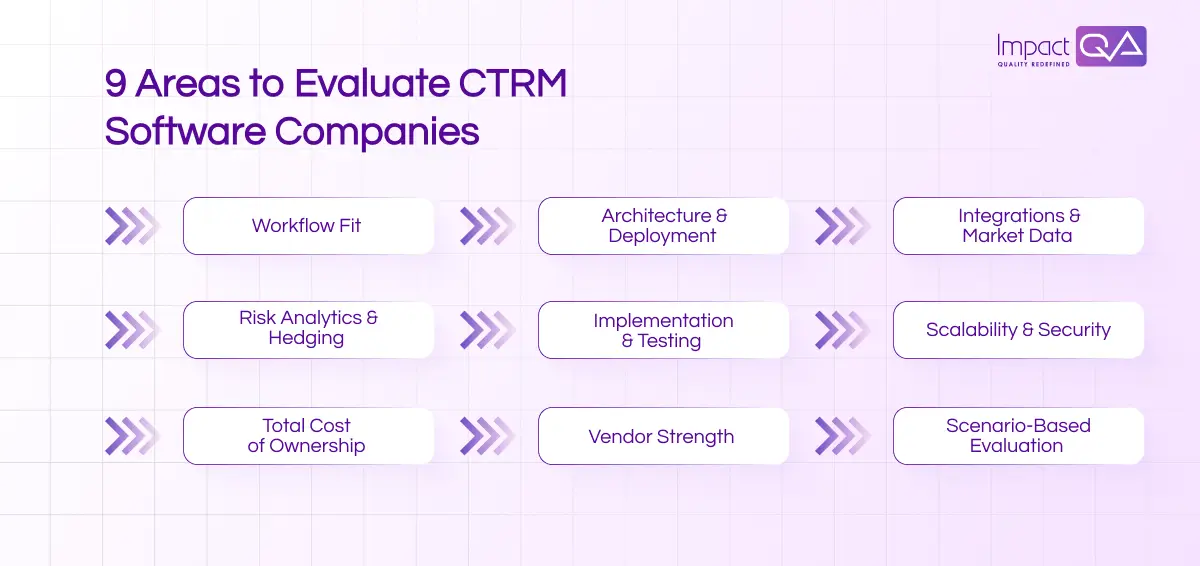
Choosing among CTRM software companies isn’t a feature-checklist exercise. The platforms that look identical in a demo often behave very differently once real trades, integrations, and pricing complexity hit production. This guide walks through nine areas to evaluate before you sign: commodity and workflow fit, architecture and deployment, integrations and market data, risk analytics, implementation and testing, scalability and security, total cost of ownership, vendor strength, and scenario-based evaluation.
Table of Contents:
- Introduction
- What Is A CTRM Software?
- 9 Areas Every Buyer Must Evaluate When Choosing Among CTRM Software Companies
- How ImpactQA Supports CTRM Quality?
- Final Say
- Frequently Asked Questions
A CTRM software demo can make almost any platform look impressive. A few screens, some dashboards, a clean trade lifecycle, and suddenly the shortlist feels easy.
The real test comes later.
Once the platform has to process your contracts, pricing rules, market data, hedges, logistics, settlements, ERP integrations, and reporting requirements, the differences between CTRM software companies become much more important.
The Insight Partners estimates the global CTRM software market at $7.58 billion in 2025, projecting $13.73 billion by 2034 at a 7.71% CAGR. The firm also identifies cloud deployment and AI-powered risk management among the category’s growth opportunities.
That is why choosing a CTRM platform should not be a feature-counting exercise. You need to evaluate how well the technology fits your business, how it will integrate with the systems around it, and how reliably it will behave once real trading data hits production.
Here are nine areas worth examining before you make the decision.
What Is A CTRM Software?
CTRM (commodity trading and risk management) software is the system of record for a commodity trading business.
It connects deal capture, position management, risk analytics, logistics, settlement, and accounting into one operating environment.
In 2026, buyers are increasingly looking at:
- Cloud and SaaS deployment
- API and ERP integration
- Real-time risk and exposure visibility
- Analytics and automation
- Scalable architecture and security
- AI-assisted workflows and exception handling
This reflects a steady, sustained demand and a useful reminder that this is a long-horizon platform decision, not a short-cycle purchase.
Put it to the test with ImpactQA’s specialized quality engineering and risk validation expertise.
9 Areas Every Buyer Must Evaluate When Choosing Among CTRM Software Companies
Before comparing CTRM software companies feature by feature, it helps to have a consistent framework. The nine areas below are what separates a platform that performs well in a sales demo from one that performs well in your production environment.
1. Start With Commodity and Workflow Fit
The right CTRM software should fit your operational workflows rather than simply offering the longest feature list. Evaluate how the platform handles your actual trade lifecycle.
A platform designed around agricultural commodities may not be the best fit for a business dealing heavily in energy derivatives. Likewise, physical commodity traders have different requirements from organizations focused primarily on financial trading.
Look at:
- Commodity types and instruments supported
- Physical and financial trade management
- Contract and pricing complexity
- Inventory and logistics workflows
- Hedging processes
- Settlement and accounting requirements
The practical test is simple: Can the vendor demonstrate your workflow, not just theirs?
If every demonstration uses the same polished example trade, ask for a scenario closer to your business.
2. Examine the Architecture and Deployment Model
Deployment architecture influences long-term operational efficiency. Buyers should compare cloud, SaaS, managed, and on-premise models against their enterprise requirements. Cloud-based CTRM solutions can make scaling and distributed access easier, but “cloud” alone is not a buying criterion.
Ask what sits behind the label.
You want to understand the architecture, hosting responsibility, upgrade process, disaster recovery model, data residency, availability commitments, and how the platform behaves when trading volumes increase.
This is also where AI-led validation can strengthen the buying process. ImpactQA’s NeX-AI supports intelligent testing across commodity platforms including SAP CM, Endur, Allegro, and RightAngle, helping teams generate reusable test scenarios from prompts.
3. Scrutinize Integrations and Market Data
CTRM software rarely works as an isolated application. This is one area where a beautiful demo can hide a lot of engineering work. Check the platform’s:
- API capabilities
- ERP integrations
- Exchange connectivity
- Market-data ingestion
- Broker integrations
- Data synchronization
- Reconciliation capabilities
Also ask how failures are handled.
If a market-data feed stops, an API changes, or an ERP transaction fails halfway through a workflow, what happens to the trade record? A CTRM platform should provide enough controls to identify, reconcile, and recover from integration failures.
4. Go Deeper Into Risk Analytics and Hedging
Risk functionality should be assessed against the decisions your trading and risk teams actually make. Look beyond the presence of a “risk dashboard” and ask whether the platform supports:
Sr. No. |
Capability |
What to Validate |
| 1. | Position management | Physical and financial position |
| 2. | Risk analytics | Exposure, sensitivities, and relevant risk measures |
| 3. | Valuation | Mark-to-market methodology and market curves |
| 4. | P&L | Realized and unrealized visibility |
| 5. | Stress Testing | Scenario flexibility and calculation speed |
| 6. | Hedging | Supported instruments and workflow |
The important word here is validate.
A feature appearing in a product brochure does not tell you whether it works for your commodity structures, pricing models, or risk methodology.
5. Treat CTRM Implementation and Testing as a Buying Criterion
CTRM implementation and testing should be considered before the contract is signed, because implementation risk can come from operational complexities, not just from the software’s core functionality.
This is where many technology evaluations become too optimistic.
A CTRM platform can satisfy the functional requirements in an RFP and still encounter serious problems during implementation. Data may not map correctly. A configured workflow may work for one trade type but fail for an exception scenario.
Testing should therefore cover:
- Functional and configuration testing
- Integration testing
- Data migration validation
- End-to-end trade lifecycle testing
- Regression testing
- Performance and load testing
- Security testing
- User acceptance testing
And don’t wait until go-live is approaching.
Independent testing during CTRM implementation gives buyers another layer of confidence that the system they approved on paper is the system they are actually deploying.
6. Test Scalability, Security, and Reliability
Scalability is about more than user numbers. Evaluate how CTRM software performs with increasing transaction volumes, concurrent users, market-data loads, integrations, portfolio complexity, and peak trading conditions while maintaining appropriate security and availability controls.
Ask vendors to demonstrate realistic load conditions rather than quoting theoretical capacity.
Also examine:
- Role-based access control
- Audit trails
- Data protection
- Authentication
- Disaster recovery
- Backup and restoration
- Availability targets
- Performance monitoring
7. Calculate Total Cost of Ownership
The cost of CTRM software extends well beyond the initial license or subscription. A useful way to frame the calculation is:
Total Cost of Ownership = Licensing + Implementation + Integration + Customization + Infrastructure + Support + Internal Resources + Future Change Costs
This matters because a lower initial quote can become expensive if the platform requires significant customization or specialist resources to maintain.
Ask for a multi-year view.
And ask what happens when your business changes.
Note: A CTRM platform is rarely a one-time technology purchase. Commodity portfolios, regulations, markets, integrations, and workflows will evolve.
8. Evaluate the Vendor, Not Just the Product
The CTRM vendor’s expertise, support, reputation, roadmap, and commitment can matter as much as the platform’s technical capabilities. Pressure-test those claims:
- Have they implemented comparable commodity environments?
- Can they provide relevant references?
- Who handles implementation?
- What support follows go-live?
- How are upgrades and customizations managed?
- What does the product roadmap look like?
A vendor that understands your operating model may be more valuable than one with a larger feature catalogue but limited relevance to your environment.
9. Replace the Demo With Scenario-Based Evaluation
The strongest way to compare CTRM software companies is to test shortlisted platforms against realistic business scenarios. Give vendors a controlled set of scenarios.
For example:
- Capture a representative physical trade.
- Apply your pricing structure.
- Process a related hedge.
- Update market data.
- Recalculate exposure and P&L.
- Move the transaction through logistics and settlement.
- Test an exception.
- Validate downstream reporting.
Then score the results.
This changes the conversation from “Does the product have this feature?” to the much more useful “Can the product perform this process correctly in our environment?”
That is the distinction buyers should care about.
Talk to ImpactQA about your testing and quality engineering requirements.
Final Say
A CTRM platform should earn its place in your technology stack before it earns its place in production.
The most useful evaluation is therefore the one that exposes assumptions early: put the platform through your trade scenarios, your data, your risk models, your integrations, and your exceptions before the contract turns those assumptions into implementation decisions. The best buying decision is the one that leaves fewer surprises after go-live.
Download the full case study and see how it works in action.
Frequently Asked Questions (FAQs)
Share this post


Related Posts
Our Case Studies