Quick Summary:
Enterprise SAP automation is moving beyond fixed workflows as agentic AI enables processes to respond to changing conditions, coordinate across systems, and handle exceptions with greater flexibility. The shift also creates new opportunities across finance, procurement, supply chain, HCM, customer operations, and SAP quality engineering. This blog explores how Agentic AI in SAP is reshaping enterprise processes, where it can create value, and what the SAP Agentic AI Framework means for testing and governance
Table of Contents:
- Introduction
- What Is Agentic AI in SAP?
- 7 Ways Agentic AI Is Reshaping Enterprise SAP Ecosystems
- How Does the SAP Agentic AI Framework Work?
- Where Can Agentic AI Create Value Across SAP?
- Why SAP Testing Becomes More Important?
- Final Say
Businesses, by nature, are rarely static. Procurement rules change, supply chains shift, customer orders arrive with exceptions, and processes that once ran predictably can suddenly demand a different decision. It’s fair to say that today’s standard procedure has a habit of becoming tomorrow’s exception.
For decades, SAP has structured this complexity into scalable workflows. That model remains effective for processes with clearly defined rules and predictable paths. Enterprise operations, however, do not always offer either. Simply advancing to the next predefined step is no longer enough.
That is where Agentic AI in SAP enters the picture. While conventional automation executes instructions, an AI agent can work toward an outcome. It can assess a situation, determine the next action, link to other systems, and adapt when the same situation may change. SAP is moving toward this model with agents designed to operate across business processes and enterprise applications.
The more important question, then, is not what an SAP AI agent is, but how agentic AI is changing enterprise SAP processes and where that change creates measurable value. The answer involves understanding the nuances of process orchestration, architecture, governance, and testing. This article examines how that shift will impact the future of SAP ecosystems in enterprises.
ImpactQA helps enterprises test AI-driven SAP processes for accuracy, security, and reliability.
What Is Agentic AI in SAP?
Agentic AI in SAP is an approach in which AI agents use enterprise context, tools, and governed access to reason through multi-step business objectives and execute actions across SAP workflows rather than merely responding to individual prompts.
The distinction becomes clearer when compared with conventional automation.
A traditional workflow might say: if an invoice meets certain conditions, route it to the next approval step.
An agentic workflow is closer to:
Goal → Context → Plan → Tool/API action → Observe → Decide → Adjust → Complete or escalate
SAP defines AI agents as components that use large language models (LLMs) to reason, plan, retrieve context, select tools, and orchestrate multi-step workflows. SAP’s platform architecture supports these capabilities through services including SAP AI Core, Generative AI Hub, Joule Studio, SAP HANA Cloud, SAP Build Process Automation, and Integration Suite.
That distinction is the foundation for understanding the evolution of SAP ecosystems.
7 Ways Agentic AI Is Reshaping Enterprise SAP Ecosystems
Agentic AI is reshaping SAP by moving beyond rule-based automation. The change becomes clearer when broken into its practical mechanisms.
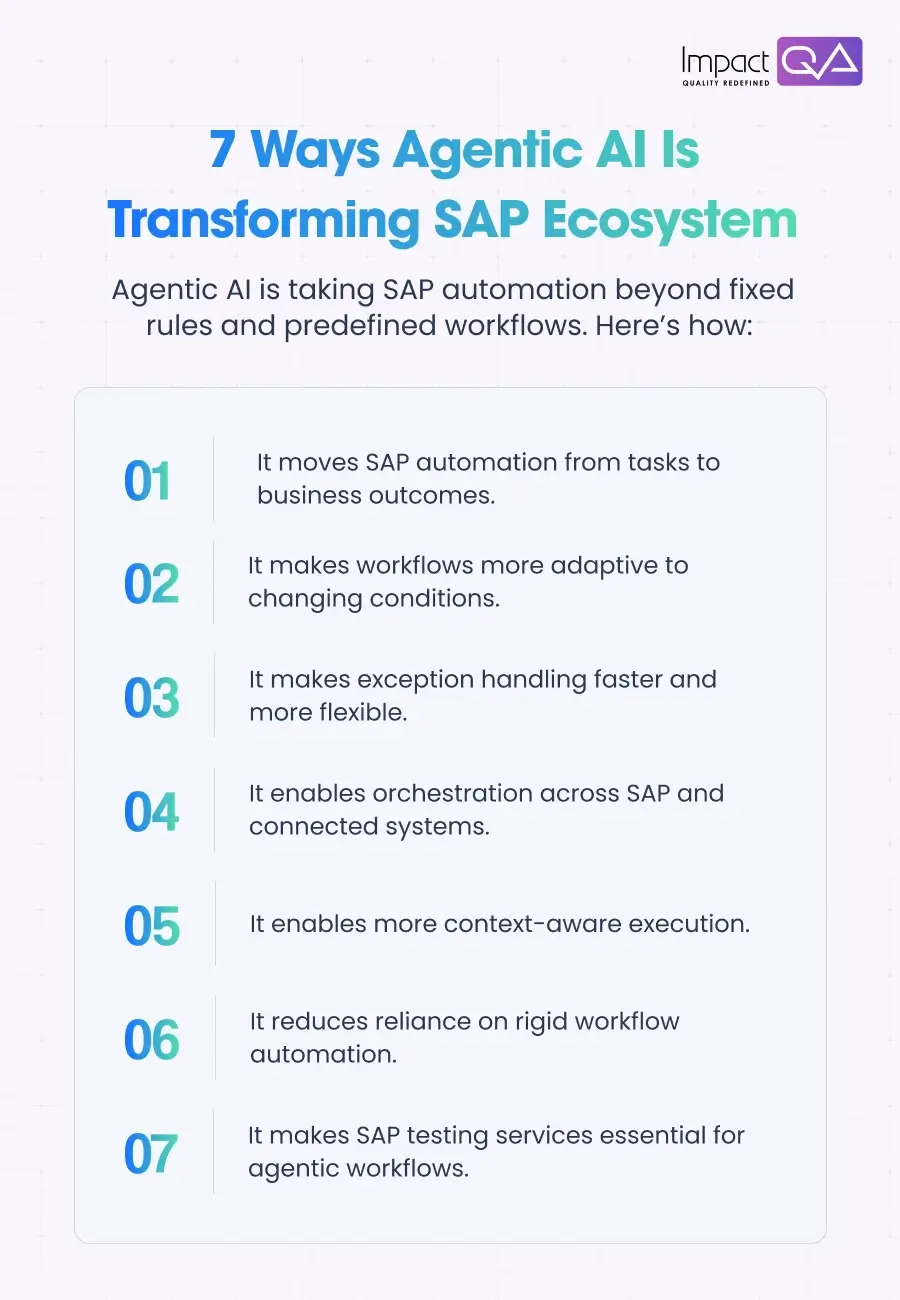
1. It moves automation from tasks to end-to-end processes
Traditional automation usually targets a defined task. An agent can coordinate several connected activities around a larger outcome.
In procurement, for instance, it could gather purchase context, identify missing information, route an approval, check supplier status, and follow up across connected systems. SAP’s Autonomous Enterprise direction is built around this broader model.
2. It makes workflows more adaptive
A rigid workflow assumes the next step is already known. An agent can assess the current state and select the next permitted action.
That matters when data is incomplete, or an exception appears halfway through a process. The value is not unrestricted in autonomy; it is the ability to handle variation without creating another hard-coded branch for every condition.
3. It changes exception handling
Exceptions are often where conventional automation gives control back to a person. An agent can investigate an issue, gather supporting information, check the relevant policy, and determine whether the case fits an approved resolution path or needs escalation.
That can reduce the manual coordination required around routine exceptions.
4. It connects SAP with surrounding enterprise systems
Most enterprise processes do not end at one SAP transaction. They touch suppliers, logistics platforms, customer systems, HR applications, data services, and other tools.
At SAP Sapphire 2026, SAP announced plans to deepen Anthropic Claude’s role across its AI portfolio and Joule, with agent-led work spanning SAP and connected enterprise environments.
5. It brings business context into AI execution
A general-purpose model does not automatically understand relationships inside an enterprise.
SAP is building its Business AI Platform around enterprise data and semantics, including SAP Knowledge Graph. That context helps agents work with business entities, processes, and relationships rather than treating each request as an isolated prompt.
6. It reduces dependence on rigid automation
When a process changes, scripts and workflow branches usually need explicit updates. Agentic execution can absorb some variation without requiring a separate rule for every scenario.
Maintenance does not disappear. The emphasis moves toward evaluating, governing, and monitoring intelligent behavior.
7. It makes testing part of the autonomy architecture
Once software can decide which action to take, quality cannot stop checking whether the final transaction succeeded. Testing needs to examine the agent’s decision, retrieved context, tool selection, authorization, exception response, and audit trail. That makes SAP testing services part of the transformation itself.
How Does the SAP Agentic AI Framework Work?
A practical SAP Agentic AI Framework brings together reasoning, enterprise context, orchestration, tools, identity, security, observability, and testing so an agent can operate in production without losing control.
The flow is straightforward:
Business intent → Reasoning and planning → Enterprise context → Tools and integrations → Execution → Observation → Governance and testing
SAP’s 2026 direction connects these layers through the SAP Business AI Platform, Joule Studio, SAP Business Data Cloud, SAP Knowledge Graph, identity capabilities, integration services, and governed runtime infrastructure.
The recent Sapphire announcements reinforce the point. SAP and Anthropic announced plans to make Claude a major reasoning and agentic capability across SAP’s AI portfolio and Joule. SAP and NVIDIA are also working with NVIDIA OpenShell, which provides sandboxed execution and configurable policies for autonomous agents.
Where Can Agentic AI Create Value Across SAP?
Agentic AI can create value across several SAP functions, particularly where processes require frequent coordination or involve changing conditions, such as:
Sr. No. |
SAP Area |
How Agentic AI can create value? |
| 1. | Finance | Supports financial analysis, reporting, reconciliation, and period-end activities by handling information gathering and routing exceptions for review. |
| 2. | Procurement | Coordinates supplier information, approvals, purchasing activities, and follow-ups through a single workflow. |
| 3. | Supply Chain | Responds to changing supply conditions and coordinates next steps, including scenarios such as rerouting supplier orders during shipment. |
| 4. | Human Resources | Brings together employee information and relevant policies to reduce manual coordination across HR processes. |
| 5. | Customer & Service Operations | Combines customer context with connected systems to support service requests and trigger appropriate actions. |
| 6. | Quality Engineering | Assists with test design, data preparation, defect analysis, regression prioritization, and validation across changing SAP environments. |
ImpactQA‘s expertise in agentic ai services for SAP and Oracle testing reflects this emerging quality-engineering layer, where autonomous agents are used to adapt testing to changing enterprise systems rather than simply repeat fixed scripts.
Why SAP Testing Becomes More Important?
Agentic systems expand the quality problem. Testing must examine the agent’s decisions and actions alongside the SAP processes those actions affect.
A conventional regression test might verify that a known input produces an expected result. An agentic workflow adds questions about context, tool selection, authorization, exceptions, and recovery. That is where SAP QA testing services need to evolve.
SAP test automation services can extend beyond repetitive regression execution into areas such as:
- Agent behaviour and decision validation
- Dynamic test-data generation
- Integration and API validation
- Exception-path testing
- Permission and access checks
- Continuous regression across changing workflows
ImpactQA’s SAP testing practice already positions AI as a way to make validation more adaptive, risk-focused, and responsive to changing enterprise environments.
ImpactQA helps validate agentic workflows before they go live.
Final Say
Agentic AI in SAP points to a different future for enterprise automation. Instead of making workflows more rigid, it gives them the flexibility to respond to the realities of business as they unfold.
That could open the door to faster execution, smarter coordination, and processes that require less manual intervention. The real progress, however, will come from bringing this capability into SAP environments without losing the reliability enterprises to depend on.
With the right architecture and quality practices in place, AI agents can become a natural extension of the SAP ecosystem. The future is not simply more automation. It is more responsive, context-aware automation built for the way modern enterprises actually operate.
Frequently Asked Questions (FAQs)
Share this post


Related Posts
Our Case Studies