Quick Summary:
Enterprise releases are frequently delayed due to long regression cycles, repetitive verification steps, and constant updates from Oracle. With the help of Oracle test automation, many of these difficulties can be overcome, as it automates critical business processes, ensures consistency, and significantly reduces execution time. This blog highlights practical methods, implementation strategies, and frameworks that help companies reduce their Oracle testing time by up to 70%.
Table of Contents:
- Introduction
- Why Oracle Test Automation Delivers Faster Enterprise Releases
- Practical Strategies to Reduce Oracle Testing Time by 70%
- Building a Sustainable Oracle Automation Testing Framework
- Closing Thoughts
The process of configuration changes, cloud updates, modifications, and integrations happening within Oracle ecosystems is often costly and requires extensive testing before every release. The adjustments compounded over time cause difficulties in executing manual regression tests and often elongate release schedules. However, automation of the testing process can help in fast and effective validation of business processes and increase testing effectiveness.
Moreover, Oracle cloud test automation allows organizations to validate updates using reusable test assets instead of rebuilding test cases for every release. This approach improves execution efficiency while supporting continuous delivery. By modernizing Oracle software testing with automation, enterprises can streamline Oracle software testing, reduce testing cycles, and maintain reliable application quality across evolving Oracle environments.
Achieve faster, reliable Oracle testing with ImpactQA's automation expertise.
Why Oracle Test Automation Delivers Faster Enterprise Releases
Oracle applications rarely operate independently. Transactions are routed through several modules and external systems; hence, whenever functionality is added or a quarterly update occurs, comprehensive checks will be needed. Because the execution is manual, the process takes longer since the same test cases must be rerun.
Oracle Cloud test automation helps businesses validate their cloud updates much more easily than before, since the entire regression testing suite does not have to be rebuilt. Instead of repeating the same operations, the team can spend more time on analysis and risk assessment before new releases.
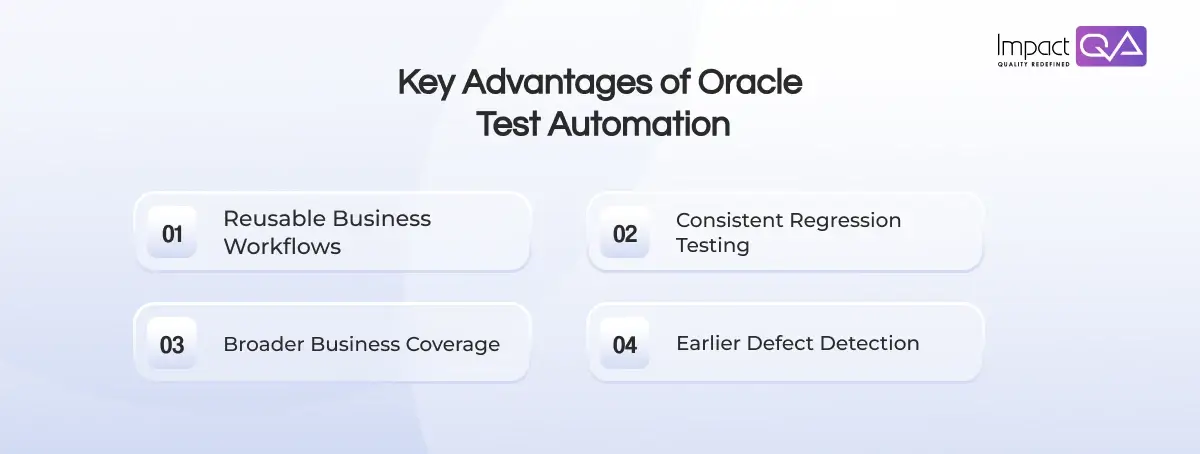
Key Advantages
1. Reusable Business Workflows
Automation converts repetitive business transactions into reusable assets. This minimizes duplicate work and simplifies future Oracle software testing activities whenever new releases or configuration changes are introduced.
2. Consistent Regression Testing
Unlike manual execution, Oracle automation testing performs identical validation every cycle. This improves defect identification while reducing inconsistencies caused by human intervention.
3. Broader Business Coverage
Automation allows quality teams to execute hundreds of scenarios within hours. Consequently, Oracle ERP testing covers more business processes without extending release schedules.
4. Earlier Defect Detection
Integrating Oracle testing tools with continuous delivery pipelines allows automated execution immediately after new builds become available. Development teams receive faster feedback and resolve issues before they become expensive.
Practical Strategies to Reduce Oracle Testing Time by 70%
Achieving substantial time savings requires more than simply automating existing manual tests. Successful organizations identify repetitive, business-critical workflows and prioritize automation according to business impact. This approach delivers measurable improvements without creating unnecessary maintenance overhead.
Selecting appropriate Oracle testing tools also plays an important role. Enterprise-grade platforms support reusable components, centralized reporting, and integration with DevOps environments. Likewise, functional testing of Oracle applications should focus first on high-volume processes such as procure-to-pay, order management, invoice processing, payroll, and inventory transactions because these workflows appear in nearly every regression cycle.
Automated Oracle testing becomes even more efficient when regression suites are categorized according to business risk. Rather than executing every available test, organizations validate high-priority workflows first and expand testing only where application changes require additional verification.
Best Practices
1. Prioritize High-Value Processes
Automate workflows executed most frequently during every release. These scenarios provide the highest return while significantly reducing repetitive manual validation.
2. Create Modular Test Components
Reusable automation modules simplify maintenance and improve adaptability whenever Oracle applications receive updates or configuration changes.
3. Adopt Risk-Based Regression
Not every deployment requires complete regression testing. Prioritizing scenarios according to business impact shortens execution without reducing quality.
4. Maintain Automation Continuously
Oracle automated testing tools require periodic optimization. Updating reusable scripts and removing obsolete scenarios keeps automation reliable across multiple releases.
Building a Sustainable Oracle Automation Testing Framework
Long-term success depends on building an automation framework that remains reliable as Oracle applications evolve. Many organizations achieve quick automation wins but struggle to maintain scripts after quarterly updates or business process changes. A sustainable framework focuses on reusability, governance, and continuous improvement rather than script volume. This approach reduces maintenance effort while ensuring Oracle automation testing continues delivering measurable business value.
An effective framework also aligns business users, developers, and QA teams around standardized test assets. Instead of creating isolated scripts for every release, reusable libraries support multiple business scenarios with minimal modifications. Additionally, integrating automated Oracle testing into continuous integration pipelines allows validation to begin immediately after new deployments. This reduces release bottlenecks and provides faster feedback without compromising application quality. As Oracle environments continue expanding, organizations that invest in structured Oracle software testing frameworks are better positioned to support frequent releases with predictable execution times.
Framework Essentials
1. Develop Reusable Test Libraries
Create common functions for login, navigation, validations, and business transactions. Reusable assets reduce script duplication and simplify maintenance across multiple Oracle testing initiatives.
2. Maintain Stable Test Data
Reliable test data is essential for accurate validation. Well-managed datasets reduce execution failures and improve the consistency of functional testing of Oracle applications.
3. Integrate Automation with DevOps
Connect Oracle testing tools with build pipelines to execute automated validation after every deployment. Continuous execution identifies defects earlier and shortens release cycles.
4. Review and Optimize Scripts Regularly
Periodic reviews remove outdated automation, improve execution efficiency, and ensure Oracle cloud test automation remains aligned with evolving business processes.
ImpactQA helps you simplify Oracle ERP testing with scalable automation solutions.
Closing Thoughts
Reducing Oracle testing time by 70% requires more than adopting automation tools. It demands a structured strategy that prioritizes business-critical workflows, reusable automation assets, risk-based regression, and continuous framework maintenance. Together, these practices make Oracle ERP testing faster, more reliable, and better suited for frequent enterprise releases while maintaining consistent software quality.
At ImpactQA, we provide Oracle test automation solutions that meet business requirements. Our solutions help customers optimize Oracle testing using proven Oracle software testing tools and frameworks. We collaborate with our clients to develop sustainable Oracle test automation strategies that improve testing performance and ensure more successful test cycles.
Frequently Asked Questions (FAQs)
Share this post


Related Posts
Our Case Studies