Quick Summary:
Frequent deployments help organizations deliver features faster, but many production issues emerge only when applications encounter real users, live traffic, and complex infrastructure conditions. This blog explores how shift-right testing extends quality assurance beyond deployment, examines key production validation techniques, compares shift-left vs shift-right testing, and explains how AI-driven insights are strengthening modern DevOps quality practices.
Table of Contents:
- What is Shift-Right Testing?
- Why the Shift-Right Testing Approach is Critical for Continuous Delivery
- Key Techniques Used in Shift-Right Testing
- Shift-Left vs Shift-Right Testing: Understanding the Difference
- How Shift-Right Testing with AI is Transforming Production Validation
- Best Practices for Implementing Shift-Right Testing in DevOps Pipelines
- Final Say
Delivering software faster has become a business necessity, but speed alone does not guarantee quality. Despite advances in automation, performance testing, and continuous integration, many application issues still emerge only after deployment. Real user interactions, unpredictable workloads, infrastructure variations, and complex service dependencies often create conditions that are difficult to reproduce within testing environments. Consequently, organizations are realizing that quality assurance cannot end when an application moves into production.
This realization has brought the shift-right testing approach into sharper focus. Rather than relying solely on pre-release validation, organizations are extending testing activities into production to observe how applications perform under actual operating conditions. By analyzing system behavior, user experience, and operational performance in real time, teams gain insights that support continuous improvement. For enterprises adopting DevOps and continuous delivery, shift-right testing has become an important practice for building reliable applications while maintaining deployment velocity.
At ImpactQA, we help organizations improve application reliability through production validation and quality engineering services.
What is Shift-Right Testing?
Shift-right testing is a quality assurance methodology that extends testing activities beyond deployment and into production environments. Instead of treating software deployment as the final checkpoint, organizations continue validating application performance, reliability, user experience, and business workflows after the application becomes available to end users.
The primary objective is to observe software under actual operating conditions. Production environments expose applications to real customer interactions, fluctuating workloads, third-party integrations, and infrastructure dependencies that are difficult to replicate during pre-production testing. As a result, teams gain access to operational insights that can drive continuous improvement.
Unlike conventional testing models that focus primarily on defect prevention, shift-right testing emphasizes defect detection, performance validation, and operational learning after deployment. The approach supports continuous delivery initiatives by helping organizations gather actionable intelligence from live systems without disrupting business operations.
As enterprises adopt cloud-native architectures, microservices, and distributed applications, production-focused quality practices are increasingly becoming part of long-term quality engineering strategies.
Why the Shift Right Testing Approach is Critical for Continuous Delivery
Continuous delivery pipelines are designed to move software from development to production at a much faster pace. While automation accelerates deployments, speed alone does not guarantee software quality. Many production incidents originate from conditions that were not present during earlier validation stages.
The shift-right testing approach addresses this gap by providing visibility into real-world application behavior.
Validates Real User Experiences
Internal test environments rarely capture every user journey. Production testing allows teams to analyze how customers interact with applications across different devices, locations, and usage scenarios.
Supports Faster Issue Identification
Monitoring production systems enables organizations to detect performance degradation, transaction failures, and service disruptions before they escalate into widespread business issues.
Provides Business-Centric Quality Metrics
Beyond technical indicators, teams can measure conversion rates, customer engagement, transaction completion rates, and user satisfaction levels to assess application effectiveness.
Strengthens Deployment Decisions
Continuous feedback from production environments helps engineering teams make informed deployment decisions and validate the effectiveness of newly deployed features.
Key Techniques Used in Shift Right Testing
Successful implementation of shift-right testing requires structured practices that generate reliable production insights while minimizing operational risks.
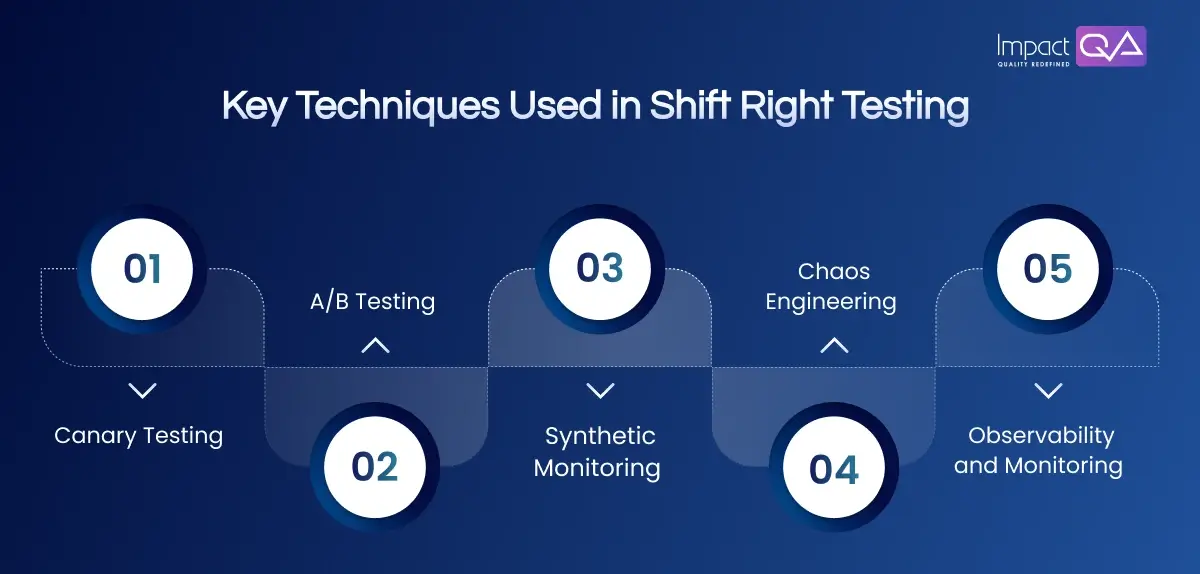
Canary Testing
New application versions are deployed to a small subset of users before broader rollout. Teams monitor system behavior and user responses to determine whether deployment should proceed.
A/B Testing
Different feature versions are presented to separate user groups. Performance metrics and customer interactions help organizations identify the most effective implementation.
Synthetic Monitoring
Automated scripts continuously simulate user transactions to verify the availability and responsiveness of critical business functions.
Chaos Engineering
Controlled failures are introduced within production environments to assess system resilience. This technique helps organizations identify weaknesses before unexpected disruptions occur.
Observability and Monitoring
Modern observability platforms collect metrics, traces, events, and logs from distributed systems. These insights help engineering teams understand application behavior across complex environments.
Shift Left vs Shift Right Testing: Understanding the Difference
The discussion around shift-left vs shift-right testing often creates the misconception that organizations must choose one methodology over the other. In reality, both approaches address different quality objectives.
Shift-left testing focuses on identifying defects as early as possible during development. Activities such as code reviews, unit testing, integration testing, and automated validation help reduce the cost of defect resolution before deployment.
Shift-right testing, on the other hand, focuses on understanding how applications behave after deployment. It evaluates performance, scalability, reliability, and user experience under actual operating conditions.
The distinction becomes clearer when viewed through a risk-management perspective.
S. No. |
Shift – Left Testing |
Shift-Right Testing |
| 1. | Detects issues early in development | Identifies issues in production conditions |
| 2. | Emphasizes prevention | Emphasizes validation and learning |
| 3. | Uses controlled testing environments | Uses real-world operating environments |
| 4. | Focuses on development quality | Focuses on operational quality |
How Shift Right Testing with AI is Transforming Production Validation
The growing volume of production data has made manual analysis increasingly challenging. Enterprises now process millions of transactions, logs, and performance events daily. Extracting meaningful insights from this data requires intelligent analysis capabilities.
This is where shift-right testing with AI is creating new opportunities.
Pattern Recognition
AI models can continuously analyze production data to identify unusual application behavior, transaction irregularities, and performance deviations that may indicate emerging quality concerns. This allows teams to investigate issues earlier and reduce the likelihood of widespread business impact.
Predictive Risk Identification
Historical production patterns can be analyzed to predict failures before users experience service disruptions. This allows teams to proactively address emerging issues and reduce the likelihood of business-critical incidents affecting end users.
Root Cause Analysis
AI-assisted diagnostics accelerate investigation efforts by correlating events across applications, services, and infrastructure components. By connecting related signals and dependencies, teams can identify underlying causes faster and shorten issue resolution timelines.
Intelligent Alert Prioritization
Production teams often face alert fatigue. AI helps filter noise and prioritize incidents based on business impact and operational severity. By analyzing service dependencies and transaction criticality, it helps teams focus on the most significant issues first.
Best Practices for Implementing Shift Right Testing in DevOps Pipelines
Organizations often struggle to maximize value from production testing because monitoring activities lack structure and measurable objectives. A disciplined implementation strategy is therefore essential.
Define Business-Relevant Metrics
Monitor indicators that directly reflect customer experience, transaction success, and operational reliability rather than relying solely on infrastructure metrics.
Integrate Testing with Observability Platforms
Production monitoring should be tightly connected with quality engineering workflows to enable faster issue detection and resolution.
Establish Continuous Feedback Mechanisms
Insights gathered from production environments should be systematically incorporated into future development and testing activities.
Prioritize Controlled Experimentation
Canary deployments and feature rollouts should follow defined governance practices to reduce operational risk.
Leverage Intelligent Analytics
Combining observability data with AI-powered analysis can improve detection accuracy and accelerate decision-making.
At ImpactQA, we help enterprises strengthen software quality through DevOps-focused testing and performance engineering services.
Final Say
Modern delivery pipelines require more than rapid deployments and automated test execution. Organizations must continuously evaluate how applications perform under real-world conditions, where customer behavior, transaction volumes, and infrastructure dynamics can expose risks that are difficult to predict during earlier testing stages. This is where shift-right testing delivers measurable value by extending quality assurance beyond deployment and into ongoing operations.
At ImpactQA, we help enterprises build comprehensive quality strategies that combine production-focused validation with DevOps-driven delivery practices. Through our expertise in advanced quality assurance services, we enable organizations to implement a scalable shift-right testing approach that supports reliability, operational stability, and sustained business performance.
Share this post


Related Posts
Our Case Studies