Quick Summary:
Large Language Models are reshaping enterprise operations, but they introduce quality risks that traditional testing cannot address. This article explores how AI testing services evaluate LLM applications for accuracy, bias, and hallucinations while ensuring fairness, reliability, and compliance. It also outlines key testing methodologies and best practices organizations can implement to establish measurable quality standards across AI-powered systems throughout deployment.
Table of Contents:
- Introduction
- Why Traditional Testing Is Not Enough for LLM Applications
- Accuracy Testing: Establishing Trustworthy AI Responses
- Bias and Fairness Testing in Enterprise AI Systems
- Hallucination Testing: Addressing One of the Largest LLM Risks
- Building a Comprehensive LLM Testing Strategy
- Final Say
Large Language Models (LLMs) are transforming how enterprises interact with customers, process information, and automate knowledge-driven tasks. From AI copilots and virtual assistants to document intelligence platforms, these systems are increasingly becoming part of critical business workflows. However, unlike conventional software applications, LLMs generate AI-generated outputs. This creates unique quality risks related to factual correctness, fairness, consistency, and reliability.
As organizations deploy AI-powered applications at scale, testing becomes a business-critical activity rather than a post-development checkpoint. Accuracy issues, factually incorrect responses, and biased outputs can impact customer trust, regulatory compliance, and operational decision-making. This is where a specialized AI testing service becomes essential. Organizations are increasingly partnering with an experienced AI testing services provider to validate model behavior under diverse conditions and establish measurable quality standards before production deployment.
At ImpactQA, we help enterprises test and validate LLMs with comprehensive AI testing services focused on accuracy, safety, and performance.
Why Traditional Testing Is Not Enough for LLM Applications
Conventional software testing focuses on deterministic systems where identical inputs produce predictable outputs. LLM-powered applications operate differently. The same prompt can generate multiple valid responses, making validation significantly more complex.
Unlike traditional applications, AI systems require continuous assessment across linguistic, contextual, ethical, and domain-specific dimensions. A model may generate grammatically correct content while still introducing factual inaccuracies or hidden biases. Therefore, testing strategies must move beyond functional verification and include behavioral evaluation.
Key areas that require dedicated validation include:
Output Variability
LLMs can generate different responses for the same prompt. Testing must evaluate whether these variations remain accurate, relevant, and aligned with business objectives.
Context Retention
Many enterprise applications rely on multi-turn conversations. Test teams must verify whether the model maintains context consistently throughout extended interactions without introducing contradictory information.
Domain Knowledge Accuracy
Industry-specific applications in healthcare, finance, energy, or legal sectors require precise responses. Even minor inaccuracies can create operational and compliance concerns.
Prompt Sensitivity
Small changes in wording can significantly alter model outputs. Testing should assess how prompt variations influence response quality and reliability.
Accuracy Testing: Establishing Trustworthy AI Responses
Accuracy testing serves as one of the most important components of LLM validation. The objective is to determine whether generated responses are factually correct, contextually appropriate, and aligned with expected business outcomes.
A comprehensive AI testing service evaluates accuracy through structured datasets, benchmark scenarios, and domain-specific validation techniques.
Factual Verification
Generated responses are compared against trusted knowledge sources and validated datasets. This process helps identify misinformation, outdated facts, and unsupported claims.
Contextual Relevance Assessment
A response may be factually correct yet fail to answer the user’s question effectively. Testing evaluates whether outputs remain aligned with user intent and conversational context.
Industry-Specific Validation
Enterprise AI solutions often support highly specialized business functions. Testing teams collaborate with subject matter experts to verify domain correctness across realistic use cases.
Consistency Evaluation
Organizations must determine whether the model delivers stable results across repeated interactions and varied input structures.
Bias and Fairness Testing in Enterprise AI Systems
Bias remains one of the most challenging issues in generative AI systems. Models trained on large-scale datasets can unintentionally reflect societal, cultural, or demographic biases present within training data. Without proper validation, biased outputs can affect hiring recommendations, customer interactions, financial assessments, and decision-support systems.
An experienced AI testing services provider implements structured fairness testing methodologies to identify and mitigate these risks.
Demographic Evaluation
Responses are analyzed across various demographic groups to identify unequal treatment, stereotypes, or discriminatory patterns.
Prompt Diversity Analysis
Testing teams create diverse prompt variations to determine whether changes in names, locations, genders, or cultural references influence model behavior.
Toxicity Assessment
Generated outputs are examined for offensive language, harmful content, inappropriate recommendations, or exclusionary messaging.
Regulatory Alignment
Organizations operating in regulated industries must demonstrate responsible AI practices. Fairness testing helps support governance and compliance requirements.
However, bias testing should not be viewed as a one-time exercise. Since models are updated frequently, continuous evaluation is necessary to maintain fairness standards throughout the AI lifecycle.
Hallucination Testing: Addressing One of the Largest LLM Risks
Hallucinations occur when an AI model generates information that appears credible but lacks factual basis. This remains one of the most significant concerns for organizations implementing LLM-powered applications.
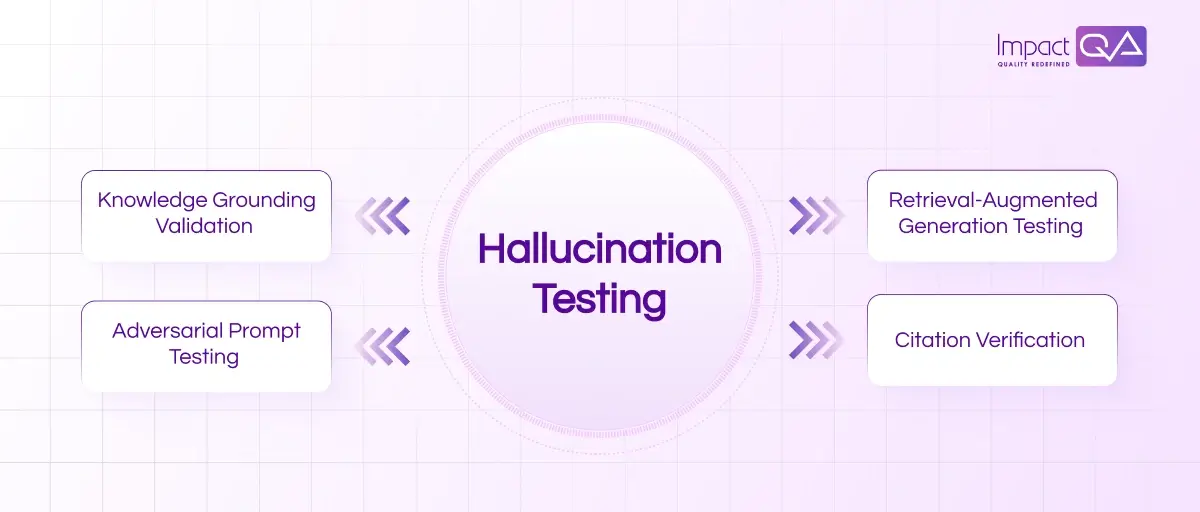
Hallucinated outputs can lead to incorrect recommendations, misleading reports, inaccurate summaries, and flawed business decisions.
Effective hallucination testing includes several structured approaches:
Knowledge Grounding Validation
Responses are checked against authoritative data sources to verify factual correctness and source alignment.
Retrieval-Augmented Generation Testing
For applications using external knowledge repositories, testing verifies whether retrieved information is accurately reflected in generated outputs.
Adversarial Prompt Testing
Testers intentionally introduce ambiguous, incomplete, or misleading prompts to assess how the model responds under uncertain conditions.
Citation Verification
Where applicable, testing frameworks evaluate whether models provide supporting references and avoid presenting assumptions as facts.
At ImpactQA, we help organizations identify accuracy, bias, and hallucination risks in LLM-powered applications through specialized AI quality engineering services.
Building a Comprehensive LLM Testing Strategy
Successful AI quality programs require a structured testing framework that combines technical validation with business-focused evaluation.
Key elements include:
Define Measurable Quality Metrics
Establish benchmarks for accuracy, fairness, relevance, toxicity, latency, and hallucination rates. Quantifiable metrics provide a foundation for objective decision-making.
Develop Representative Test Datasets
Test data should reflect real user interactions, industry terminology, edge cases, and high-risk business scenarios.
Implement Automated Evaluation Pipelines
Organizations are increasingly integrating AI in software test automation to support continuous model validation throughout development and deployment cycles.
Perform Human-in-the-Loop Reviews
Automated evaluation provides scale, but expert review remains essential for assessing nuanced responses and contextual appropriateness.
Monitor Production Performance
Testing should continue after deployment. User behavior, changing data sources, and model updates can introduce new quality risks over time.
Final Say
LLM applications introduce testing challenges that differ significantly from traditional software systems. Accuracy, bias, and hallucination risks can affect customer trust, operational reliability, regulatory compliance, and business outcomes. At ImpactQA, we deliver specialized AI testing services designed to address these challenges through comprehensive model evaluation, hallucination testing, bias assessment, accuracy validation, and governance-focused quality assurance. As an AI testing services provider, we help organizations establish measurable quality, reliability, and accountability in their AI systems before deployment and throughout production operations.
Frequently Asked Questions (FAQs)
Share this post


Related Posts
Our Case Studies