How AI Testing Saves Businesses Thousands in Operational Costs

Quick Summary:
AI testing reduces operational cost by restructuring how testing effort is distributed across the lifecycle. Instead of relying on volume-based execution and manual upkeep, it applies data-driven prioritization, adaptive automation, and predictive insights to control where time, infrastructure, and human effort are spent. This blog examines how an AI testing services provider enables this shift, and how an AI testing service converts testing from a cost-heavy activity into a measurable efficiency driver.
Table of Contents:
- Introduction
- The Real Cost Architecture of Traditional Testing
- How AI-Led Testing Reconstructs Cost Efficiency
- Key Areas Where AI Cuts Costs for Businesses
- Implementation Gaps That Can Erode Cost Benefits
- Strategic Execution Framework for Sustainable ROI
- Conclusion
Software testing costs are increasing not because testing is ineffective, but because the scope of validation has expanded significantly. Frequent releases, distributed architectures, and tightly integrated systems require continuous verification across multiple layers. Traditional automation struggles to manage this scale because it depends on static scripts and recurring manual intervention. Over time, this creates cost pressure that is difficult to control and even harder to optimize.
According to Gartner, organizations adopting AI-driven quality engineering can reduce testing effort by up to 30 percent while improving accuracy. This shift reflects a bigger change in how testing is structured. Instead of executing everything, the focus shifts to what matters most. An AI testing services provider enables this transition by using data to guide test selection, execution timing, and failure analysis. This is where an AI testing service begins to control costs at the source, turning testing from a reactive expense into a disciplined, efficient-driven function.
ImpactQA’s AI testing service helps you achieve faster releases with controlled spend.
The Real Cost Architecture of Traditional Testing
Testing costs are not concentrated in one area. They accumulate across multiple activities that appear manageable individually but become expensive when combined over time.
Script Instability and Continuous Rework
Automation scripts frequently fail due to application updates. Teams spend significant time fixing broken flows, which increases maintenance effort and reduces time available for meaningful test expansion.
Unoptimized Test Suites and Redundant Execution
Test repositories expand without regular review. Many cases overlap in coverage or validate low-risk areas, which increases execution time without improving defect detection efficiency.
Delayed Feedback and Escalation Impact
Defects identified late require broader validation across dependent modules. This extends timelines and increases effort across development, testing, and release management teams.
Inefficient Infrastructure Utilization
Test environments are often provisioned for peak demand but remain idle during off cycles. This results in unnecessary infrastructure costs, especially in cloud-based testing environments.
Manual Effort Across Testing Activities
Test design, execution monitoring, and reporting rely heavily on manual input. This slows down processes and increases dependency on skilled resources, adding to operational cost.
How AI-Led Testing Reconstructs Cost Efficiency
AI testing changes how effort is allocated. Instead of increasing execution volume, it focuses on improving relevance, accuracy, and timing of testing activities.
Self-Healing Automation Reduces Maintenance Effort
AI frameworks adapt to application changes by updating element locators and execution paths. This reduces the need for manual script correction and stabilizes automation suites over time.
Risk-Based Test Prioritization Improves Coverage Efficiency
AI evaluates defect history and code changes to identify high-impact areas. This ensures critical scenarios are tested first while reducing effort spent on low-value cases.
Intelligent Test Case Generation Enhances Relevance
AI creates test scenarios using system behavior and historical data. This improves coverage quality and reduces duplication across test suites.
Predictive Failure Analysis Speeds Up Resolution
AI analyzes execution patterns and logs to identify failure causes quickly. This reduces investigation time and accelerates issue resolution cycles.
Optimized Resource Scheduling Controls Infrastructure Cost
AI schedules test execution based on priority and resource availability. This improves environment utilization and reduces unnecessary infrastructure usage.
Key Areas Where AI Cuts Costs for Businesses
AI introduces efficiency across operational layers by reducing waste and improving decision accuracy. According to PwC, enterprises using AI for automation and predictive analytics are expected to achieve significant cost reductions across business operations.
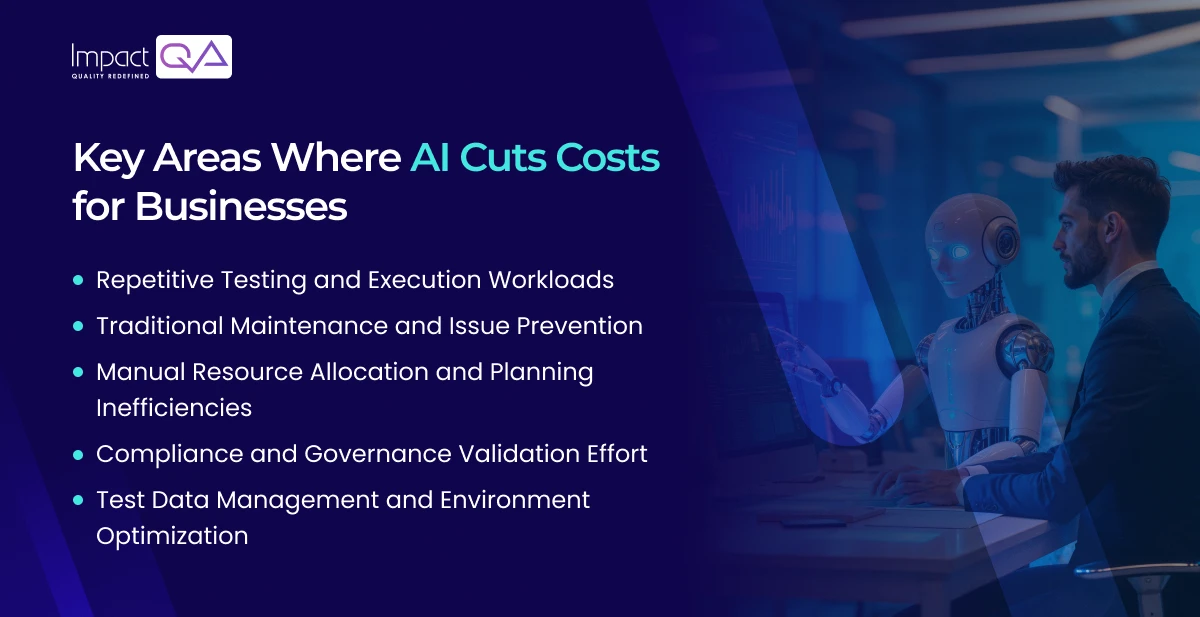
Organizations investing in an AI testing service can expect cost benefits in the following areas:
Repetitive Testing and Execution Workloads
AI automates regression cycles, test data preparation, and validation activities. This reduces manual effort and ensures consistent execution without increasing dependency on large testing teams.
Traditional Maintenance and Issue Prevention
AI monitors system behavior continuously and identifies anomalies early. Preventing failures before escalation reduces rework effort and avoids the cost associated with downtime and disruptions.
Manual Resource Allocation and Planning Inefficiencies
Predictive analytics helps allocate testing effort based on workload and risk. This ensures teams and infrastructure are used efficiently without over-allocation or underutilization.
Compliance and Governance Validation Effort
AI automates validation of compliance rules and reporting requirements. This reduces manual verification effort while maintaining consistency and accuracy across regulatory checks.
Test Data Management and Environment Optimization
AI generates and manages test data based on usage patterns. It also improves environment utilization by aligning execution schedules with actual demand.
Implementation Gaps That Can Erode Cost Benefits
AI testing requires structured adoption. Without proper alignment, organizations may not achieve the expected cost advantages.
Tool Adoption Without Process Alignment
Implementing AI tools without redefining testing workflows limits impact. Existing inefficiencies remain, which reduces the overall value of AI-driven testing.
Insufficient Data for Accurate AI Predictions
AI models depend on reliable historical data. Poor data quality leads to inaccurate insights, which affects test prioritization and reduces effectiveness.
Integration Complexity with Existing Systems
Integrating AI solutions into legacy environments requires planning. Without alignment, integration efforts increase cost and delay expected benefits.
Skill Gaps Within Testing Teams
Teams need to understand AI-driven insights and workflows. Lack of expertise slows adoption and reduces the efficiency gains expected from AI implementation.
Lack of Defined Cost Measurement Metrics
Without clear KPIs, organizations cannot track savings effectively. This limits visibility into ROI and affects long-term decision-making.
Partner with ImpactQA, a leading AI Testing services provider delivering measurable business value.
Strategic Execution Framework for Sustainable ROI
A structured approach ensures that AI testing delivers consistent cost savings and long-term efficiency.
Focus on High-Cost Testing Areas First
Identify modules with frequent changes or high maintenance effort. Targeting these areas ensures immediate cost reduction and validates the effectiveness of AI-driven testing.
Adopt a Phased Implementation Model
Introduce AI capabilities gradually to reduce disruption. This allows teams to adapt to new workflows and ensures smoother integration.
Define Measurable Cost Optimization Metrics
Track execution time, maintenance effort, and testing efficiency. These indicators provide visibility into cost savings and guide continuous improvement.
Strengthen Data Readiness for AI Systems
Ensure data is clean, structured, and accessible. Strong data quality improves AI predictions and enhances decision-making accuracy.
Collaborate with an Experienced AI Testing services provider
Partnering with experts ensures proper implementation and scaling. This reduces risk and accelerates return on investment.
Conclusion
AI testing introduces a structured approach to controlling the cost of quality. By improving how testing effort is planned, executed, and analyzed, it reduces unnecessary spending while maintaining strong validation standards. An AI testing service enables organizations to move away from effort-heavy processes and adopt models where every test cycle is aligned with business impact. This is why AI testing services are becoming critical for organizations that need to scale without increasing operational cost.
ImpactQA delivers specialized AI-driven testing solutions designed to achieve this balance between cost control and quality assurance. Our approach integrates intelligent automation with data-driven insights to reduce inefficiencies and improve testing precision across complex environments. Recognized among the best AI testing services, ImpactQA supports organizations in building scalable, cost-efficient testing frameworks that align with modern delivery expectations and long-term business goals.
Share this post


Related Posts
Our Case Studies