Quick Summary:
Accelerating enterprise release cycles while managing highly customized SAP and Oracle environments introduces immense testing friction and skyrocketing maintenance costs. Fortunately, agentic AI offers a powerful, autonomous path forward. By deploying self-healing agents that dynamically adapt to system changes, enterprises can eliminate manual script upkeep, achieve total test coverage, and confidently fast-track their continuous digital transformation initiatives.
Table of Contents:
- The Evolution of Enterprise Quality Engineering
- Understanding the Role of Autonomous Agents in ERP Validation
- Practical Enterprise Use Cases and Realized Business Value
- Common Implementation Challenges and Strategic Mitigations
- Future-Proofing Corporate ERP Systems with Intelligent Automation
The Evolution of Enterprise Quality Engineering
The rapid migration of legacy ERP systems to modern cloud infrastructures demands an avant-garde approach to quality assurance. Traditional automated scripts often crack under the weight of continuous transport updates and massive quarterly releases. As organizations seek smarter validation pathways, autonomous AI agents are stepping in to shift the paradigm from reactive script maintenance to proactive, self-healing quality pipelines.
This technical paradigm shift is fundamentally reshaping how enterprises manage risk across their core business applications. By embedding cognitive decision-making models directly into the testing lifecycle, engineering teams can now move away from static test scripts that require constant human intervention. The result is an autonomous quality ecosystem capable of understanding complex end-to-end workflows and anticipating failures before they reach production.
Additionally, this evolutionary leap allows organizations to scale their testing output without a linear increase in headcount or overhead costs. Instead of spending valuable engineering hours manually mapping out application code changes or fixing broken element locators, teams can direct their energy toward high-level strategy and exploratory scenarios. Ultimately, transitioning to intelligent testing ecosystems guarantees that rapid software updates do not compromise transactional integrity or disrupt core business continuity.
Partner with ImpactQA to deploy cognitive, self-healing validation frameworks that safeguard your SAP and Oracle ecosystem.
Understanding the Role of Autonomous Agents in ERP Validation
Deploying agentic AI in SAP environments changes how quality teams map out complex business flows. Unlike traditional automated systems that rigidly follow pre-recorded actions, an autonomous agent dynamically evaluates user interfaces, business logic, and backend data layers simultaneously. When an enterprise introduces a customized SAP S/4HANA patch, these agents analyze the transport logs, predict which transaction codes are vulnerable, and dynamically generate precise test cases.
To achieve this level of maturity, organizations are building a structured SAP agentic AI framework that connects large language models directly to system transport layers. This connection allows the AI to autonomously discover change impacts and configure test data on the fly. Furthermore, leading global enterprises rely on dedicated SAP testing services to ensure these intelligent agents are properly trained on specific industry verticals, preventing costly false positives in highly customized environments.
The true strength of an autonomous framework lies in its ability to handle end-to-end workflows that span multiple platforms. For instance, a single order-to-cash process might begin in an external CRM, move through an internal supply chain engine, and settle within core financial modules. AI agents track these data paths across boundaries, verifying that mid-stream schema changes do not break downstream transactional compliance.
Practical Enterprise Use Cases and Realized Business Value
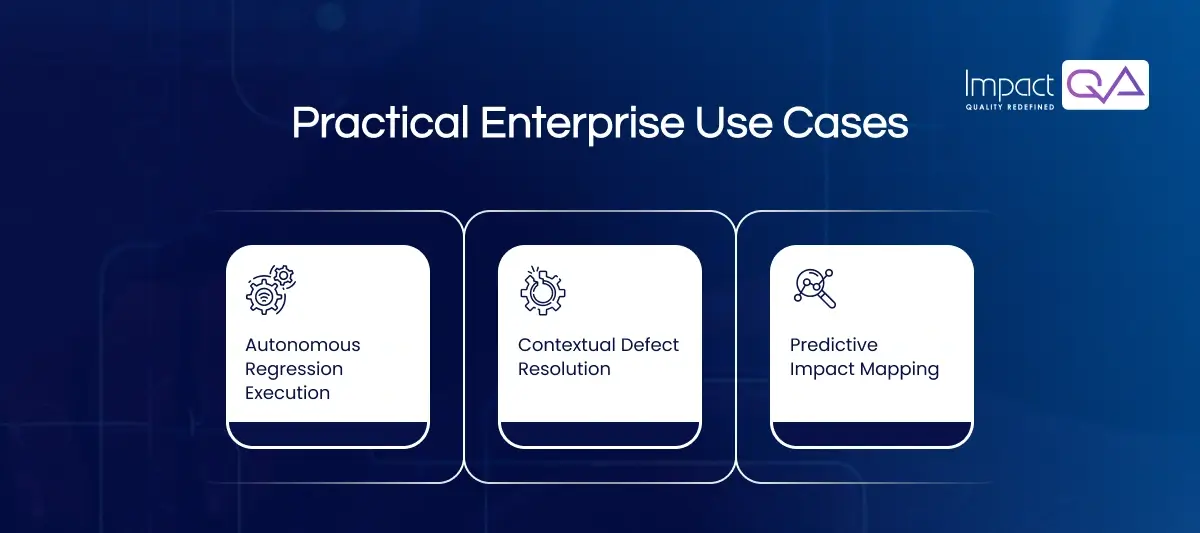
Implementing advanced cognitive validation models yields immediate operational advantages across diverse corporate environments. Rather than focusing solely on raw execution speed, these intelligent systems optimize the broader testing ecosystem by making contextual decisions that mimic an expert human QA engineer.
Autonomous Regression Execution: Intelligent agents actively monitor system performance during updates, identifying modified elements and updating test libraries without manual script correction to minimize release overhead.
Contextual Defect Resolution: When an execution failure occurs, the agent automatically cross-references application server logs, database states, and historical code repositories to pinpoint the root cause of the issue.
Predictive Impact Mapping: By analyzing technical change logs before execution begins, the system isolates high-risk business paths, allowing teams to run targeted tests instead of entire regression suites.
By integrating comprehensive SAP QA testing services into their deployment pipelines, modern enterprises can successfully bridge the gap between legacy processes and autonomous execution models. Additionally, specialized SAP test automation services provide the necessary guardrails to manage complex data compliance rules during automated test runs.
On the Oracle side, leveraging robust Oracle test automation methodologies ensures that heavy cloud updates do not interrupt continuous business operations. For organizations operating heavily customized deployments, utilizing specialized Oracle Cloud test automation strategies remains essential for validating deep integrations. Through a systematic application of oracle testing principles, enterprises can reliably protect their core logistical and financial data paths.
Selecting the right oracle testing tools allows teams to automate structural validations, while the deployment of modern oracle automated testing tools reduces testing turnaround time. Ultimately, embracing comprehensive oracle automation testing leads to higher software reliability, making automated oracle testing a core requirement for sustainable corporate scaling.
Common Implementation Challenges and Strategic Mitigations
While the shift toward autonomous quality management offers tremendous business benefits, enterprises frequently encounter unique technical hurdles during early deployment stages. Complex ERP platforms are highly susceptible to data segregation and strict security policies, which can restrict an intelligent agent’s visibility into underlying system behaviors. If an autonomous system cannot access realistic data configurations, the generated test paths lose accuracy and fail to reflect true production environments.
To overcome these data visibility barriers, engineering teams must establish robust synthetic data generation protocols within their validation frameworks. Additionally, organizations should implement strict role-based access controls that allow AI agents to safely query environment logs without violating corporate data compliance mandates. By pairing advanced simulation capabilities with tightly controlled test spaces, companies can systematically reduce data-related execution errors.
Another notable hurdle involves managing the underlying machine learning models to prevent algorithmic drift over extended periods. As business logic evolves through custom extensions and routine configuration updates, older model training data may gradually lose its contextual relevance. Enterprises can successfully mitigate this risk by scheduling automated retraining cycles tied directly to major platform releases. This ensures the agents always operate with up-to-date business knowledge.
Let us help you deploy self-healing agents that autonomously validate your customized SAP and Oracle workflows.
Future-Proofing Corporate ERP Systems with Intelligent Automation
Transitioning to an agent-driven quality model requires a deliberate shift in operational strategy, moving away from hyper-rigid automation templates toward dynamic, context-aware frameworks. As software systems grow more interconnected, testing architectures must evolve to independently adapt to continuous changes without stalling active deployment tracks.
At ImpactQA, we help organizations navigate this technological shift by delivering tailored quality engineering strategies that convert complex testing hurdles into scalable business advantages. Our deep domain knowledge allows us to design resilient testing frameworks that seamlessly integrate autonomous validation models with existing enterprise architectures. Learn more about our specialized approach to ERP validation by visiting our Oracle testing services.
By combining intelligent automation with deep industry expertise, we ensure your core business systems remain secure and functional through every update cycle. Our teams focus on reducing script maintenance and expanding real-world test coverage, giving your enterprise the assurance to accelerate digital transformation initiatives safely.
Frequently Asked Questions (FAQs)
Share this post


Related Posts
Our Case Studies