Quick Summary:
This blog explores modern performance test automation frameworks designed specifically for distributed multi-runtime environments. The discussion covers practical strategies, automation techniques, and framework design practices that help teams identify throughput degradation and latency regressions early. It also highlights approaches for maintaining reliability and performance stability across interconnected services and API gateways under fluctuating workloads.
Table of Contents:
- Introduction
- What Makes Modern App Testing Different from Old Methods?
- Key Architectural Components for Automated Verification
- Architectural Challenges in Distributed Systems Performance Testing
- Automation Strategies for Microservices
- Conclusion
Modern enterprise applications rely heavily on decentralized topologies in which decoupled microservices communicate via event-driven protocols, message queues, and distributed API gateways. Traditional validation methodologies often fail to evaluate these complex networks because they treat the system as a centralized entity, overlooking latency variations and operational friction among components. To address these challenges, engineering teams need a structured approach to continuous performance testing that supports reliable performance validation across delivery pipelines.
By integrating sophisticated scripts that simulate computational stress, organizations can evaluate system thresholds, memory consumption patterns, and communication payload efficiency. Utilizing specialized performance testing tools enables engineering teams to model diverse traffic profiles and analyze behavior across multiple runtime dependencies. Transitioning to a model focused on performance test automation ensures that non-functional verification becomes a repeatable and reliable process, while preventing regressions and maintaining operational resilience across distributed cloud architectures.
ImpactQA applies intelligent cloud automated testing to reduce risk and accelerate releases.
What Makes Modern App Testing Different from Old Methods?
Testing regular software is simple because everything lives in one place, but modern apps use separate pieces that talk over a network. When one piece slows down, it can cause a reaction that slows down the entire application for the end user.
- Network Delay Accumulation: A small pause in a backend database service can quickly cause requests to back up, which fills up system buffers and drops new user traffic.
- Data Processing Overhead: Converting data back and forth between different services uses heavy computer processing power, which lowers total system speed during busy hours.
- Queue Backup Pressures: When a service cannot process messages as fast as they arrive on the network queue, the system memory overloads, leading to application crashes.
Understanding these basic performance issues helps software teams move toward regular performance testing services to keep a check on system health. By tracking performance numbers early, developers can find and fix code issues before updates are sent to customers. This simple approach ensures that all connected parts work well together and can handle large amounts of business traffic without breaking.
Key Architectural Components for Automated Verification
To build a reliable performance testing services framework, engineering teams must dissect a distributed setup into distinct testable areas rather than treating the whole cluster as a single block. Each deployment tier features specific hardware limitations and processing behaviors that demand targeted load injections.
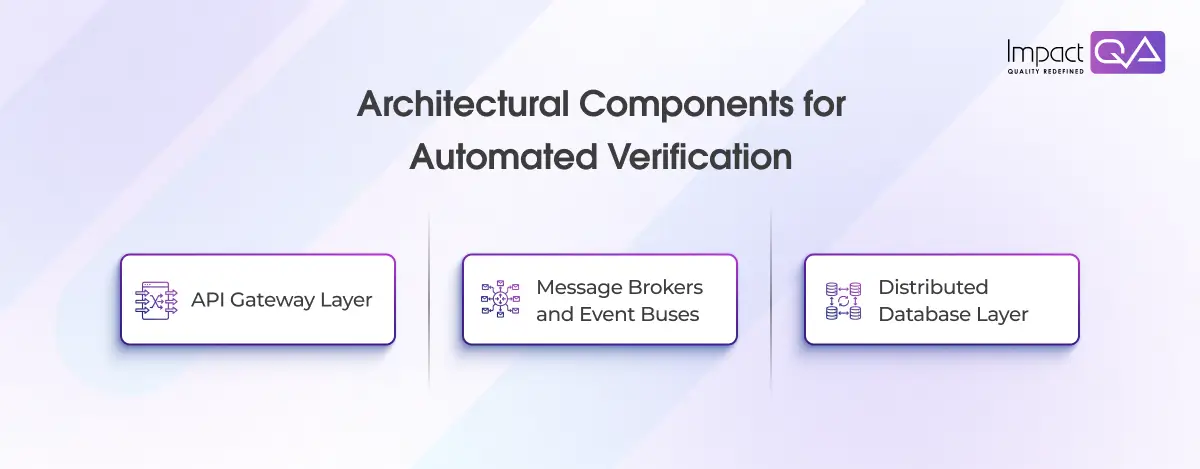
- API Gateway Layer: This entry point handles rate limits, user entry checks, and request routing, requiring rigorous load testing services to ensure it can manage high concurrent user loads without slowing down.
- Message Brokers and Event Buses: Asynchronous communication channels relying on tools like Kafka or RabbitMQ must be evaluated for message ingestion rates, queuing delays, and consumer process backlogs during simulated traffic spikes.
- Distributed Database Layer: Split and copied datastores must undergo strict validation to measure query execution times, data sync lags, and database connection exhaustion under heavy, uncached read and write stress.
Architectural Challenges in Distributed Systems Performance Testing
Evaluating the capacity limits and execution speeds of microservices introduces distinct difficulties that are not found in single-tier architectures, where transactions remain confined within a single shared runtime process. In a decentralized topology, a single user request often triggers a complex cascade of synchronous HTTP calls and asynchronous message transformations across multiple autonomous services, making it exceptionally difficult to isolate latency inflation.
Architectural Attribute |
Monolithic System Testing |
Distributed & Microservices Testing |
| Latency Identification | Simple to isolate as transactions occur within a single shared memory space or runtime process. | Complex due to network transit hops, serialized payloads, and multiple service boundaries. |
| Data Management | Centralized database structure allows easy teardown and standard state restoration scripts. | Distributed datastores require coordinated state injection across distinct physical nodes. |
| Environment Stability | Fixed infrastructure makes configuration management straightforward and easily reproducible. | Dynamic service discoveries and auto-scaling components introduce volatile testing variables. |
Managing state synchronization and dynamic data dependencies across containerized nodes represents a significant operational hurdle for QA engineers. If test data is reused across automated routines, database caching can skew the response metrics, creating an inaccurate representation of the system under true stress conditions. This scenario requires a top-tier performance testing company to design advanced data generation utilities that supply fresh, unique parameter sets for every automated cycle, preventing data collision and ensuring that resource utilization metrics accurately reflect production-level usage profiles.
Another major obstacle stems from the sheer variety of deployment endpoints, especially when applications must cater to diverse consumer interfaces. Mobile channels require deep expertise from specialized mobile performance testing services to simulate varying cellular network conditions, packet drops, and device-level resource constraints that directly impact user-facing API response times. Without incorporating these distinct network profiles into your automated suites, backend load simulations remain incomplete, failing to capture how real-world edge devices affect upstream microservice resource queues and message brokers.
Automation Strategies for Microservices
Overcoming these distributed barriers requires a shift away from late-stage manual execution toward automated, shift-left testing methodologies that inject stress validation directly into the early stages of the development cycle. Implementing robust load testing services early allows software teams to execute specialized component-level load scripts against isolated services before exposing them to downstream dependencies.
Isolate Through Component Mocking: Utilize high-performance service virtualization tools to mock slow asynchronous downstream message brokers and third-party APIs, ensuring that your automated performance scripts isolate the explicit processing capacity of the specific microservice under evaluation.
Implement Contract-Driven Testing: Validate that automated load scripts strictly adhere to API schemas and protocol definitions, which prevents false performance metrics caused by unhandled structural serialization errors at the API gateway layer during heavy load cycles.
Incorporate Realistic Edge Simulation: Integrate specific network throttling profiles directly into the automated execution framework to ensure that mobile performance testing services capture realistic packet delivery delays and signal variability typical of real-world end-user behaviors.
An effective modern strategy relies on specialized scalability testing services that gradually increase virtual user volumes to identify infrastructure limits. This approach helps uncover database connection issues, memory leaks, and gaps in auto-scaling configurations. By combining these methods with advanced application performance testing services, engineering teams can evaluate system behavior under heavy workloads and gain visibility into performance across interconnected microservices.
To maintain long-term reliability, these efforts should be supported by professional performance engineering solutions that establish clear performance benchmarks. Partnering with a trusted performance testing company like ImpactQA to build automated test suites helps identify performance regressions early within delivery pipelines. Ultimately, embedding these continuous practices transforms performance evaluation from a post-release activity into a proactive development process, helping systems remain stable during unexpected traffic spikes.
ImpactQA delivers performance testing services that improve stability, scalability, and release readiness.
Conclusion
Validating modern microservices and complex distributed architectures requires a fundamental transition away from traditional, reactive siloed verification strategies. Adopting automated, continuous verification frameworks allows engineering organizations to isolate hidden performance bottlenecks, prevent thread pool exhaustion, and keep distributed API networks performant under heavy transaction volumes. Integrating continuous performance verification within delivery pipelines helps software teams establish clear architectural baselines to ensure that software updates do not degrade overall system throughput or compromise cloud infrastructure stability.
At ImpactQA, we deliver comprehensive enterprise performance testing through advanced methodologies tailored specifically for complex cloud-native architectures. Our technical experts build sophisticated automation suites that natively integrate with your pipelines, offering unmatched mobile performance testing services, robust load testing services, and complete validation of your back-end APIs. We utilize top-tier performance testing tools to transform your testing operations, helping your business deploy resilient, highly scalable microservices with greater operational reliability.
From problem to payoff: download the full breakdown.
Share this post


Related Posts
Our Case Studies