Quick Summary:
This technical guide explores the implementation of a modern shift-right testing approach in engineering pipelines. By breaking down architectural requirements and comparing production methodologies, this blog provides actionable strategies to balance pre-release validation with real-world application monitoring. Additionally, investigating shift-right testing with AI offers the precise insights needed to ensure resilient software deployment.
Table of Contents:
- Introduction
- Deconstructing the Paradigms: Shift-Left vs Shift-Right Testing
- Operational Challenges in Modern Production Environments
- Strategic Implementation of a Shift-Right Testing Approach
- Conclusion
- Technical FAQ
Modern software delivery pipelines require continuous resilience that extends well past the traditional deployment boundary. Distributed cloud architectures introduce production variables that remain impossible to replicate fully inside isolated staging environments. Engineering organizations must look beyond pre-release validation architectures to maintain system availability and ensure software quality under dynamic real-world workloads.
Adopting a comprehensive shift-right testing approach provides mechanisms to isolate, monitor, and resolve runtime anomalies directly inside live infrastructure. This framework treats production environments as extended verification spaces, converting real-user interactions into actionable telemetry data. Organizations can systematically mitigate deployment risks and achieve sustainable continuous delivery by executing targeted validation policies during live operations.
ImpactQA applies intelligent shift-right validation mechanisms to reduce application downtime and accelerate enterprise releases.
Deconstructing the Paradigms: Shift-Left vs Shift-Right Testing
Software quality management relies on balanced methodologies across the continuous engineering lifecycle. Historically, teams moved validation activities early into development to intercept bugs before code reached main branches. Comparing shift-left vs shift-right testing reveals that while the former controls structural defects early, the latter establishes system durability under authentic operational stress. Staging environments lack data variance, unpredictable user patterns, and third-party API latency present in actual systems.
The technical distinction lies in how environments are controlled and analyzed. Pre-release methodologies utilize deterministic datasets where inputs are controlled, limiting discovery to anticipated failure modes. Conversely, a modern shift-right testing approach accepts the non-deterministic nature of active traffic, monitoring systemic behavior across live microservices. Integrating both frameworks allows development teams to secure structural integrity while simultaneously validating production elasticity and user-experience consistency.
Parameters for Comparison
Parameter |
Shift-Left Testing Methodology |
Shift-Right Testing Methodology |
| Primary Operational Goal | Intercept structural bugs and code defects during initial development | Ensure runtime elasticity, system availability, and user resilience |
| Environment Control | Completely deterministic, isolated, and simulated environments | Non-deterministic, active production with real traffic conditions |
| Data Inputs Utilized | Synthetically generated datasets with predefined assertions | Authentic user behavior streams and real-time telemetry pipelines |
| Common Techniques | Unit assertions, static analysis, component mock integration | Canary routing, synthetic traffic injections, chaos engineering |
Execution strategies differ across these two paradigms due to infrastructure access and tooling. Early-stage verification integrates directly with integrated development environments and continuous integration pipelines. Right-side testing requires native integrations with application performance monitoring platforms, traffic routing controllers, and real-time logging systems. These tools allow engineers to evaluate resource consumption and transactional latency under live conditions, ensuring comprehensive visibility during heavy production utilization.
Operational Challenges in Modern Production Environments
Deploying validation mechanisms directly into active production environments poses distinct structural risks that require careful planning. The most pressing challenge involves managing the blast radius of live exercises to prevent synthetic testing from degrading actual user experiences. Poorly isolated test scripts can accidentally corrupt live databases, trigger false alerts, or consume shared infrastructure capacity. Engineers must build distinct data segregation layers, using metadata tags to separate synthetic records from real transactional accounts.
Maintaining data security and regulatory compliance creates additional complexity when executing verification policies on live application clusters. Production pipelines contain sensitive personally identifiable information that must be protected against unauthorized modification or exposure. Automated validation systems must operate with restricted permissions, ensuring test actions do not inadvertently access restricted client records. Additionally, infrastructure teams must distinguish test traffic from malicious cyber-attacks to avoid triggering security blocks.
Incorporating modern shift-right testing with AI helps solve complex data bottlenecks by introducing automated log parsing and intelligent anomaly detection algorithms. Machine learning algorithms analyze telemetry data streams in real time, filtering out background noise to isolate true system regressions. This automated data analysis prevents alert fatigue and gives site reliability engineering teams the precise insights needed to resolve production issues quickly.
Strategic Implementation of a Shift-Right Testing Approach
Successfully adopting a shift-right testing architecture requires structural adaptations across deployment mechanisms, infrastructure monitoring, and release management policies. Organizations must first establish a progressive delivery pipeline that supports advanced traffic routing techniques like canary deployments and blue-green clustering. These deployment models allow teams to expose new code versions to a tiny fraction of live user traffic before initiating full-scale updates.
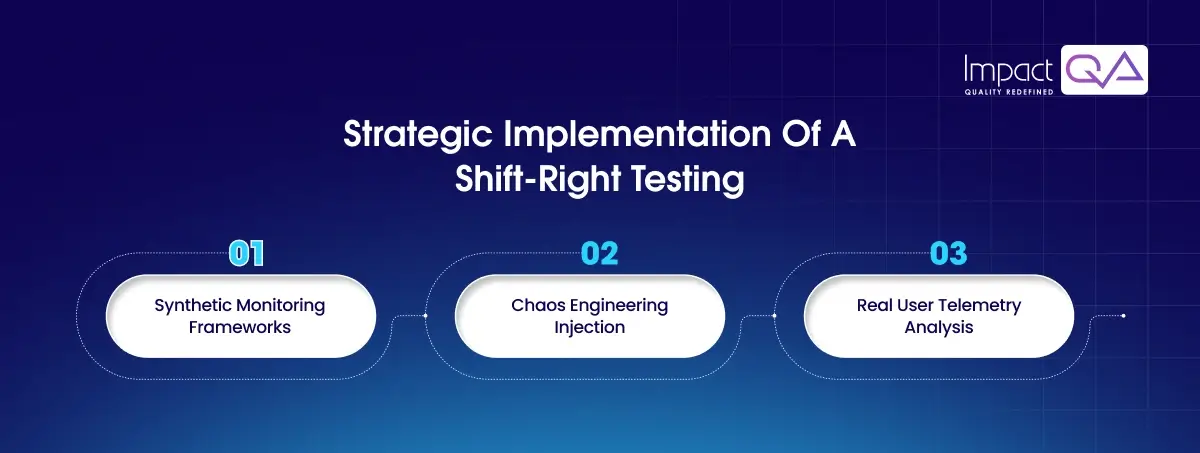
Synthetic Monitoring Frameworks: Automated scripts simulate typical user journey like authentication and checkout, at regular intervals across geographical zones. This continuous synthetic monitoring flags performance degradation and critical API failures before actual users notice or report them.
Chaos Engineering Injection: Intentionally introducing controlled failures, such as server shutdowns or network latency, validating system redundancy, and automated self-healing mechanisms. This proactive approach uncovers hidden configuration issues to ensure microservices degrade gracefully during real-world hardware failures.
Real User Telemetry Analysis: Tracking client-side performance data directly from real browsers and mobile apps exposes regional CDN bottlenecks, network latency variances, and device-specific rendering flaws that synthetic tests often miss. Analyzing this real-world performance data ensures engineering teams can perform highly targeted optimization.
Utilizing shift-right testing with AI allows organizations to automate complex analytical tasks, such as tracking down the root causes of microservice failures or predicting capacity bottlenecks. Intelligent testing agents can run synthetic tests dynamically based on real-time traffic spikes, checking vulnerable application areas when the system is under heavy load. This self-managing verification loop shortens the time required to detect live issues, helping software teams protect application stability.
ImpactQA delivers deep expertise across shift-left vs shift-right testing frameworks to safeguard your live environments.
Conclusion
Embracing modern production validation methodologies marks a significant shift toward autonomous, self-healing software ecosystems. As we look toward future-ready systems, moving past traditional gates allows our engineering teams to transform live environments into rich pipelines of continuous telemetry. This proactive integration minimizes runtime system issues, shortens recovery times, and ensures enterprise systems dynamically scale ahead of unexpected demand spikes.
Achieving this layer of operational resilience demands specialized engineering expertise and modern quality assurance infrastructure. At ImpactQA, we provide comprehensive software validation services, helping organizations smoothly adopt advanced post-deployment strategies across complex cloud environments. Partnering with us gives your business the technical depth required to build resilient testing pipelines and secure long-term software quality.
Share this post


Related Posts
Our Case Studies