Adopting Shift-Left Testing Strategies to Enhance Code Quality in EdTech SaaS Development

Quick Summary:
As the EdTech SaaS landscape rapidly advances, the need for secure, scalable, and high-quality solutions is paramount. Yet, quick development cycles often overlook crucial defects and security concerns. Shift-left testing offers a solution by incorporating testing early in the software development lifecycle (SDLC), enabling early bug detection, cost savings, and faster time-to-market. This blog delves into how EdTech SaaS companies can harness Shift-left testing to improve code quality, enhance security, and deliver smooth digital learning experiences.
Table of Contents
- Understanding Shift-Left Testing
- Why Shift-Left Testing is Crucial for EdTech SaaS Companies
- How to Implement Shift-Left Testing in EdTech SaaS Development
- Overcoming Challenges in Shift-Left Testing for EdTech SaaS Companies
- Conclusion
EdTech SaaS companies are racing to meet the growing demand for digital learning solutions, requiring fast, agile development and seamless deployments. However, balancing speed with code quality and security in this high-pressure landscape is no easy feat.
This is where shift-left testing comes into play. By moving testing earlier in the software development lifecycle (SDLC), shift-left testing helps EdTech SaaS companies detect defects early, enhance security, and improve overall product reliability.
In this blog, we will explore how adopting shift-left testing strategies can optimize code quality for EdTech SaaS development and drive superior user experiences.
Let ImpactQA help you test early and efficiently!
Understanding Shift-Left Testing
Shift-left testing is a proactive approach that integrates testing activities from the beginning of the development process rather than at the end. Traditional software testing often takes place late in the SDLC, leading to delayed defect detection, increased debugging costs, and compromised product quality.
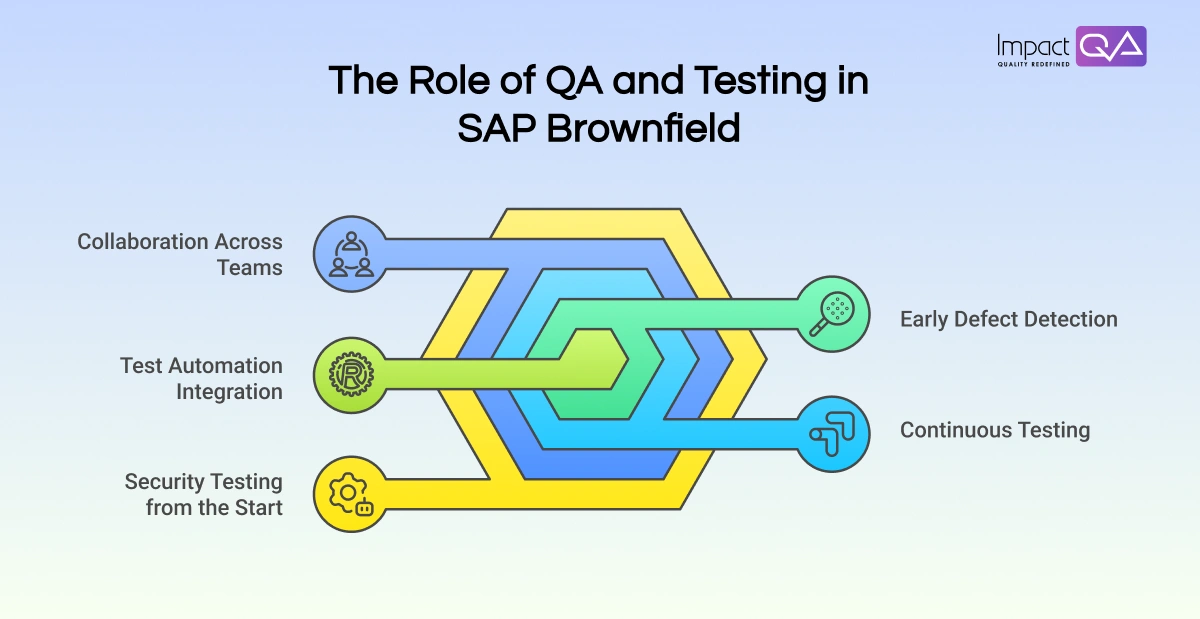
Key Principles of Shift-Left Testing

1. Early Defect Detection
Identifying bugs early in the software development lifecycle (SDLC) significantly reduces the time, effort, and cost associated with fixing them. Addressing defects at the initial stages prevents potential system failures, enhances software reliability, and ensures a smoother development process.
2. Continuous Testing
Automated tests are executed at every stage of the SDLC, ensuring that new code changes do not introduce defects. This ongoing validation process helps maintain software quality, accelerates feedback loops, and allows teams to detect and resolve issues in real-time.
3. Collaboration Across Teams
Effective communication and coordination among developers, testers, and business analysts from the initial planning phase enhance the overall software quality. This cross-functional collaboration ensures that testing is aligned with business goals, user expectations, and development objectives.
4. Test Automation Integration
Automated test scripts are seamlessly integrated into the development pipeline, validating software functionality as soon as new code is added. This approach reduces manual effort, speeds up testing cycles, and provides rapid feedback to developers, enabling quick issue resolution.
5. Security Testing from the Start
Security vulnerabilities are proactively identified and mitigated from the early stages of development rather than being addressed as an afterthought. By embedding security testing into the SDLC, organizations can strengthen application security, minimize risks, and ensure compliance with industry standards.
Why Shift-Left Testing is Crucial for EdTech SaaS Companies
1. Ensuring High-Quality Learning Experiences
EdTech SaaS platforms cater to students, educators, and institutions, where seamless functionality is essential. A bug-ridden application can disrupt learning experiences and erode user trust. Shift-left testing ensures early defect detection, reducing downtime and ensuring a frictionless user experience.
2. Reducing Costs Associated with Late-Stage Bug Fixing
Defects detected during the later stages of software development are expensive to resolve. The earlier a defect is found, the lower the cost of fixing it. Shift-Left Testing prevents last-minute patches and rewrites, helping EdTech SaaS companies cut costs and improve ROI.
3. Accelerating Time-to-Market
With intense competition in the EdTech industry, speed is crucial. Implementing Shift-Left Testing allows faster releases without compromising quality, ensuring that new features and updates reach users promptly.
4. Strengthening Security and Compliance
Since EdTech SaaS solutions handle sensitive user data, security testing should be a priority from the beginning. Shift-left testing helps in identifying security loopholes early, making compliance with data protection regulations easier.
How to Implement Shift-Left Testing in EdTech SaaS Development

1. Integrate Testing into the Development Pipeline
Continuous integration and continuous deployment (CI/CD) pipelines should include automated tests at every stage. This ensures that each code commit is validated, minimizing the risk of introducing defects into production.
Implementation Tips:
1. Incorporate a Variety of Tests
A robust CI/CD pipeline should include multiple layers of testing to ensure all aspects of the application are covered:
- Unit Tests: Validate individual components or functions.
- Integration Tests: Check how different modules interact with each other.
- Regression Tests: Ensure that new changes do not disrupt existing functionalities.
- API Tests: Validate the functionality and performance of APIs, crucial for EdTech platforms integrating with LMS, payment gateways, and third-party tools.
- End-to-End (E2E) Testing: Simulate real-world user interactions to ensure the overall application works as expected.
2. Automate Performance Testing
- Implement tools like JMeter, or LoadRunner to assess how the application performs under varying user loads.
- Ensure that response times, server loads, and database performance are monitored throughout the pipeline.
- Identify potential bottlenecks before deployment to avoid slow performance during peak usage.
2. Encourage a Test-Driven Development (TDD) Approach
Test-Driven Development (TDD) follows a “test-first” approach, where developers create automated tests before writing the functional code. This approach follows a cycle of writing tests, implementing code, and refining it until the tests pass. By prioritizing testing from the beginning, TDD ensures that software is built with quality, functionality, and maintainability in mind.
Benefits of TDD:
1. Reduces Defect Density
- Since tests are written before coding begins, defects are detected at the earliest stage of development.
- Fixing errors early is less expensive and time-consuming than resolving them later in the SDLC.
- With automated tests running continuously, regression issues are identified quickly.
2. Encourages Clean and Modular Code
- TDD promotes small, testable, and independent components, leading to a modular codebase.
- Developers focus on writing only the necessary code to meet functional requirements.
- Code that follows TDD is often more readable, structured, and easier to debug.
3. Improves Code Maintainability
- Because tests serve as executable documentation, developers can easily understand and modify the codebase without breaking functionality.
- Refactoring becomes safe and efficient, allowing teams to enhance features without fear of introducing bugs.
- New developers onboarding a project can rely on existing tests to understand expected behavior.
3. Emphasize API and UI Testing Early
Many EdTech SaaS platforms rely on APIs to integrate with external learning management systems (LMS), payment gateways, and third-party tools. API testing should be conducted early to prevent integration issues.
Best Practices for Effective API and UI Testing:
- Validate Cross-Browser and Cross-Device Compatibility: Ensure the EdTech platform functions seamlessly across different browsers.
- Simulate Real-World Scenarios: Test API endpoints under various load conditions and simulate user interactions on the UI to detect performance and usability issues.
- Check Data Accuracy and Error Handling: Validate that API responses return correct data formats and meaningful error messages for failed requests.
- Ensure Security and Compliance: Conduct penetration testing for APIs and validate WCAG accessibility standards for UI to ensure compliance with GDPR, FERPA, and data protection regulations.
- Integrate Testing into CI/CD Pipelines: Implement automated API and UI testing within continuous integration and continuous deployment (CI/CD) workflows to catch defects early.
- Monitor Performance and Scalability: Conduct load testing for APIs using and tracking UI performance to ensure responsiveness under high traffic.
- Conduct Responsive UI Testing: Verify that the UI adapts well to various screen sizes and resolutions, ensuring an optimal experience for all users.
4. Foster Collaboration Between Developers and Testers
Shift-Left Testing thrives in a collaborative environment. QA teams should work closely with developers from the initial stages of development to align on test strategies.
Best Practices:
- Conduct daily stand-ups with developers and testers.
- Use tools like JIRA or Trello to track testing tasks.
- Adopt behavior-driven development (BDD) using frameworks like Cucumber.
5. Implement Performance Testing from the Start
With thousands of students and educators accessing EdTech SaaS solutions simultaneously, performance bottlenecks can arise. Running early performance tests prevents scalability issues and ensures a smooth user experience.
6. Prioritize Security Testing in Early Stages
Given the rise in cyber threats targeting educational platforms, security testing should not be left for the last phase. Conduct early penetration testing, vulnerability assessments, and code security analysis to prevent data breaches.
Overcoming Challenges in Shift-Left Testing for EdTech SaaS Companies
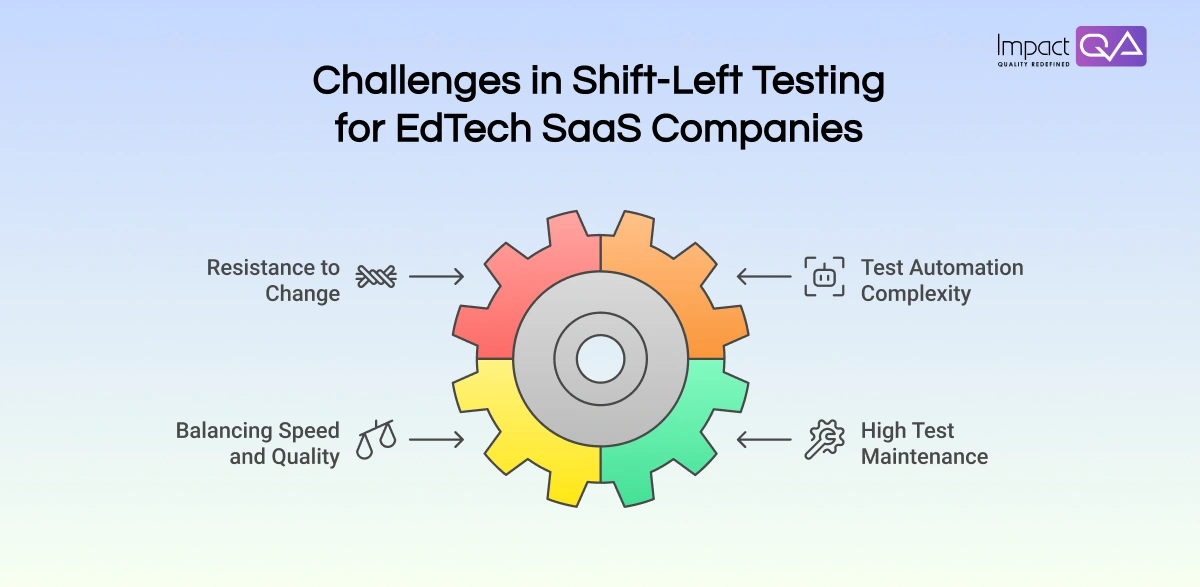
Implementing shift-left testing in EdTech SaaS development comes with its share of challenges. From cultural resistance to technical complexities, companies must proactively address these hurdles to fully leverage the benefits of early testing. Here are some major challenges along with strategies to address them.
1. Resistance to Change
Many teams are accustomed to traditional end-of-cycle testing and may be hesitant to adopt shift-left testing practices. The transition requires a shift in mindset, which can be met with skepticism.
Solution:
- Conduct training sessions and workshops to educate teams about the advantages of early defect detection and cost savings.
- Showcase successful case studies from similar organizations that have adopted shift-left testing.
- Encourage collaboration between developers and testers from the early stages of the software development lifecycle (SDLC) to create a culture of shared responsibility for quality.
2. Test Automation Complexity
Automating tests from the start can be challenging, especially for teams with limited expertise in automation frameworks. Writing and maintaining test scripts requires both technical knowledge and strategic planning.
Solution:
- Start with small automation projects, such as automating unit tests, and gradually scale up to integration and regression tests.
- Use AI-powered testing tools which reduce script maintenance by adapting to changes in UI and API structures.
- Leverage low-code or no-code automation frameworks to enable testers and business analysts to contribute to the automation effort.
3. Balancing Speed and Quality
With agile development cycles and frequent releases, teams often prioritize speed over comprehensive testing, leading to overlooked defects. This can compromise user experience, security, and performance.
Solution:
- Implement CI/CD pipelines to integrate automated testing at every stage of development, ensuring that new code is validated before deployment.
- Use test-driven development (TDD) and behavior-driven development (BDD) methodologies to enforce quality-first coding practices.
- Establish real-time monitoring and alerting systems to catch post-deployment issues early and continuously improve software reliability.
4. Managing High Test Maintenance
Frequent code updates, UI modifications, and API changes can lead to high maintenance costs for test scripts, making it difficult to keep up with evolving requirements.
Solution:
- Utilize self-healing test automation frameworks which use AI to adapt to minor UI and API changes without manual intervention.
- Implement modular test case design, where test scripts are broken down into reusable components to minimize maintenance efforts.
- Adopt version control and test case management tools to organize test cases efficiently and track changes over time.
By proactively addressing these challenges, EdTech SaaS companies can successfully implement shift-left testing, ensuring higher code quality, improved security, and faster time-to-market while maintaining scalability and reliability in their applications.
Catch them early with ImpactQA’s expertise!
Conclusion
For EdTech SaaS companies, ensuring high code quality, security, and scalability is essential to delivering seamless digital learning experiences. However, rapid development cycles often introduce defects that can impact performance and user trust. By adopting shift-left testing strategies, organizations can proactively detect and resolve issues early in the SDLC—reducing costs, improving security, and accelerating time-to-market.
Implementing test automation, TDD, security testing, and cross-team collaboration ensures that quality is embedded from the start of development rather than treated as an afterthought. This proactive approach not only enhances software reliability but also drives innovation in the ever-evolving EdTech industry.
As the demand for high-performing SaaS solutions grows, investing in shift-left testing will be a game-changer for EdTech companies aiming to provide scalable, secure, and impactful learning platforms. ImpactQA, a leading software testing and quality assurance company, helps EdTech SaaS firms implement comprehensive shift-left testing strategies, ensuring seamless digital experiences for learners and educators worldwide.
Share this post


Related Posts
Our Case Studies