Quick Summary:
Artificial intelligence transforms modern quality engineering by shifting workflows from reactive execution to predictive insights and intelligent automation. This comprehensive analysis evaluates operational shifts, key deployment strategies, core institutional benefits, and mitigation frameworks for structural challenges. Discover how advanced testing providers utilize machine learning and generative tools to optimize release speed, accuracy, and infrastructure resource allocation across complex software platforms.
Table of Contents:
- Introduction
- The Evolution from Predictive Insights to Intelligent Automation
- Strategic Implementation Challenges in Quality Engineering
- Technical Mitigation Frameworks for Smooth Adoption
- Operational Benefits of Intelligent Automation
- Best Practices for Continuous Quality Engineering
- Final Thought
The software engineering sector is experiencing a massive change in how teams check code. For years, engineers had to follow a slow and frustrating routine where they manually wrote long, rigid validation scripts, only to watch them break the moment a designer changed a single button or color on a website dashboard. Relying on these old-fashioned practices delays software launches and costs companies a lot of unnecessary time and money. To fix this common bottleneck, progressive engineering teams are partnering with an advanced AI testing service to make their QA operations smarter, highly adaptable, and much faster.
The push to upgrade these old testing methods is backed by clear market trends. Recent research from Gartner shows that 40% of enterprise applications will use autonomous AI agents to handle tasks by the end of 2026, a huge jump from under 5% in 2025. This rapid shift means application features are evolving too fast for human testers to review by hand. To keep up with modern user demands, companies must stop relying on manual script writing and move toward intelligent automation ecosystems that can analyze data patterns and fix errors instantly.
ImpactQA applies intelligent predictive automated testing to reduce risk and accelerate releases.
The Evolution from Predictive Insights to Intelligent Automation
Predictive quality engineering relies heavily on historical data aggregation to forecast software stability trends. By analyzing a broad array of development telemetry, machine learning models pinpoint high-risk application components to execute regression suites exclusively on vulnerable modules. This targeted validation drastically reduces execution times, lowers cloud infrastructure costs, and enables rapid feedback loops for agile sprint teams.
As these predictive engines mature, they link directly with smart automation tools to manage the entire testing lifecycle. Generative tools read plain-English business requirements to instantly build test cases, scripts, and mock data. This fast setup ensures new features are checked immediately, removing paperwork delays. When dealing with tricky user journeys, companies often work with an experienced AI testing services provider to run advanced AI agents that act like real users and find hidden bugs that old scripts miss. These smart agents adjust their actions based on live app responses to ensure total coverage.
Modern quality standards need strong checking layers to keep application features working perfectly. Engineering teams rely on functional testing in software testing to ensure that individual business requirements operate exactly as specified. When teams ask what functional testing in software is, they define it as a systematic verification process that validates inputs against expected outputs, disregarding internal code structures. To scale this process efficiently, modern teams implement automated functional testing software that integrates machine learning algorithms to identify broken paths and fix them without human developer intervention. This deep check keeps login paths and payment systems working smoothly during quick software updates.
Going a step further, the latest testing tools adapt to changes on the fly rather than following static rules. Smart scripts watch data move across complex networks to catch errors without human help. This tech upgrade keeps enterprise systems fast and reliable even when user traffic spikes. By checking both backend data and frontend screens at the same time, these advanced systems guarantee your entire software setup stays perfectly aligned.
Strategic Implementation Challenges in Quality Engineering
Adopting intelligent quality frameworks requires teams to overcome complex data systems and cultural bottlenecks. If left unchecked, these hurdles can disrupt development timelines and stall software releases.
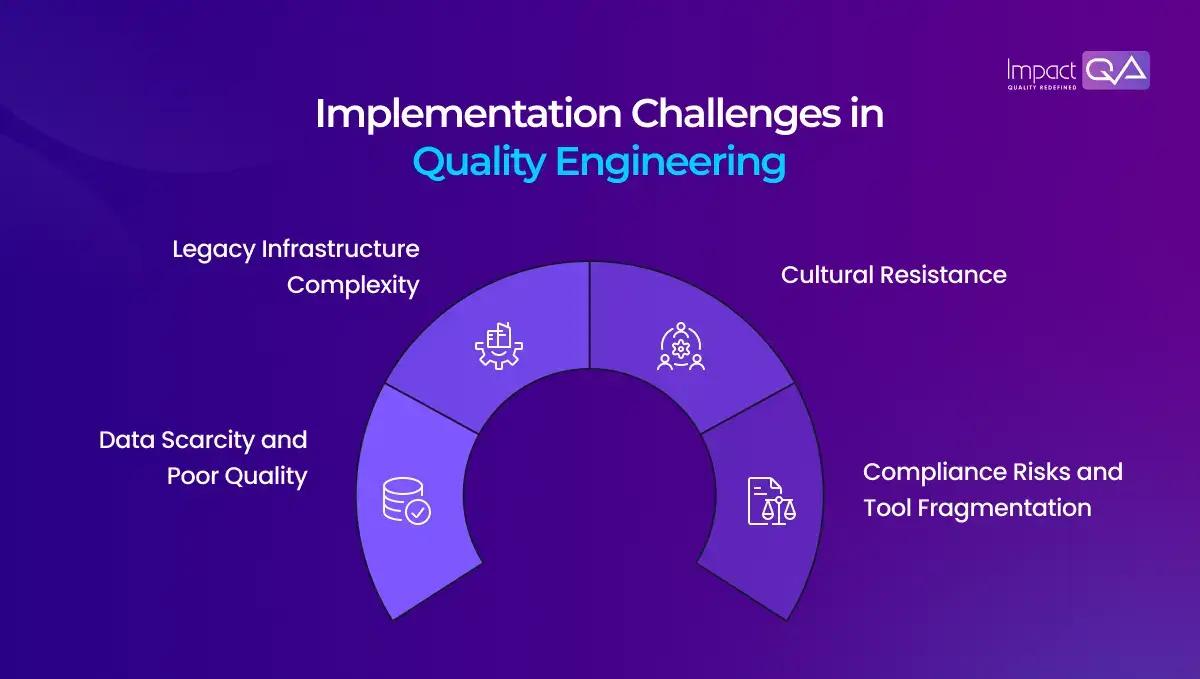
Data Scarcity and Poor Quality: Machine learning engines need huge amounts of clean logs and bug reports to predict errors accurately. Using bad or incomplete data causes high false-positive rates that confuse engineers and damage team trust.
Legacy Infrastructure Complexity: Older deployment setups lack the flexible connections needed to process live AI predictions. This forces teams to build complex, expensive custom code bridges to link new tools with old systems.
Cultural Resistance: Human testing teams often worry that automated generation tools will replace their jobs entirely. This fear creates friction and slows down the adoption of new technology across the department.
Compliance Risks and Tool Fragmentation: Generative models often need to look at real user data shapes to build realistic test scenarios, creating major regulatory and privacy risks. Furthermore, running mismatched tools across different cloud environments creates isolated info silos.
Technical Mitigation Frameworks for Smooth Adoption
To solve these deployment issues, companies must establish clear cleanup paths, secure data rules, and gradual integration plans to ensure advanced automation runs reliably.
Data Cleaning and Hygiene: Testing departments must rigorously clean and label their historical logs. This training ensures smart scripts can clearly tell the difference between a real bug and an intentional design update.
Gradual Integration Roadmaps: Savvy enterprises look for the best AI testing services to design step-by-step transition plans. These roadmaps retrain engineering teams to act as supervisors of smart scripts rather than manual script authors.
Synthetic Data Generation: Engineering leaders deploy synthetic data tools that mimic real production traffic distributions. This creates precise data structures for thorough verification without exposing private customer IDs or risking compliance.
Standardized Communication Protocols: Standardizing tools across multi-cloud environments allows different testing nodes to share error telemetry data smoothly. This interconnected approach stops data siloing and automatically pushes improvements across all active product pipelines.
Operational Benefits of Intelligent Automation
Moving to smart testing systems delivers massive improvements across engineering teams. By shifting routine checks to self-healing tools, enterprises keep their software stable and highly cost-effective.
Early Flaw Isolation: Automated tools watch software environments around the clock to catch performance lags and safety flaws during early coding stages. This fast monitoring lets developers fix errors while the logic is fresh in their minds, keeping major bugs out of live production.
Fewer Production Defects: Catching errors early means fewer critical bugs escape into live systems, protecting corporate brand reputation and user satisfaction. Eliminating unexpected emergency hotfixes stabilizes team planning and allows product roadmaps to advance predictably.
Massive Resource Savings: Shifting routine verification efforts to autonomous tools saves huge amounts of engineering hours. These saved resources are redirected toward exploratory validation and complex system architecture design, maximizing human talent.
Stakeholder Transparency: Automated real-time dashboards translate complex test results into clear, actionable intelligence. This removes communication gaps between tech teams and non-technical managers, making strategic product launch decisions completely objective.
Best Practices for Continuous Quality Engineering
To maximize your operational returns, organizations must follow clear implementation guidelines. Partnering with external experts and keeping systems updated ensures your automation stays accurate over time.
Modular Framework Architecture: Tech leaders need to build separate layers for data creation, testing logic, and reporting to support functional testing in software engineering. Keeping these elements independent makes the entire testing network easier to update and maintain.
Smart Algorithm Selection: Working with a top AI testing services provider ensures teams select the exact machine learning algorithms needed for their specific tasks. This careful matching prevents companies from over-engineering their systems.
Regular Model Retraining: Teams must schedule regular updates for their machine learning engines to counter algorithmic drifts. Continuous oversight guarantees that automated suites do not generate outdated insights as the core application grows and changes.
Lowering Costs with External Expertise: Utilizing an external AI testing service gives companies immediate access to cutting-edge tools. This lowers upfront software capital investments and accelerates the overall return on quality modernization initiatives.
ImpactQA deploys advanced machine learning testing models to secure production quality.
Final Thought
The migration toward intelligent quality engineering represents an unavoidable technological evolution for companies aiming to remain viable. Replacing rigid, manual scripting paradigms with adaptive, predictive automation allows engineering teams to deploy flawless code at extreme speeds. As natural language generation and self-healing execution mechanisms grow more mature, the distinction between development and validation fades. Enterprises that embed these autonomous validation workflows into their core delivery models achieve sustainable competitive operational advantages.
Organizations looking to lead this digital transformation can leverage the advanced capabilities of ImpactQA. As an elite provider of the best AI testing services, ImpactQA delivers tailored solutions that optimize release pipelines through smart validation workflows. Our comprehensive suite of services incorporates predictive analytics and automated script maintenance to eliminate delivery bottlenecks. Explore how our specialized team modernizes corporate release frameworks by reviewing our dedicated AI-led Quality Engineering offerings to secure your software delivery quality.
Share this post


Related Posts
Our Case Studies